If you want to know the weather tomorrow, meteorologists can tell you. If you’d like to know what it’ll be like in 50 years, climatologists can tell you that reasonably accurately, too. But if you want to know the weather six months from now?
That’s a far trickier matter. Between the reliability of short-term and long-term cycles falls a shadow: indeterminacies bigger than the path of a single storm or pressure system, seasonal variations that average out over years but don’t individually hew to the curve.
This is where Judah Cohen, a consultant at Atmospheric and Environmental Research, a weather-risk-management company, makes his living. He’s part of a small, mysterious tribe of seasonal forecasters, men and women whose climate models are crystal balls into the next season.
It’s not an easy job. A meteorologist knows in a day or two how his predictions turned out. If he’s wrong, there’s always tomorrow. For a seasonal forecaster, everything is prolonged. The wait stretches for weeks or months. If some forecasters take a Zen approach, not getting caught up in a cold snap or heat wave, Cohen isn’t one of them.
After all, clients—utility companies trying to anticipate customer demands, insurance companies number-crunching expected payouts, financiers wagering on energy-market trends—pay a lot of money for seasonal forecasts. (See the related Nautilus stories “Taming the Unfriendly Skies,” about airlines’ effort to predict near-term weather; and “How to Insure Against a Rainy Day,” about the financial market for weather derivatives.) There’s a lot riding on them, and that weight hangs over Cohen, swaying a bit with each morning’s weather report. “I don’t think I necessarily handle stress particularly well. I don’t think I have ice water in my veins,” he says. “From November through January, I rarely get a good night’s sleep.”
Last winter, Cohen went out on the proverbial limb, predicting deep cold and snow across much of the United States. He was just about the only person in the business to say so. On the government side, the National Oceanic and Atmospheric Administration tentatively predicted that it’d be warmer than usual, but hedged that seasonal predictions were only about 25 percent more reliable than a random guess.
“I don’t think I necessarily handle stress particularly well. I don’t think I have ice water in my veins…From November through January, I rarely get a good night’s sleep.”
How could two forecasts be so different? Whereas NOAA’s models emphasized the atmospheric role of El Nino, the unusually warm water conditions that form cyclically off the Pacific coast of South America, Cohen’s models emphasize Arctic snowfall. It’s what he studied as a postdoctoral student at MIT in the early 1990s (“We can’t make seasonal forecasts. Why would you take a job you’re going to be lousy at?” warned his thesis advisor), and has since become cutting-edge climate science.
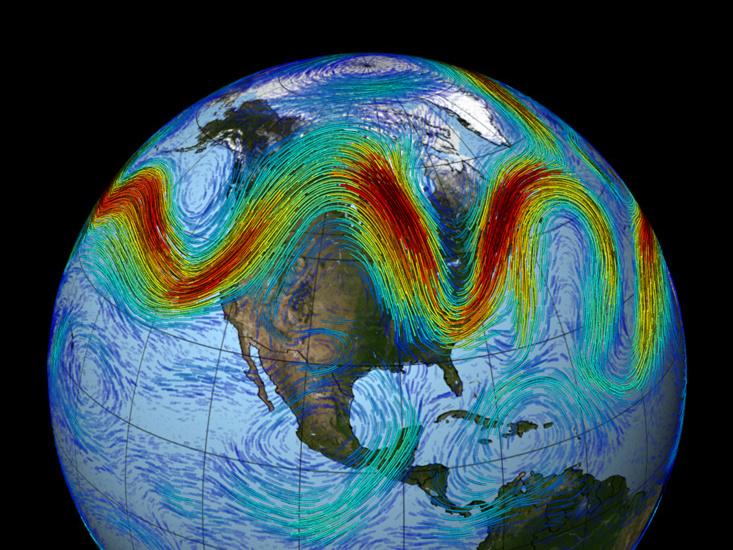
Climatologists had long known that Arctic weather conditions interact with the jet stream, the vast river of air that flows around the Northern Hemisphere, but they couldn’t predict it. There were too many variables, too many data points that needed to be filled in with estimates or assumptions, each mistake multiplied and amplified by climate-model calculations.
What Cohen and a small group of researchers noted was a close correlation between snowfall, specifically snowfall in Siberia in October, and temperate-latitude weather in subsequent months. In the decades since, they’ve sketched out a mechanism: Heavy snows create a vast dome of cold air over Siberia. As the jet stream courses off the Himalayas and hits the dome, its west-to-east course slows and wavers. A north-to-south oscillation is added. Cold air typically trapped over the Arctic drifts south.
Of course, this remains difficult to quantify. The models are still unforgiving of error, and the climate-science community doesn’t yet agree on the predictive validity of these Arctic mechanisms. But they work for Cohen. He was right three winters ago, and the one after that, and then this year’s unusually cold winter.
Predicting it was correspondingly more impressive than predicting an average winter, and all the more so because winter didn’t start off that way. “It started off very warm. Eventually the United States came back in line with the rest of the hemisphere,” says Cohen. “The most difficult thing is not to get emotional, to not panic.”
Summer is somewhat easier to anticipate. Arctic air patterns don’t matter so much; persistence—if it’s hot now, it’ll probably be hot tomorrow—is more evident. Soil moisture levels, which have a cooling effect, are pronounced and relatively easy to compute. Even so, the season provides little respite for Cohen. “I am not planning some extended beach vacation,” he said when asked about resting on this winter’s laurels. “I will be feeling the heat long before anyone else does.”
Last year, he called a hot summer, but the first few weeks of June were cool. “It was a rough stretch there for a while,” Cohen said, “but as we all know, it was pretty hot in the end.” In case you’re curious, he thinks this summer will be a hot one, too. “It’s going pretty well,” he said. “But it’s still early.”
Brandon Keim (@9brandon) is a freelance journalist specializing in science, environment, and culture. Based in Brooklyn and Bangor, Maine, he often carries sidewalk caterpillars to safety.