When talking about our health, we tend to refer breezily to “the immune system,” as if it were as simple as an electric fence keeping out invaders. And there’s certainly an electric fence component: The innate immune response is an ancient, relatively nonspecific kind of defense that triggers inflammation and the deployment of attack cells when invaders breach your body’s walls. This kind of immunity has deep roots, and for many organisms it is their primary weapon. All plants, for instance, depend on it to clear infections.
But what we are usually thinking about when we talk about human immunity is the adaptive immune system. And that is a devilishly complex chemical soup that blends the depth of J. Edgar Hoover’s files and sensitivity the NSA dreams of having with its various Internet-surveillance techniques. This is a relatively recent creation—less than 500 million years old (around 3 billion years younger than life itself), and confined to vertebrates—and in every one of us it rebuilds itself anew over the course of our lifetimes. And like all surveillance technologies, it hinges on being able to recognize the bad guys and distinguish them from the good guys.
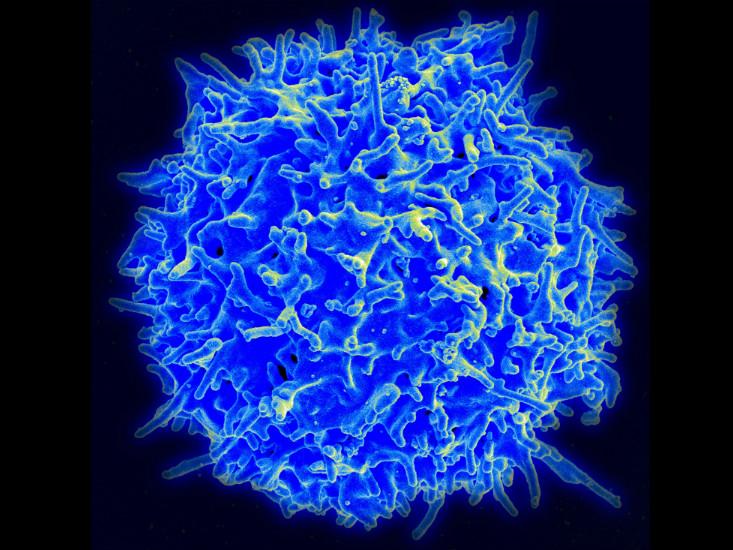
The adaptive immune response begins with a posse of cells, called lymphocytes, whose total mass rivals that of the brain. Think of each of these as a sheriff, capable of calling in the deputies and launching a wider attack if the right proof is presented. Now enters a dendritic cell, which functions like a bounty-hunter—after it confronts, engulfs, and digests a pathogen unwisely entering your body, it wears a trophy of its conquest on its outer membrane and shows that trophy, the antigen, to the lymphocytes. When the lymphocytes see that antigen and register it as one that does not appear naturally in your body, they trigger an immense, multi-layered response involving many types of cells, finely tuned to identify and kill the invader. It’s instant infamy for the pathogen—wanted posters hung up everywhere around your body. When we get a vaccination, we’re manufacturing infamy for that pathogen, introducing its antigen without causing an infection, and telling the adaptive immune system to be on the lookout.
After the pathogen is cleared from the body, many of the immune cells die off. But a few remain, carrying the memory of that invader. Over the course of our lives, we accumulate a long list of detailed dossiers on the microbes we’ve come into contact with. You still carry the details of invaders who haven’t been seen around these parts for decades, bad guys that are remembered thanks to the immune system’s wanted posters.
Veronique Greenwood is a former staff writer at DISCOVER magazine. Her work has appeared in Scientific American, Popular Science, and the sites of Time, The Atlantic, and The New Yorker. Follow her on Twitter here.