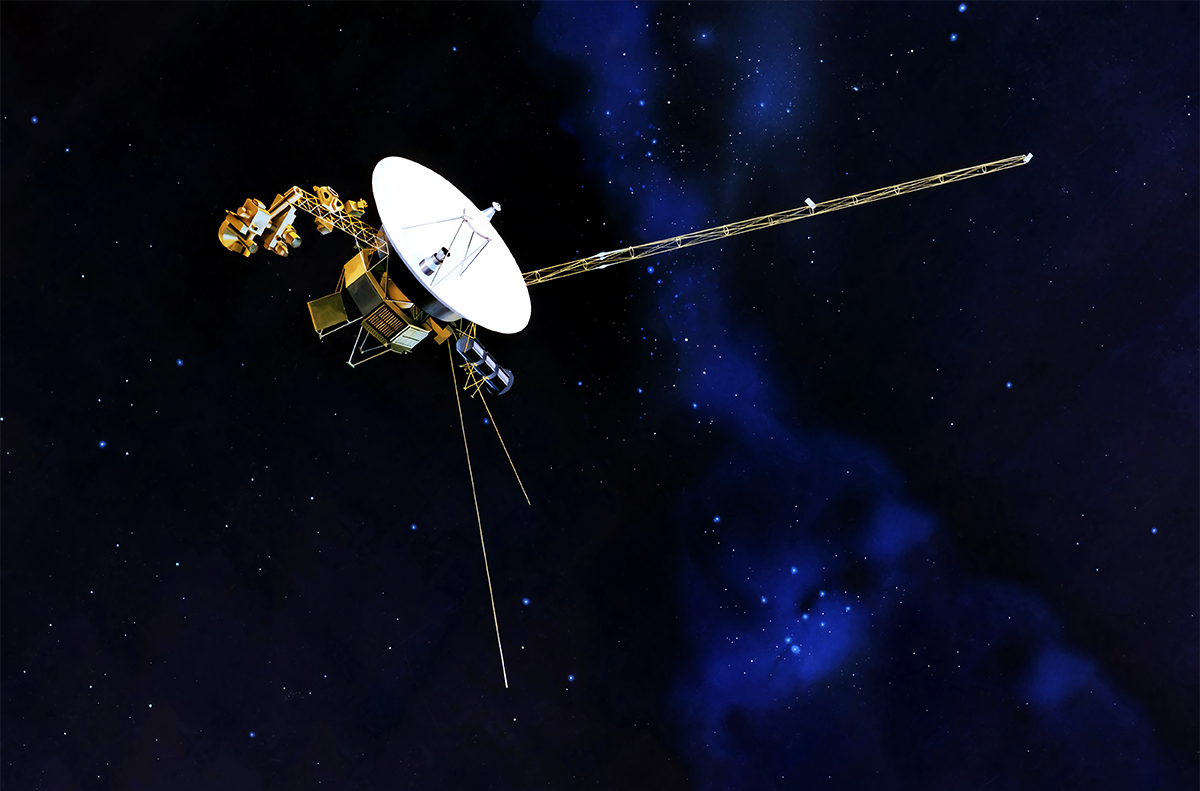
For almost 49 years, Voyager 1 has been speeding away from Earth, beaming data back to NASA researchers, skirting the gravitational pulls of planets and moons, and carrying a payload of consolidated cultural wealth out into the cosmos. Carried by a Titan-Centaur rocket, Voyager 1 lifted off from the Florida coast on Sept. 5, 1977. I was exactly 3 months old.
But now, Voyager 1, and its twin Voyager 2, are drifting nearer the ends of their lives.
More than 15 billion miles away from us, outside the gravitational embrace of our solar system and nearing the end of its mission, Voyager 1 has lost another of its scientific instruments. Last week, NASA announced that it was forced to power down one of the probe’s three remaining scientific instruments to conserve energy on the craft. The fact that Voyager 1 and Voyager 2 have both lasted this long, sending unprecedented information to engineers at NASA's Jet Propulsion Laboratory in Southern California for nearly half a century, is remarkable. They were originally designed to last a mere five years.
Read more: “Voyagers Ready to Go Dark”
“There’s been a big push to try to keep the mission going until the 50th anniversary of their launches,” in 2027, Johns Hopkins University space scientist Ralph McNutt told Nautilus in 2024. “We’ll see.”
NASA launched Voyager 2 before Voyager 1 in 1977, and the probe had a mission and payload very similar to its twin, preceding it into space. Both crafts, laden with instrumentation to support 11 scientific experiments, were designed to take advantage of a rare alignment of the planets of the outer solar system. Their goal was to deliver unprecedented information and insight into the composition of Saturn, Jupiter, Neptune, and Uranus and their many moons. Both Voyagers fulfilled that mission, beaming back data that constituted humanity’s closest look at the worlds on the periphery of our solar system.
Both Voyager probes cleared their planetary targets in 1990, but outward they continued, beyond the reach of the solar winds and the tug of our home star.
Because the probes do not include solar panels, they derive their power from small bits of Plutonium-238 that decay, releasing energy. As this power source dwindles, instruments have been powered down throughout their service while others have been switched off because they performed their job, for example, capturing the physical properties of particles in the atmospheres of Jupiter and Saturn, which are both now far in the rearview of the Voyager probes.
Read more: “Beyond Voyager”
The first scientific instruments to be powered down were Voyager 1’s photopolarimeter subsystem, which included a small telescope and was designed to measure the intensity and linear polarization of scattered sunlight passing through the atmospheres of Jupiter, Saturn and the rings of Saturn. This yielded information about the properties of particulate matter in those regions.
Most recently, NASA engineers decided to switch off Voyager 1’s low-energy particle telescope and its low-energy magnetospheric particle analyzer. These instruments measured the speed of particles that collided with sensors, elucidating how many and from whence such particles are blown through space on solar winds. The same instruments on Voyager 2 were powered down in March of last year.
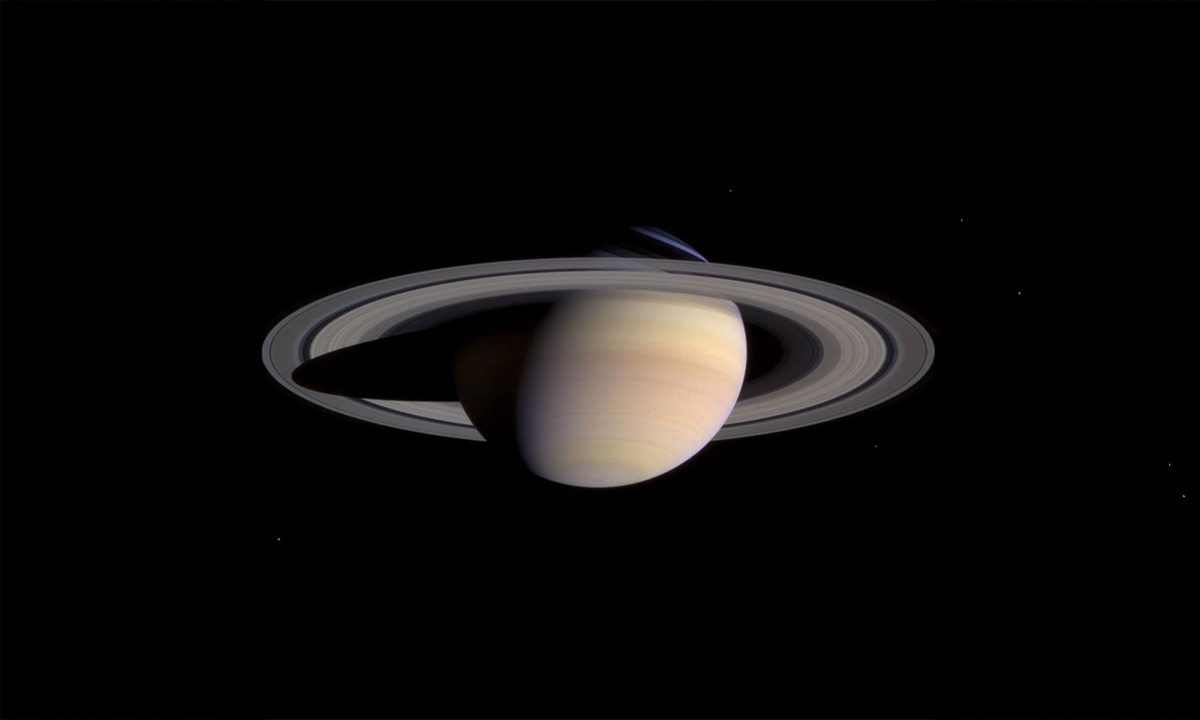
When they do go dark, the Voyager twins will be survived by an impressive array of space telescopes and ground-based detectors that, since their groundbreaking mission, have helped us peer ever deeper into the cosmos. The Vera C. Rubin Observatory in Chile started releasing mind-boggling imagery last year. Already, that instrument has pinpointed 11,000 new asteroids and has imaged distant nebulae and galaxies thousands of light-years from Earth. NASA launched the James Webb Space Telescope in 2021, and it too—working in conjunction with the Hubble Space Telescope, which was launched in 1990—has captured unparalleled images of our cosmos. Most recently, those two space telescopes delivered the most detailed views of Saturn.
Read more: “Ann Druyan on How NASA’s Golden Records Got Made”
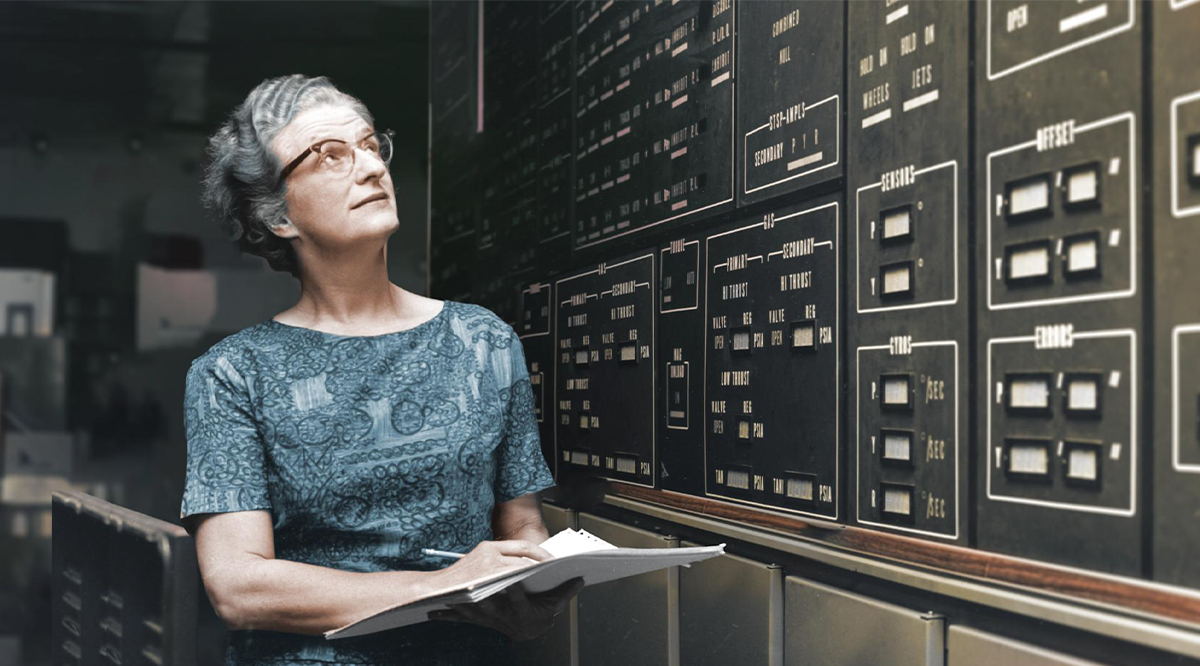
And now, NASA plans to launch the Nancy Grace Roman Space Telescope in September 2026. This powerful camera will capture images in visible and near-infrared light, complimenting Webb’s infrared observations and Hubble’s visible and ultraviolet images. This could help untangle dark matter and energy, the unknown, undetected substances and forces holding our universe together.
As these new tools deploy into the mysterious corners of the cosmos, the Voyagers limp along on life support. The team of engineers that monitor and manipulate the long-lived probes on their extended mission told NPR that they plan to do some instrument testing on the Voyagers this year that may extend their lifespans into the 2030s. Far from a sentimental exercise, keeping the Voyagers functioning makes scientific sense: The probes are floating farther out into interstellar space than any other human-made object. Data that they send on the 23-hour journey to Earth could encode insights that we could never see coming.
These first and farthest robots in space stand as pioneers into our ever-expanding appreciation of what makes our universe tick. Dimmed, but not darkened, I wish these plucky robots the best as they continue to traverse the space between mystery and knowledge. 
Enjoying Nautilus? Subscribe to our free newsletter.
Lead image: Artsiom P / Adobe Stock