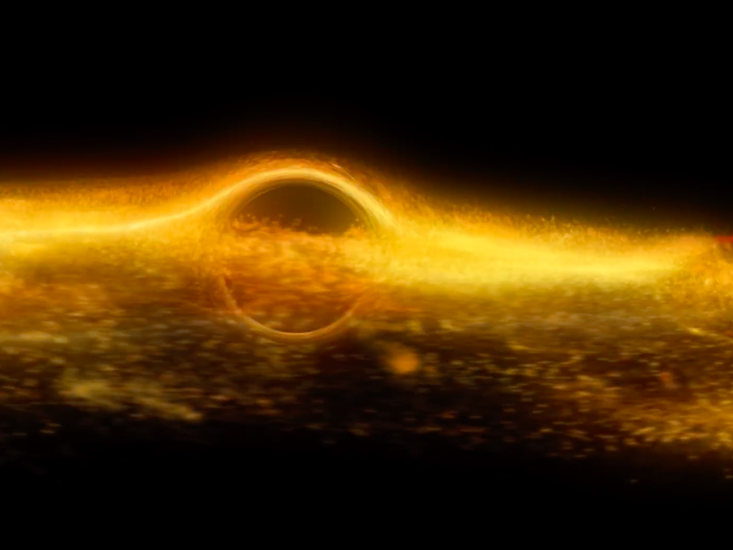
The great irony of black holes is that, in all the decades that we astrophysicists have talked about them, we never had any direct observational evidence for them. When astronomers said they had “found black holes” in this or that location in a faraway location in the universe, what this really meant was a very compact object—an enormous concentration of mass, far greater than that of any conventional star or planet.
On Wednesday all that changed. The key characteristic of a black hole, what makes it black and a hole, is the existence of an event horizon—a one-way membrane or, if you like, a boundary in spacetime. Because of it, black holes gulp everything but do not allow any matter within, or even light, to escape. The Event Horizon Telescope (EHT) has now precisely offered that evidence in the form of a shadow that the black hole necessarily casts.
Strictly speaking, the system did not see an event horizon, which cannot be seen by definition. Furthermore, although an event horizon necessarily implies a shadow and silhouette, the converse is not true. Nonetheless the observations are still so precise that whatever is casting the shadow must be exotic. No ordinary body could be so small and yet so dark and so massive. A black hole is now the most conservative conclusion. If it is not a black hole, it might be a naked singularity, a type of immensely dense object that I have studied, and that would make a black hole look rather mundane.
The EHT is not a telescope in the normal sense of the word, but actually it is a network of several of the existing radio telescopes, spread across several continents. Each of these telescopes receive radio waves from the central region of the galaxy Messier 87. The data from the individual instruments is then compiled and processed.
At the moment the system is restricted to the largest black holes. The images now making the rounds are of a supermassive black hole, with the mass of 6.5 billion suns, lying at the center of the galaxy Messier 87. The EHT is also seeking to observe the black hole at the center of our galaxy, which is roughly comparable. The angle such an object presents to us on the sky diminishes with mass. For now, black holes equal in a mass to a single star are beyond reach.
Beyond confirming the existence of the black hole, EHT tells us that all its features of the hole match the predictions of Einstein’s general theory of relativity. The object is rotating clockwise. A black hole, unless a hole in your jeans, spins. This rotation drives the jets that the hole ejects from its environs into deep space. Interestingly, the image from the telescope is asymmetric, which might be a further clue to the spin and mass.
Clearly, though, these are still very early days. The scientists and team leaders readily acknowledged that the image was somewhat fuzzy. They are planning to add more telescopes to their current network of some ten radio telescopes. My own hope is that we can go beyond general relativity and directly measure the quantum properties of gravity, which we think may be the rock-bottom level of physical reality. Many have said such a goal is hopelessly ambitious. But people used to say the same about black holes, too.
Pankaj S. Joshi is an astrophysicist who specializes in compact objects such as black holes. He is currently a vice chancellor and founding director of the International Center for Cosmology at the Charusat University in Anand, India.