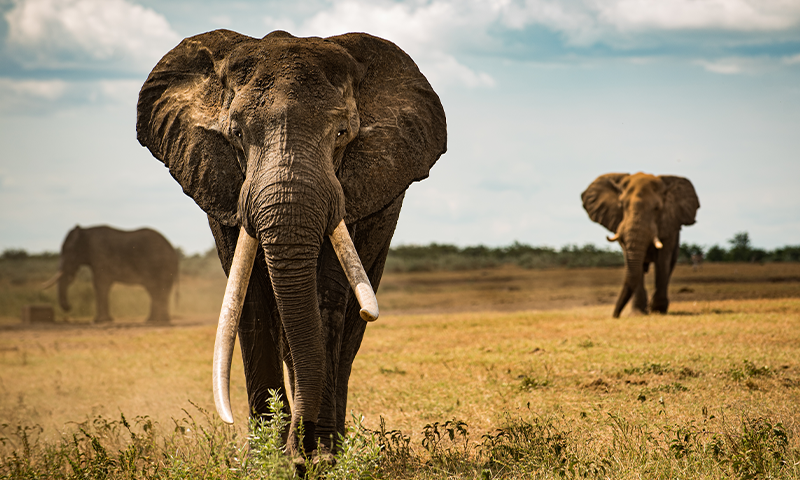
As the Siberian permafrost melts, it’s revealing an increasing number of millennia-old woolly mammoth tusks. These ancient tusks might be sating some of the global demand for ivory from endangered African elephants. But not enough. Between poaching and habitat loss, African elephant populations have plummeted in recent decades.
To try to evade the law, some smugglers mix legally traded mammoth ivory with contraband elephant ivory, and it’s difficult to distinguish between these relatives without costly tests—radiocarbon dating and molecular analysis—that can take weeks to yield answers.
So scientists from the University of Hong Kong have proposed a cheaper, speedier solution to keep African elephant tusks out of the trade. By comparing the ratios of certain elements’ isotopes in tusks, law enforcement could easily pinpoint which hulking proboscideans the ivory belonged to, according to results recently published in Frontiers in Ecology and Evolution.
The team analyzed 79 pieces of ivory, which included 44 samples from elephants and 35 from mammoths. They inspected the ratios of five elements—sulfur, hydrogen, carbon, nitrogen, and oxygen—to determine which would be most helpful in distinguishing between the animals.
Ultimately, the oxygen and hydrogen isotope ratios seemed to deliver the clearest results.
This is due to their distinct locales, the paper noted: The water once sipped by mammoths in high-latitude regions like Siberia contains unique ratios of isotopes compared with those in water consumed by elephants in tropical spots.
But the technique has not yet been perfected. The researchers noted that aspects such as an animal’s age, or the specific part of the tusk sampled, might impact the results. While the test is not yet ready for the courtroom, the team notes in a statement that it could already offer “quick, efficient first screening step.” And help the African elephant not go the way of the wooly mammoth just yet. 
Lead image: Johann Mader / Shutterstock