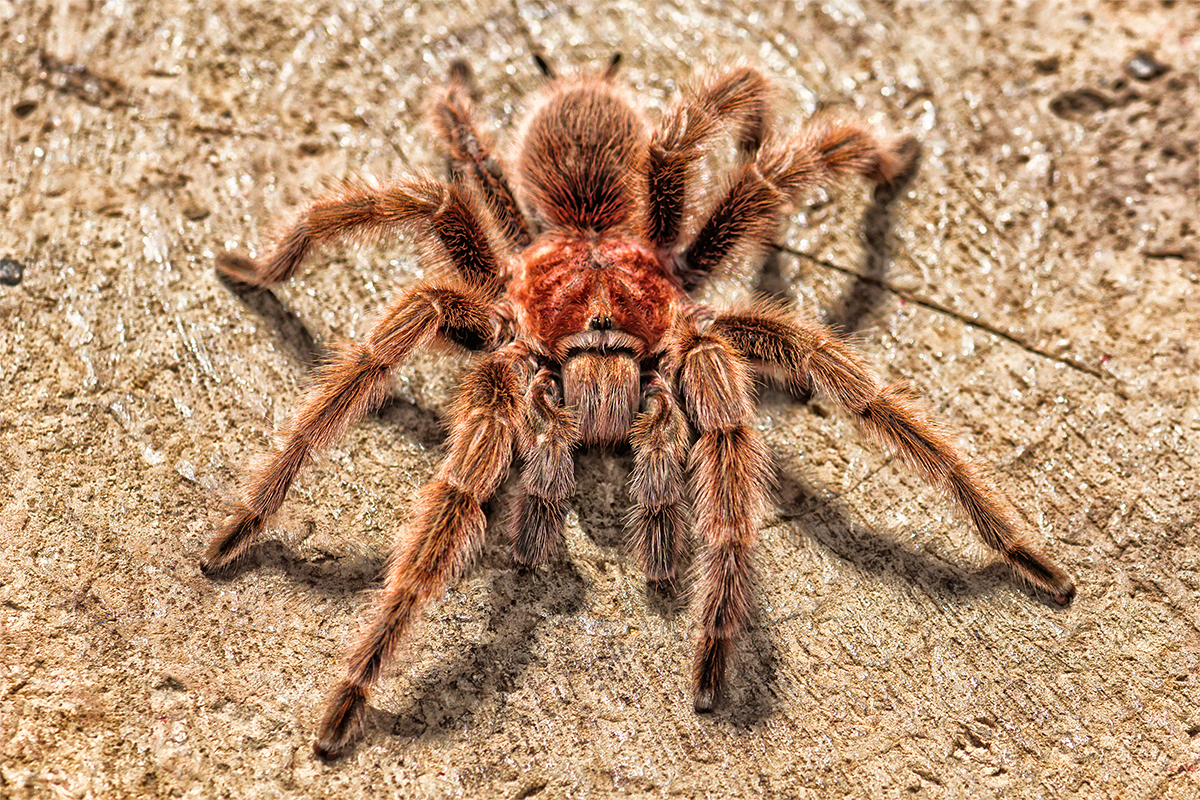
In horror movies involving tarantulas, like the classic Arachnophobia, the spiders have no trouble locating their victims. It’s true-to-life as well: Under laboratory conditions, tarantulas (family Theraphosidae) have demonstrated surprising navigational abilities that suggest learned behavior.
“Previous studies have shown that tarantulas can learn to avoid unpleasant stimuli, navigate complex mazes, and remember spatial locations over time,” explained University of Turku arachnologist Alireza Zamani in a press release for a new study he led that looked for evidence of learned spatial orientation in wild tarantulas. “These abilities suggest that their nervous systems support more flexible behavior than traditionally assumed.”
Zamani reviewed nine cases of apparent spatial orientation in wild tarantulas collected during field surveys by study co-author Rick C. West, an independent tarantula authority, as well as other researchers. Collectively, the cases suggest that both burrow-dwelling and tree-dwelling tarantulas can navigate purposefully by recalling learned information about their environments.
Read more: “New Tarantula Discovered in Unexpected Place”
For example, for two weeks straight, an adult female pinktoe tarantula (Avicularia avicularia) left her retreat in the beams of a building in French Guiana, traveled about six feet, made a right-angle turn to the left, and foraged on flying insects around a light, before returning to her spider lair. Meanwhile, an adult female burrowing desert tarantula (Aphonopelma iodius) in Nevada seen foraging on the ground at night took a straight-line path of more than six feet directly back to its burrow. And a subadult Mexican blue femur tarantula (Bonnetina cf. cyaneifemur) was similarly observed bee-lining directly to its home base after a disturbance.
This clearly demonstrates that tarantulas have spatial awareness, which contributes to their ability to escape danger and hunt successfully by returning to food-rich places such as artificial lights. The study authors hypothesize that tarantulas are using a combination of learned information from their outbound journeys, which could include “light position, polarized light, web tension patterns, [and] gravity.”
Noting that even a blind, cave-dwelling tarantula (Hemirrhagus sp.) showed the ability to return to a retreat when threatened by human presence, the researchers proposed that internal body signals must be part of the navigation equation as well.
Honestly, all of this kind of makes them even more effective horror movie material. 
Enjoying Nautilus? Subscribe to our free newsletter.
Lead image: ryanladbrook / Adobe Stock