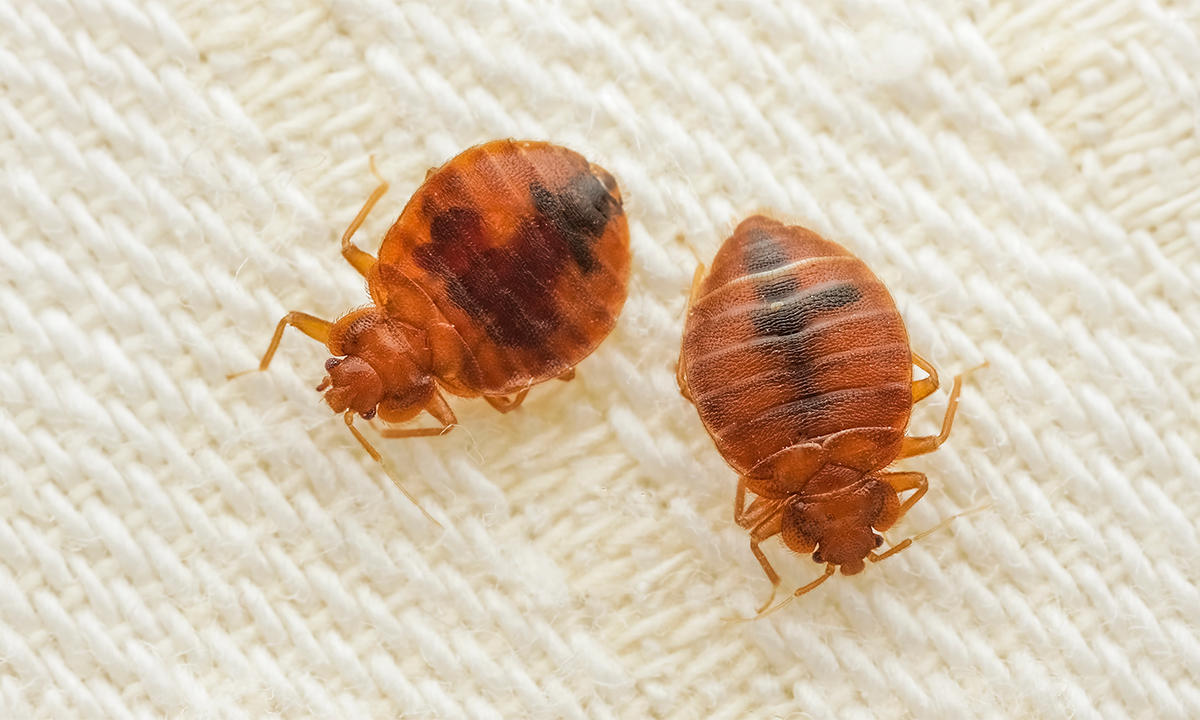
If you’ve ever crossed paths with bedbugs, you know what a scourge they can be. Several pesticide treatments later, and these tiny parasites may still be lurking in your mattress. Because they’re obligatory blood feeders, it’s tough to convince them to leave a good (human) meal behind. But a study in the Journal of Ethology offered a new approach to consider for purging bedbugs.
University of California, Riverside entomologists introduced bedbugs (Cimex lectularius) to the lid of a tissue culture dish, about 4 inches in diameter, with a filter paper floor. Half the floor was wet, and the other half was dry. The liquid proved repellent to the bedbugs—the majority (nearly 90 percent) turned away before stepping on the wet part of the filter paper. Indeed, they fled from the moisture, increasing their outbound speed by about 40 percent relative to incoming speed. In control conditions with the entire arena dry, no such behavior was apparent.
“Due to its strong adhesive power, water could be very dangerous from a bedbug’s perspective. So, it’s not surprising to learn that they’re extremely averse to moisture,” explained study co-author Dong-Hwan Choe in a press release.
Read more: “When Plants Go to War”
Because bedbugs evolved from ancestors that parasitized animals like birds and bats that nested up high, C. lectularius may never have adapted to withstand flooding, according to the researchers. And other studies have found that bedbug babies die if conditions are too humid. So, their ancestry may have limited bedbug tolerance for wet places.
Little sensory organs on bedbug antennae may serve as moisture detectors, allowing them to take evasive action before getting wet. Their “negative hydrotaxis” behavior showed up as far as 0.6 inches before the wet zone, with nymphs turning away sooner than adult bedbugs. The greater reaction of nymphs may derive from their thinner, less hardened exoskeletons, making them more sensitive to water, according to the paper.
As for how to apply these new findings to keeping bedbugs out of your life, “take a bath. It’ll solve the problem,” added Chloe. “Of course, the bedbugs in the room or on the bed will require different approaches.”
These findings are just one more tool in the arsenal for the war on bedbugs—a war that’s seemingly best waged with water. 
Enjoying Nautilus? Subscribe to our free newsletter.
Lead image: Pavel Krasensky / Shutterstock