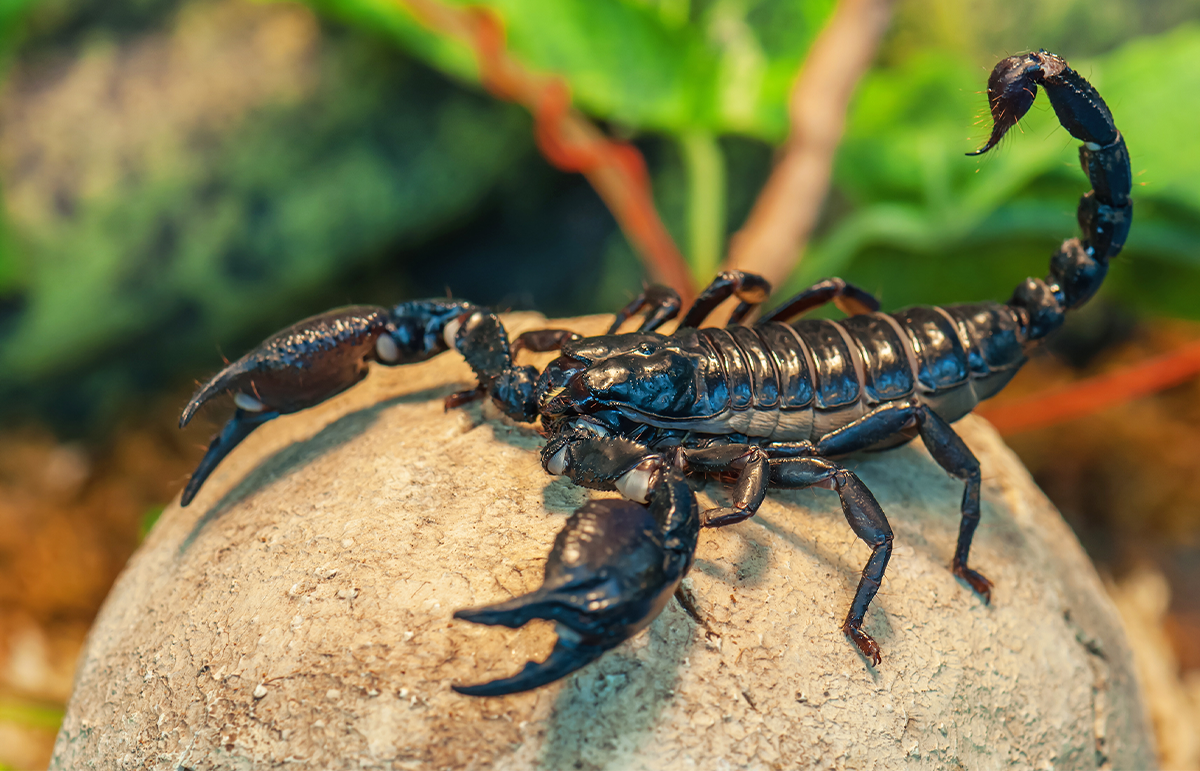
Humans started reinforcing the tips of their spears with metal several thousands years ago, but scorpions beat them to it by hundreds of millions of years. Like many arthropods, a scorpion’s exoskeleton is made of chitin, but the tip of its stinger—one of the only body parts that doesn’t fluoresce under ultraviolet light—is imbued with zinc. Now, new research published in the Journal of the Royal Society Interface is shedding light on how scorpions reinforce their weapons with metal.
Scorpions all share the same dangerous body plan—pincers in the front, stinger in the back—but the size and utilization of these structures can differ between species. Some scorpions have big beefy claws for crushing prey coupled with smaller stingers, while others have more delicate pincers and more muscular stingers.
“Scorpions are incredible hunters, and while we knew that metals strengthen the weapons in some species’ arsenals, we don’t know if all scorpions’ weapons contain metal, and if so, whether this metal enrichment relates to how they hunt,” study author Sam Campbell, a Ph.D. candidate in Australia who studies scorpion venom, explained in a statement.
Read more: “5 Devious Ways People Made Bugs Into Bombs”
Campbell and a team of researchers from the Smithsonian Institution used high‑resolution electron microscopy and X‑ray analysis to take a closer look at the metal concentrations in a broad range of scorpion arsenals. They found zinc concentrated in the tip of the venomous stinger, followed by a band of manganese. Meanwhile, the pincers contained either zinc or a mixture of zinc and iron—these metals, however, were primarily concentrated in the tiny toothlike structures that grip prey.
Comparing species with powerful claws to those with daintier pincers, they expected to find higher concentrations of zinc in the former. Instead they found the opposite. Scorpions with long, slender claws were more likely to be loaded with zinc. “This points to a role for zinc beyond hardness, perhaps playing a bigger role in durability,” Campbell said. “After all, long claws need to grasp prey and prevent it from escaping before being injected by venom.”
Basically, the metal-tipped teeth could be protecting the claws from the wear and tear of repeatedly gripping struggling prey.
The researchers hint that there could be even more to this find. While their study focused on 18 species representative of the scorpion diversity, there are more than 3,000 species of scorpions. Who knows what developments the rest of these little weapon manufacturers came up with during their 400 million years of evolution. 
Enjoying Nautilus? Subscribe to our free newsletter.
Lead image: Volodymyr Shevchuk / Adobe Stock