Plants are a lot smarter than we give them credit for. They can sense their surroundings, anticipate changes, and even communicate in ways we’re only beginning to understand. According to new research published in Cognitive Science, they might be able to count, too.
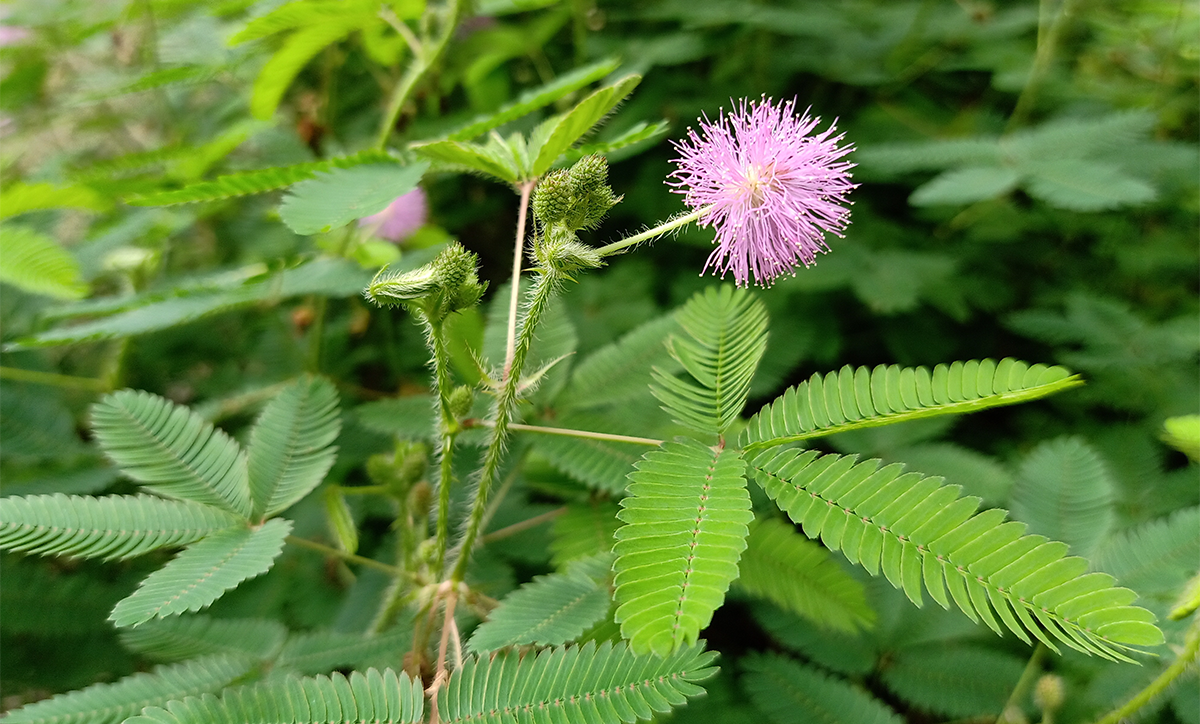
To determine whether plants can count, a team led by cognitive psychologist Peter Vishton of the College of William & Mary studied the behavior of Mimosa pudica. Also known as the “touch-me-not” plant, the mimosa rapidly folds its leaves up when perturbed, something it also does at night.
In the first phase of their experiment, the researchers subjected the plant to two standard days of 12 hours of light followed by 12 hours of darkness and then a third day of complete darkness. They repeated the entire three-day cycle five times and discovered that the plant’s leaves began moving before the “lights-on time” on days when the lights were scheduled to come on, but not on scheduled days of total darkness.
“This seems to suggest that the plants were able to ‘learn,’ for lack of a better word, this three-day cycle and shift their movement in response,” Vishton said in a statement.
Intriguingly, the plant’s behavioral patterns fit a logarithmic curve, similar to patterns displayed by animals when learning new things. “This is the same pattern we see all the time in animal learning,” Vishton said. “For example, if you are teaching a rat to perform a series of actions in a certain order, you would expect to see a period of time when they’re figuring out the sequence and then a gradual increase in their ability to predict the pattern.”
Of course the 24-hour circadian behavior of the mimosa is well-known, and Vishton and his team needed to be sure they hadn’t just entrained the plant to a bizarre 72-hour cycle. As such, they shortened the plants’ day length to 20 hours (10 hours of light, followed by 10 hours of darkness). Once again, the plants adapted quickly, opening their leaves before the lights came on, but not before scheduled darkness.
Read more: “What Plants Are Saying About Us”
To challenge the plants further and ensure they were responding to the number of light stimuli rather than the timing of them, they randomly subjected the plants to day lengths between 10 and 32 hours. They found that the pattern broke down when days were shorter than 12 hours or longer than 24 hours.
To Vishton, this suggests that the plants have a minimum exposure window to process the light-dark paradigm and a maximum memory limit after which they “forget” it. Within the 12- to 24-hour days, however, they showed the same anticipatory behavior. “The simplest explanation for this result is that these plants are tracking the number of events that take place,” Vishton said. “Not simply responding to time.”
If these results are confirmed, Vishton says it could point to a new kind of information processing that doesn’t involve neurons at all.
“There are lots of cells in animals and humans that aren’t neurons. And we just assume they’re not involved in learning,” Vishton said. “But maybe they could be. Maybe learning is present in every cell. We’ve just never really studied it before.”
Just how these cells might learn, store, and recall such information are questions for future research. In the meantime, remember to water your plants—they might be keeping track of how many days it’s been. 
Enjoying Nautilus? Subscribe to our free newsletter.
Lead image: Suyash.dwivedi / Wikimedia Commons