There are three fundamental rules of humor. Unfortunately, no one can remember what they are. We can probably blame the Greek philosopher Aristotle for this because he apparently wrote an entire book on laughter, which was then lost. His mistake was not to write on tablets of stone. They are harder to lose, but the downside is that they demand brevity. There has to be a reason why there are only 10 commandments. Stone tablets were the Post-it notes of the ancient world. “Enough!” I hear you cry. “I demand some science.” Very well, if you insist.
If you laughed at any of the above, I invite you to consider why. What makes something funny? And if you didn’t laugh, you too can play this game, but from the other end. What is missing that failed to make you laugh? All kinds of deep thinkers have tried to discover the secret formula for funny, convinced that some rules must exist. The English philosopher Thomas Hobbes believed that the joy of humor came from delight in feeling superior to the person who was the butt of the joke. There is something in this, I fear, but it can hardly be the whole story, or the chicken would never have bothered to cross the road.
Sigmund Freud believed that jokes are enjoyed because the punchline delivers a feeling of catharsis. Also surely true to a degree, but if this were fundamental to humor then the top professional comics would not use warm-up acts to get the audience in the mood, because catharsis exhausts rather than enhances emotion. By the time Chris Rock got to the stage, everyone would have stopped laughing and gone home.
Personally, I do not find ChatGPT, a Grand Plagiarism Tool, at all funny.
When the English comic Jimmy Carr and writer Lucy Greeves tried to count the number of theories of humor in their book The Naked Jape: Uncovering the Hidden World of Jokes, they reached more than 100 before giving up. Comics are naturally curious about what makes people laugh, but they use trial-and-error and intuition to devise their material, not theory. The great American comic W.C. Fields said, “I know what makes them laugh but trying to get your hands on the why of it is like trying to pick an eel out of a tub of water.” Luckily, science has now managed to pin that eel to a dissecting board and uncovered one really convincing hypothesis.
The secret sauce of humor is incongruity. In a joke, the set-up creates an expectation, the punchline provides an unexpected counterpoint, and the collision between the two stimulates laughter. Non-verbal humor works the same way. The numerous family of J.S. Bach practiced a singalong they called a quodlibet in which they would improvise an incongruous medley of hymns, pop songs, and indecent lyrics, switching from one to another to hilarious effect. The final iteration in J.S. Bach’s Goldberg Variations for piano is a quodlibet that quotes German folk songs.
The cognitive processing of humor contains three elements: detection of incongruity, incongruity resolution as you comprehend the humor, and the inducement of emotion in amusement. Taiwanese psychologist Yu-Chen Chan and her team had experimental subjects listen to jokes formulated to independently manipulate each of the three elements, for example giving them a set-up and punchline that were incongruous but could not be resolved. fMRI scans revealed that the three elements of humor processing map to different regions of the brain cortex, providing a neat experimental confirmation of the incongruity hypothesis.
Have you heard the one about the AI that went into a bar?
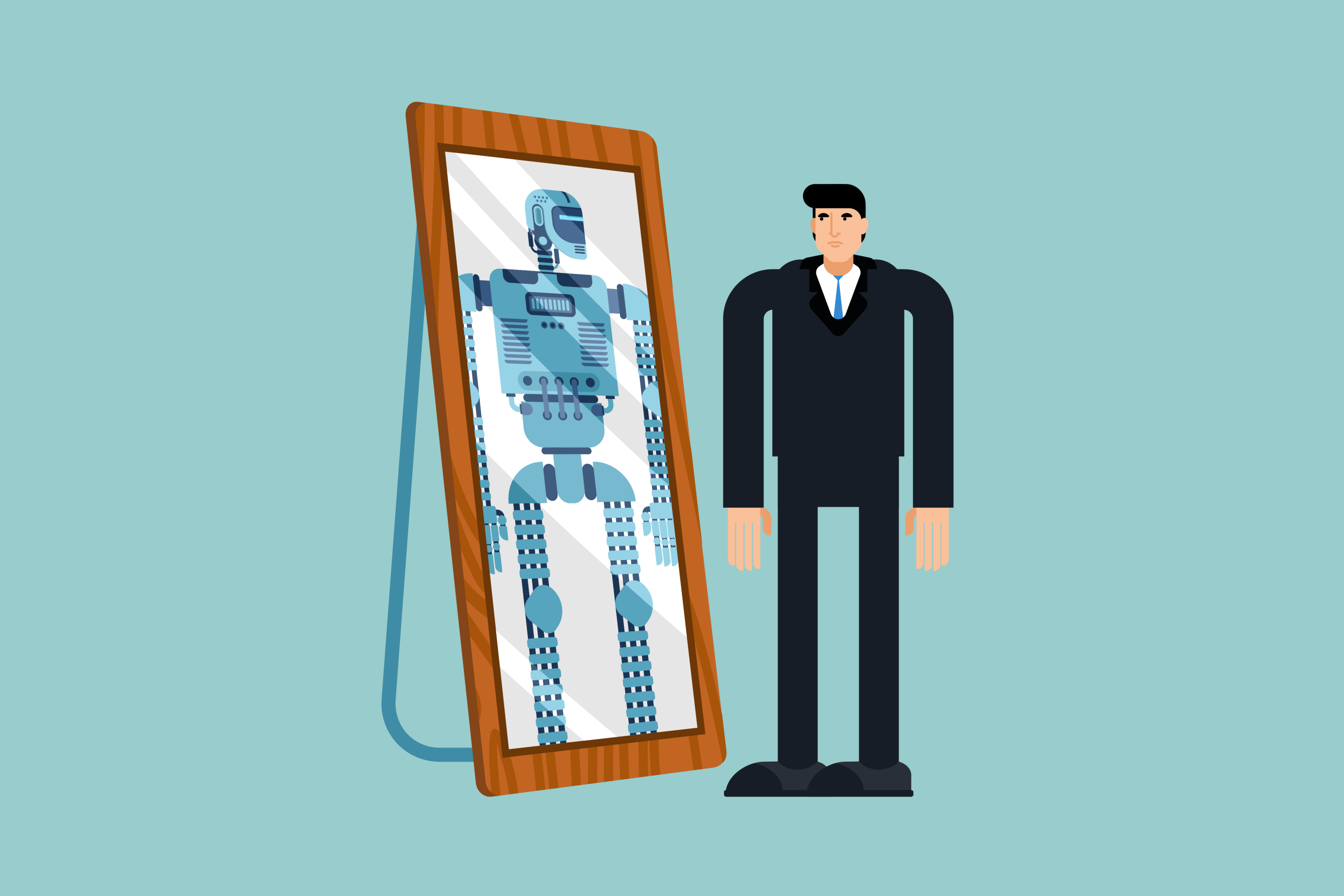
Just as humor psychologists were gathering in the bar to celebrate a job well done, what should walk in but ChatGPT. In a preprint posted to PsyArXiv in February, Drew Gorenz and Norbert Schwarz from the University of Southern California, Los Angeles, report some experiments with AI-generated humor. Can AI be funny? Some full disclosure is necessary on my part here. AI programs like ChatGPT are based on large language models that are fed on human-authored texts lifted from the internet. I discovered recently that a book of my own is in the corpus called Books3, comprising more than 180,000 titles that the AI companies purloined without permission to train their models. So, personally, I do not find ChatGPT, a Grand Plagiarism Tool, at all funny.
What is funny, or at least ironic, is that of all the products of human creativity I can think of, jokes are the only one that actually belongs to no one. There are no new jokes, only ones you haven’t heard before. So perhaps uniquely in the area of humor, ChatGPT can legitimately do what everyone does, which is to re-version old jokes.
The study by Gorenz and Schwarz primed ChatGPT with various types of humor: satirical headlines of the kind published by The Onion, roasts of the kind “Yo Mama’s so … she …” and a couple of others. Human participants were asked to create jokes of the same kind and then both AI-generated and human-generated jokes were rated for funniness by a human panel.
The result? No real difference between AI- and human-generated jokes. (To be fair, ChatGPT produced the most highly rated entry: “Local Man Discovers New Emotion, Still Can’t Describe It Properly.” And people did rate the AI jokes as slightly funnier than those generated by their fellow humans.) Unfortunately, I’m not sure we can conclude anything from this study because none of the jokes were much good, and that’s not my opinion, it’s what the data show. On a six-point scale of funniness, where one was not at all funny, the mean rating for jokes in the study was almost always less than three.
It would appear that W.C. Fields was right all along and that humor is one slippery eel. Have you heard the one about the AI that went into a bar and said “Have you heard the one about the AI that went into a bar?” My advice to ChatGPT is not to give up the day job. 
Lead image: Nadia Snopek / Shutterstock