Last July, during a routine survey of the sky, the wide-field X-ray telescope equipped on China’s Einstein Probe detected something strange: an X-ray source that showed “violent” variability. Around the same time, NASA’s Fermi Gamma-ray Space Telescope detected a series of gamma ray bursts from the same region—the longest ever recorded, followed by two more. Across the planet and in space, several other telescopes were pointed in the direction of the phenomenon to watch the fallout.
An examination of earlier observations from the wide-field X-ray telescope revealed another persistent X-ray signal preceding the gamma ray burst, which is an odd order of events for high-energy cosmic explosions. Fifteen hours later, the region erupted in some of the brightest X-ray flares ever recorded.
“This early X-ray signal is crucial,” Dongyue LI of the National Astronomical Observatories of China said in a statement. “It tells us this was not an ordinary gamma-ray burst.”
Read more: “Earth May Not Be Toast”
Dongyue and a team of international collaborators pored over the data collected from the telescopes and determined the event, dubbed EP250702a, defied explanation by current models. Now, in a new paper published in Science Bulletin the team is proposing they witnessed a black hole feeding on a white dwarf.
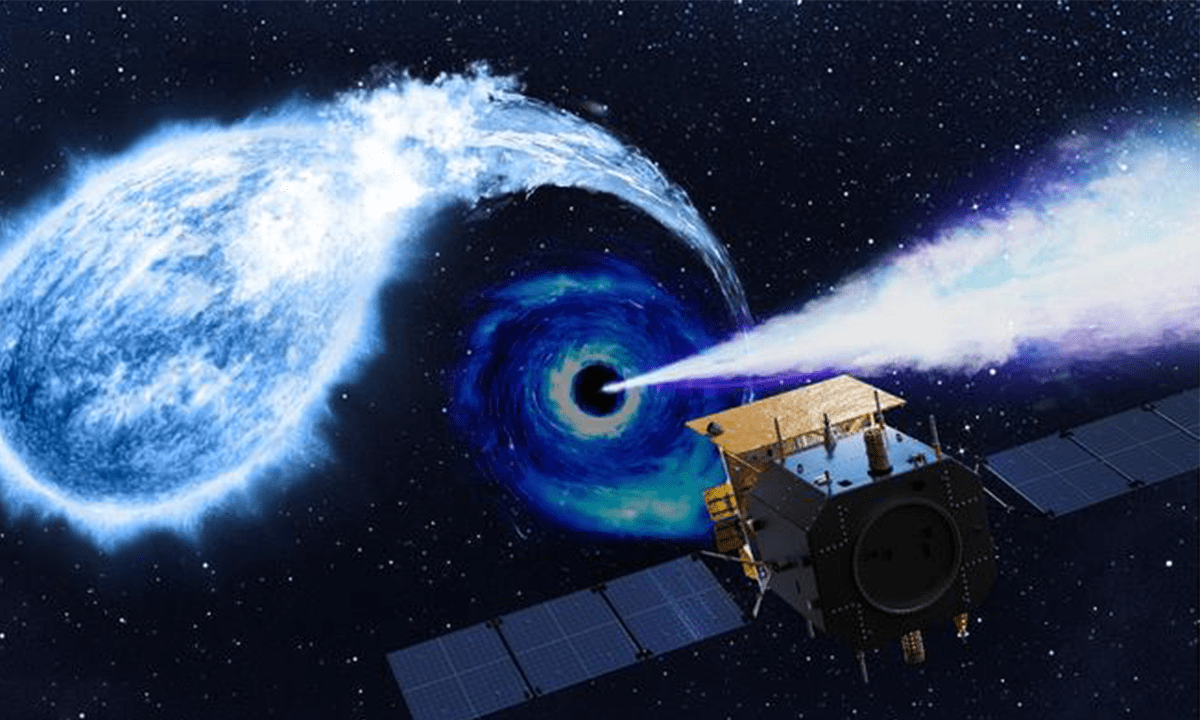
Believed to be the final stage of stars with insufficient mass to collapse into black holes, white dwarfs are incredibly dense, with the mass of the sun packed into a volume just the size of Earth. In other words, it’s a bite-sized nugget with plenty of matter for a black hole to shred. As the black hole tore apart the white dwarf, it rapidly emitted jets of matter and energy in the form of X-rays and gamma rays that were detected back on Earth.
“Our computational simulations show that the combination of the tidal forces of an intermediate-mass black hole, combined with the extreme density of a white dwarf, can produce jet energies and evolutionary timescales that are highly consistent with the observational data,” study co-author Jinhong Chen of Hong Kong University explained.
If confirmed, it would be the first-ever observational evidence of a black hole feeding on a white dwarf. 
Enjoying Nautilus? Subscribe to our free newsletter.
Lead image: Artist's impression of the Einstein Probe satellite catching an intermediate black hole, tearing apart a white dwarf, and producing a relativistic jet. Credit: Einstein Probe Science Center, National Astronomical Observatories, CAS / Sci Visual.