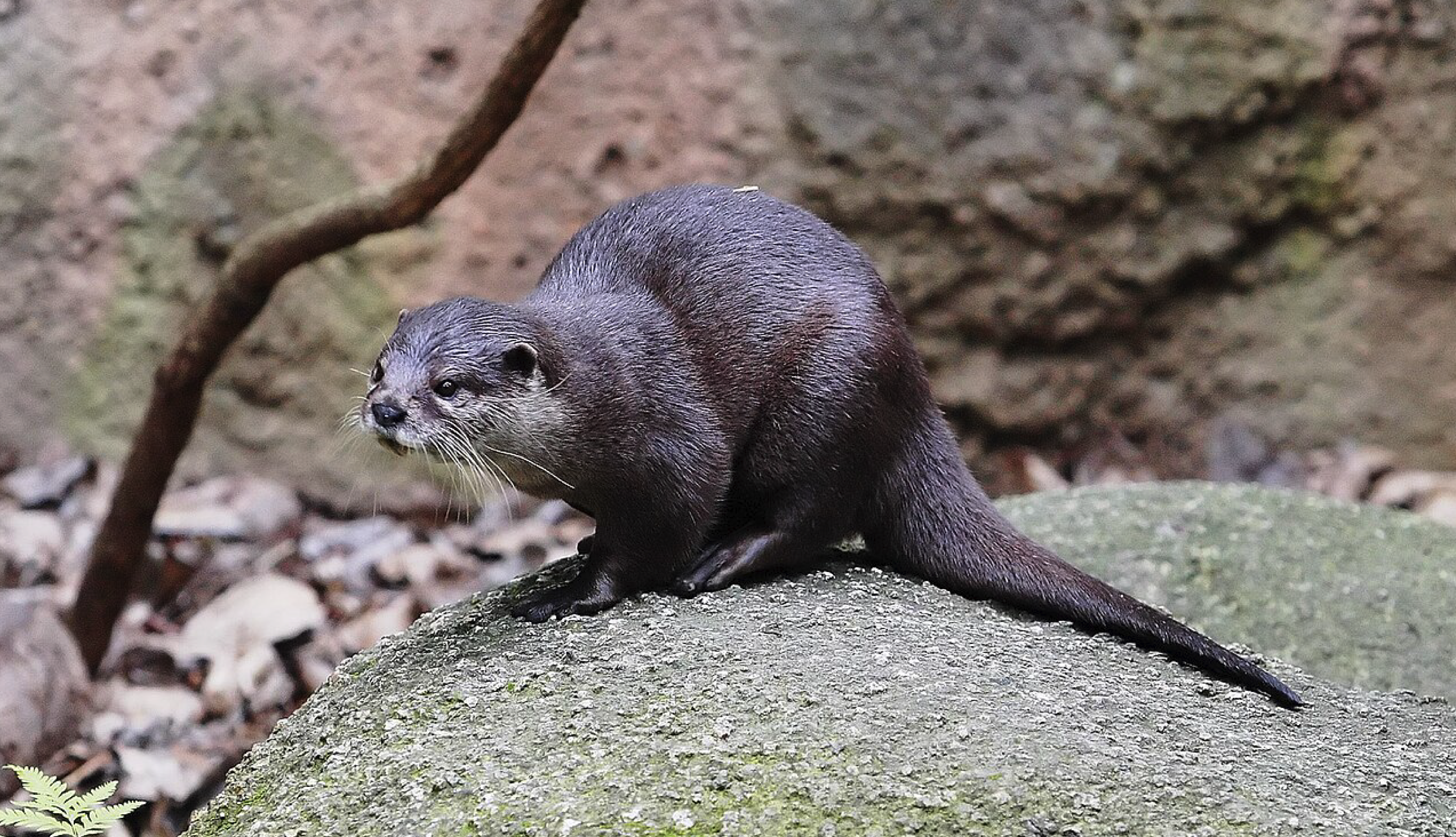
Zoos take great care to reduce the stress on captive animals—providing everything from visual barriers to hidden nooks—as the accepted wisdom is that contact with humans, especially in crowds, is tough on these animals. But a recent paper in the Journal of Zoological and Botanical Gardens challenges that assumption—at least in the case of Asian small-clawed otters (Lutra cinerea).
Veterinary researchers at Adelaide University in Australia tracked the behavior of six captive otters at the local zoo. These otters, ranging from young adults to middle-aged, are housed in a naturalistic habitat with pools and logs that’s visible to the public, but from which they can retreat at any time into a private, sheltered area.
The otters were observed by trained undergrad students during hour-long sessions over six months. The undergrads kept behavioral logs—or ethograms—by scanning every 60 seconds and noting any otter vocalizations and behaviors. They also noted the presence or absence of humans. Fifteen distinct behaviors were detected across categories that included grooming, foraging, resting, and socializing.
Read more: “This Is Urban Wildlife Biology”
The researchers then used the ethograms to compare the behaviors from sessions where the otters were alone to those where visitors or zoo staff were present. Based on otter behavior, no evidence of the expected stress in the presence of people was detected. On the contrary, the otters were more active and visible when people were around.
“Visitors may actually have a positive or enriching effect on their welfare,” said study author Paige Klingner, a veterinary doctoral student at Adelaide University, in a statement “although more research is needed before we can say that with confidence."
Because the research was observational, explained the study authors, it’s hard to know which is the cart and which is the horse: otter activity or the presence of people. Perhaps, as the otters got more active, the excitement drew more people into the exhibit. The clawed otters, which communicate with chirps, barks, squeals, and screams, were slightly more likely to make noises when people were around. But those noises, based on prior studies, could convey excitement over the stimulation or could be expressions of stress, something the researchers aim to investigate next.
In other words, don’t get too full of yourself, clawed otters might not be so happy to see you after all. 
Enjoying Nautilus? Subscribe to our free newsletter.
Lead image: flagstaffotos / Wikimedia Commons