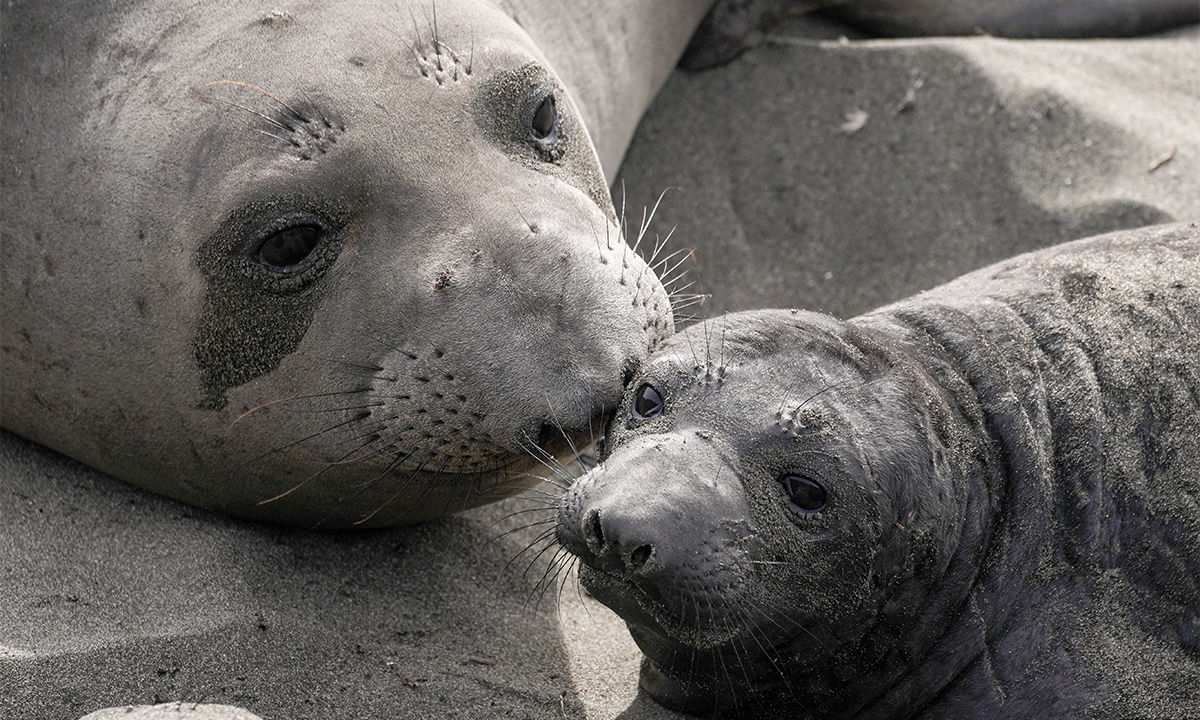
When a young adult leaves home to work or study, there’s a good chance they’ll settle into life in a new locale. A Pew Research Center survey found only 18 percent of United States adults between the ages of 25 and 34 live in their parents’ homes, despite the potential advantages of familiarity and lower costs. In contrast, for many species, females return to their homelands to reproduce. Such “natal philopatry” has been recorded in animals as diverse as sparrows and turtles. Now, a study published in Oecologia shows that elephant seals also return to their birthplaces—again and again.
Researchers from the University of California, Santa Cruz, used 20 years of mark-recapture data to track nesting of Northern elephant seals (Mirounga angustirostris) in a colony at Año Nuevo State Park in the Golden State. Previous unpublished research indicated that about 10 percent of females dispersed from Año Nuevo to breed elsewhere, while the majority returned to the same general coastline. By mapping returning female locations, the researchers hoped to determine the specificity of their loyalty to their birth sites.
Distances between birth sites and pupping sites were analyzed for 124 mother-pup pairs at Año Nuevo from 2000 to 2023. The results demonstrated that females bore their pups significantly closer to their own birth site than random chance would dictate. On average, a female gave birth 1,296 feet from where she was born, and a quarter of the time within just 407 feet—a bit more than the length of a football field. While that may sound like a lot, consider that these females are migrating to the nesting beaches from thousands of miles away.
Read more: “A Leopard Seal Mother’s Love Transcends Death”
“It is already remarkable that northern elephant seals—a species that can travel more than 12,000 miles in a single year—can navigate back to the same colony where they were born. We found that this precision continues within the colony, with underlying drivers of site selection creating a surprisingly organized breeding structure,” explains Bella Garfield, lead author and now a marine science grad student at the University of Massachusetts, Dartmouth.
Also, in their future rounds of reproduction, females tended to return close to the spots where they had their pups. So, their natal philopatry carried across years of their lives, although longer intervals between pupping corresponded with nesting further away. “This fine-scale philopatry suggests a generational context for where seals choose to pup, with implications for genetic dispersal within the colony,” Garfield adds.
Returning to the same site to breed confers a risk of inbreeding with relatives, with the consequent genetic liabilities of lower diversity. Given that Northern elephant seals recovered from near extinction, their tendency to return to natal sites may limit the outcrossing needed to restore genetic diversity.
However, their loyalty to their birth sites may increase the chance of locating a mate as well as confer the advantage of already being familiar with environmental conditions at the site. “Our results establish a baseline for breeding patterns at Año Nuevo that can be revisited to understand how environmental change reshapes colony structure over time,” says Garfield. 
Enjoying Nautilus? Subscribe to our free newsletter.
Lead image: Tiny Turkey / Shutterstock