The elemental building blocks that made life on Earth possible may have originally come from red giant stars, but how they got here has remained something of a mystery. For decades, scientists assumed carbon, oxygen, and nitrogen were carried across the cosmos, blown by stellar winds pushing infinitesimal motes of stardust. But now, new research from a team led by Theo Khouri at Chalmers University of Technology is upending that hypothesis.
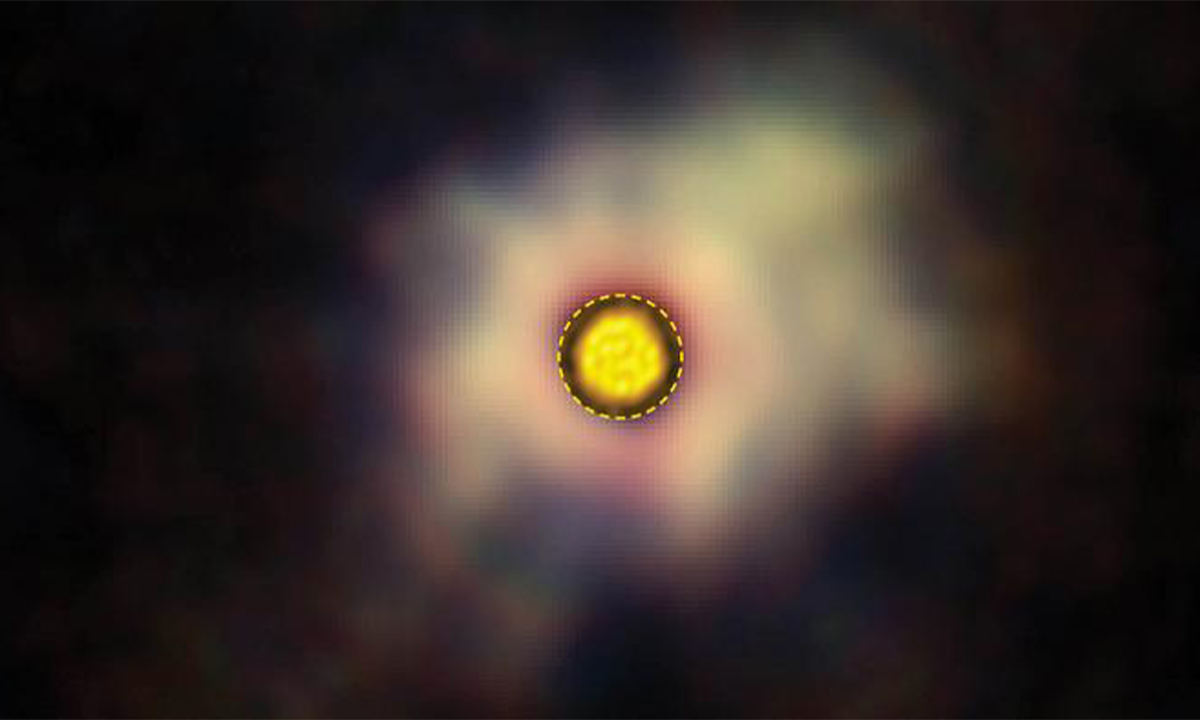
Observing the star R Doradus with instruments equipped on the Very Large Telescope in Chile, astronomers analyzed polarized light of different wavelengths reflecting off dust grains surrounding the red giant. Incredibly, this allowed them to determine both the chemical makeup and size of the tiny grains from over 180 light-years away. Using advanced computer models, they came to a surprising conclusion: The dust particles were too small to escape the star with stellar radiation alone. They published their findings in Astronomy & Astrophysics.
Read more: “How to Build a Planet from Dust”
“Dust is definitely present, and it is illuminated by the star,” study co-author Thiébaut Schirmer explained in a statement. “But it simply doesn’t provide enough force to explain what we see.”
The stellar wind hypothesis was the easiest explanation for the spread of these particles, but oftentimes, Occam’s razor gets snagged on scientific reality. Though this latest research is sending astronomers back to the drawing board, they’re far from discouraged—if anything, they’re a little enthusiastic.
“Even though the simplest explanation doesn’t work, there are exciting alternatives to explore,” study co-author Wouter Vlemmings added. “Giant convective bubbles, stellar pulsations, or dramatic episodes of dust formation could all help explain how these winds are launched.”
When it comes to the scientific method, sometimes bad news is the best news. 
Enjoying Nautilus? Subscribe to our free newsletter.
Lead image: ESO/T. Schirmer/T. Khouri; ALMA (ESO/NAOJ/NRAO)