A race against the clock to coordinate an intergovernmental effort to reposition imaging hardware atop a mountain in Chile’s Atacama Desert sounds like something out of a spy thriller. But the reason for the rush was even more dramatic—the explosive death of a massive star and a rapidly closing window to observe it.
On April 10, 2024, astronomers detected supernova SN 2024ggi a mere 22 light-years away, and Yi Yang, an assistant professor at Tsinghua University in China, quickly contacted the European Southern Observatory for permission to use their Very Large Telescope in Chile to capture it. SN 2024ggi offered a rare opportunity to study a massive star explosion; if Yang had waited, the opportunity would have been lost. Luckily he was just in time.
The shape of the initial supernova explosions of massive stars, in this case a red supergiant 12 to 15 times more massive than our sun, has been a subject of debate. As a star gains more mass over its life, it develops layers of mass shells around its core consisting of heavier and heavier elements undergoing fusion. When the star exhausts its fuel, the mass shells collapse around the core, bounce off, and send shockwaves erupting outward. It’s this initial “breakout phase” that Yang was eager to capture.
Read more: “The Eccentric Seer of Supernovas”
“The geometry of a supernova explosion provides fundamental information on stellar evolution and the physical processes leading to these cosmic fireworks,” Yang said in a statement.
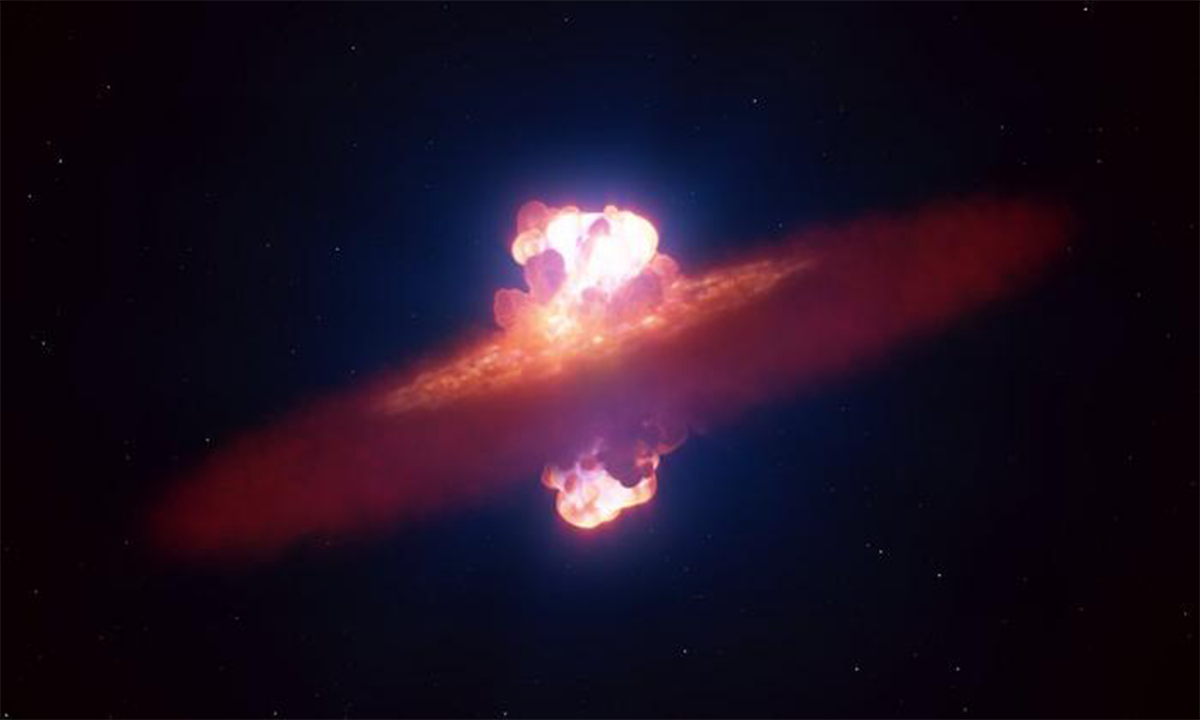
Astronomers have attempted to model the supernovas resulting from the death of massive stars, but hadn’t been able to directly observe one until now. In a study published in Science Advances, Yang and his team explained their findings. Using a technique called spectropolarimetry, they determined the shape of SN 2024ggi’s explosion based on clues in the polarization of the light it emitted. The team found that the initial explosion was oval-shaped, like an olive, that flattened as it progressed, spreading outward into space while maintaining its axis of symmetry.
It’s a dramatic finding that promises to rewrite our understanding of stellar evolution. According to co-author Ferdinando Patat, it’s also “a powerful reminder that curiosity, collaboration, and swift action can unlock profound insights into the physics shaping our universe.” 
Enjoying Nautilus? Subscribe to our free newsletter.
Lead image: ESO/L. Calçada