Goblin sharks are far from nature’s cuddliest creations. With their long snouts, sharp, thorn-like teeth, and protruding jaws they’re downright ugly. These living fossils have been lurking in the depths for around 120 million years, but unfortunately, most of our knowledge about them comes from accidental catches by fishing trawlers.
Living goblin sharks have been observed, but only briefly. These specimens were brought to the surface and watched in shallow waters for short periods of time until they perished. While these unlucky goblin sharks yielded valuable information about how they capture prey in their gnarly jaws, researchers haven’t been able to see them in their native habitat, thousands of feet beneath the ocean—until now.
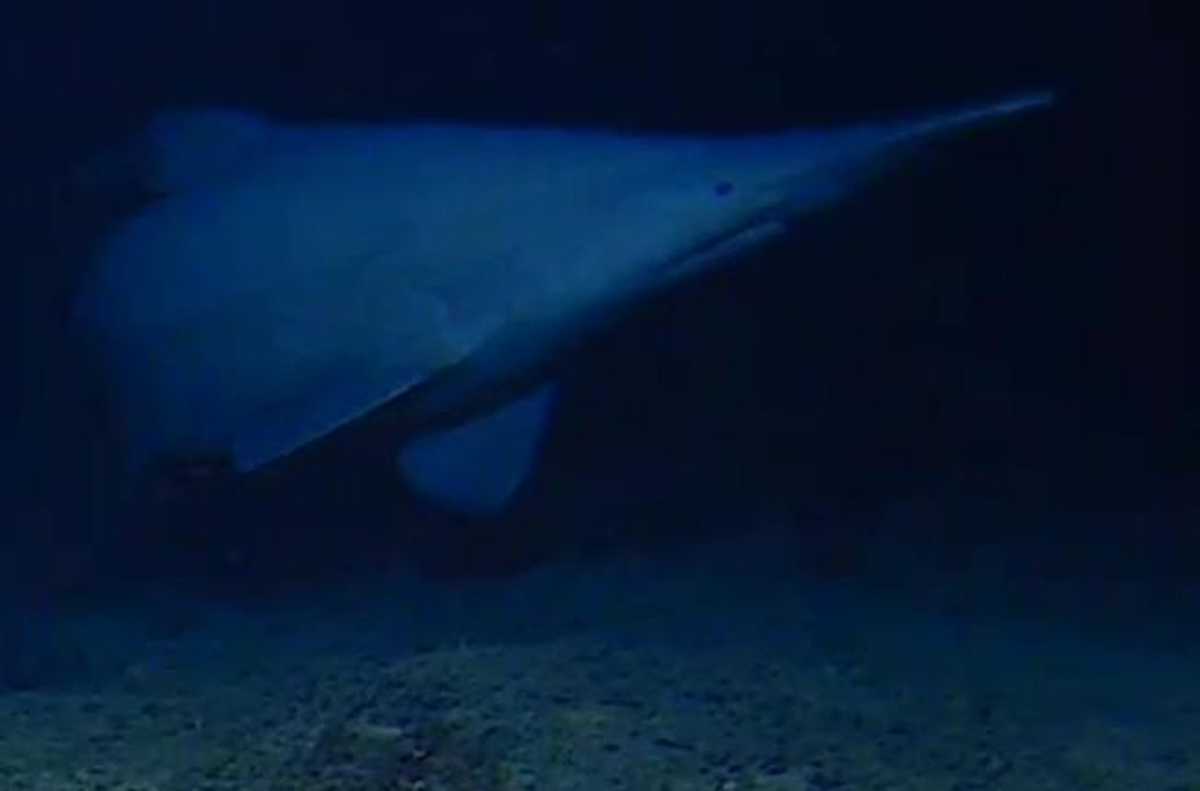
Goblin sharks were recently caught on camera in their natural environment for the first time, and the observations were detailed in a new paper published in the Journal of Fish Biology. “Seeing the most iconic of all the deep-sea sharks alive and looking healthy in its natural habitat is a unique honor,” study author Aaron Judah of the University of Hawai’i at Mānoa said in a statement.
Read more: “The Evolutionary Wonders in the Deep Sea”
The researchers caught glimpses of the enigmatic sharks in two video recordings, both captured by deep-sea submersibles exploring the depths of the Pacific Ocean between Australia and Hawaii. The first was a male recorded in 2019 near an unnamed seamount near Jarvis Island. Its location came as something of a surprise. “I was shocked to hear this because this species was not to be known to be in the Central Pacific,” said Judah.
The second shark, believed to be a female, was recorded in 2024 on the slope of the Tonga Trench, located southeast of Fiji. This observation extended the known depth range for the goblin shark by nearly 2,300 feet. In fact, it’s the deepest any species of the goblin shark’s order, lamniformes (the mackerel sharks), have been known to dive. “The goblin shark is one of these deep-sea charismatic animals that I never thought we’d see alive, and then to do so was amazing,” study author Alan Jamieson of University of Western Australia said.
Who knows what else is lurking out in the depths? 
Enjoying Nautilus? Subscribe to our free newsletter.
Lead image: Minderoo-University of Western Australia Deep-Sea Research Center and Inkfish