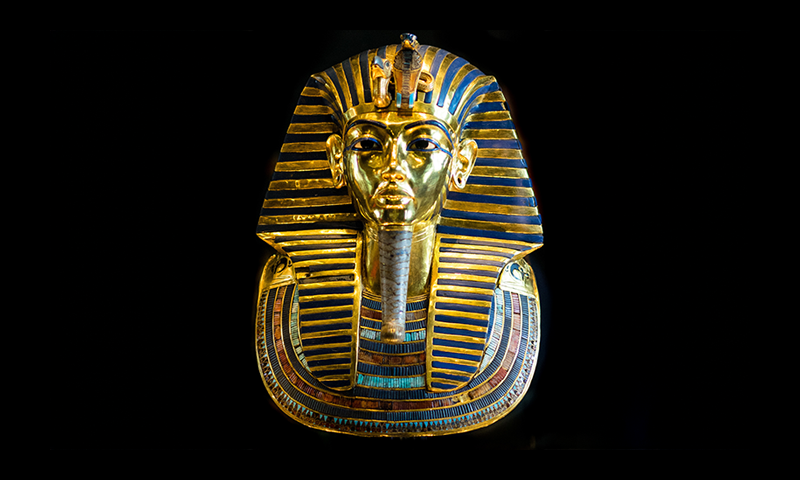
In 1922, British archaeologist Howard Carter and his team stumbled across a descending staircase amid rubble and debris near the 12th century B.C. tomb of King Ramses VI in Luxor, Egypt. On this day—Nov. 4, 1922—103 years ago, they had discovered the tomb of King Tutankhamun. Later that same month, on Nov. 26, Carter and another egyptologist named Lord Carnarvon, who bankrolled the search, would enter the surprisingly intact inner sanctum of the tomb, occupied by the teenage king’s three-millenia-old, gilded sarcophagus surrounded by priceless treasures.
Carter, with co-author Authur Cruttenden Mace, would later recall the revelation of entering the burial chamber, in a 1923 book: “At first I could see nothing, the hot air escaping from the chamber causing the candle flame to flicker, but presently, as my eyes grew accustomed to the light, details of the room within emerged slowly from the mist, strange animals, statues, and gold—everywhere the glint of gold.”
What followed was not atypical of the unfortunate way that archaeology was practiced a century ago. Some of the incalculable wealth and history ensconced in King Tut’s 14th-century B.C. tomb, which had managed to escape the grasp of graverobbers for more than 3,000 years, was summarily looted and carted off to the United Kingdom and beyond, some apparently by Carter himself.
There were long simmering suspicions that Carter helped himself to some of the ancient treasures in King Tut’s tomb, even as the find itself was still being excavated. In 1924, the Egyptian government and the archaeologist were at loggerheads concerning control of the tomb and its contents, and Carter and his team stopped working in protest until a deal was hammered out. In short, Carter agreed to transfer most artifacts to Cairo’s Egyptian Museum down the Nile from Luxor, and then got back to work near the end of that year.
But rumors of malfeasance continued to swirl for decades as artifacts presumed to have come from King Tut’s tomb showed up in museums around the world. The Metropolitan Museum of Art in New York acquired 19 objects in the 1920s and 1940s that it returned to Egypt in 2010, saying in a statement that the treasures “can be attributed with certainty to Tutankhamun's tomb.”
Read more: “An Archaeological Reckoning”
In 2022, a letter sent to Carter in 1934 from Sir Alan Gardiner, a philologist tasked with translating hieroglyphics on Carter’s team, came to light. In it, Gardiner mentioned an amulet that Carter had gifted him, saying that he had shown it to Rex Engelbach, the director of the Egyptian Museum in Cairo at the time. Engelbach told Gardiner that the amulet was “undoubtedly stolen from the tomb of Tutankhamun.” Gardiner ever-so-gently scolded Carter: “I deeply regret having been placed in so awkward a position.”
The letter strongly suggested that Carter had looted at least some of the treasures in King Tut’s tomb. Other archaeological digs of the same era were plagued by similar accusations of thievery. In 2019, Egypt unsuccessfully demanded the return of a King Tut stone statue that eventually sold for nearly $6 million at auction at Christie’s in London that year. Zahi Hawass, an Egyptian archaeologist claimed that the statue was stolen goods. “It seems that this sculpture was looted from [Luxor's] Karnak Temple,” he told ABC News before the sale of the artifact. “Christie's would not have any proof whatsoever of its ownership.” And Egyptians have been demanding the repatriation of the famed Rosetta Stone for years. That key deciphering tool, which still sits in the British Museum, was claimed by the United Kingdom in 1801, when Napoleon Bonaparte ceded his claim to it after French soldiers removed it from its discovery location near the town of Rashid, Egypt, a few years earlier.
And this is just Egypt. There are countless other examples across the globe of a culture’s rich material heritage being extracted and exported by colonial entities.
But at least for King Tut, most of his riches are home. Earlier this month, the $1 billion, 120-acre Grand Egyptian Museum in Giza opened its main galleries, where visitors can see more than 5,000 artifacts from the tomb on display. These include his famous golden burial mask and his gilded chariot.
We may be far removed from archaeology as practiced a century ago, but there are still many artifacts that have yet to make their way back to their rightful places. It is certainly a more regular practice for archaeologists and anthropologists to consult with Indigenous communities and to take other care as to the treatment of artifacts or remains they unearth. Hopefully, the continued efforts to repatriate artifacts to cultures where they belong and the spread of more sensitive and collaborative approaches to tell the ancient stories of humanity will help us relegate the bad old days of archaeology to the distant past. 
Enjoying Nautilus? Subscribe to our free newsletter.
Lead image: Credit: Mark Fischer / Wikimedia