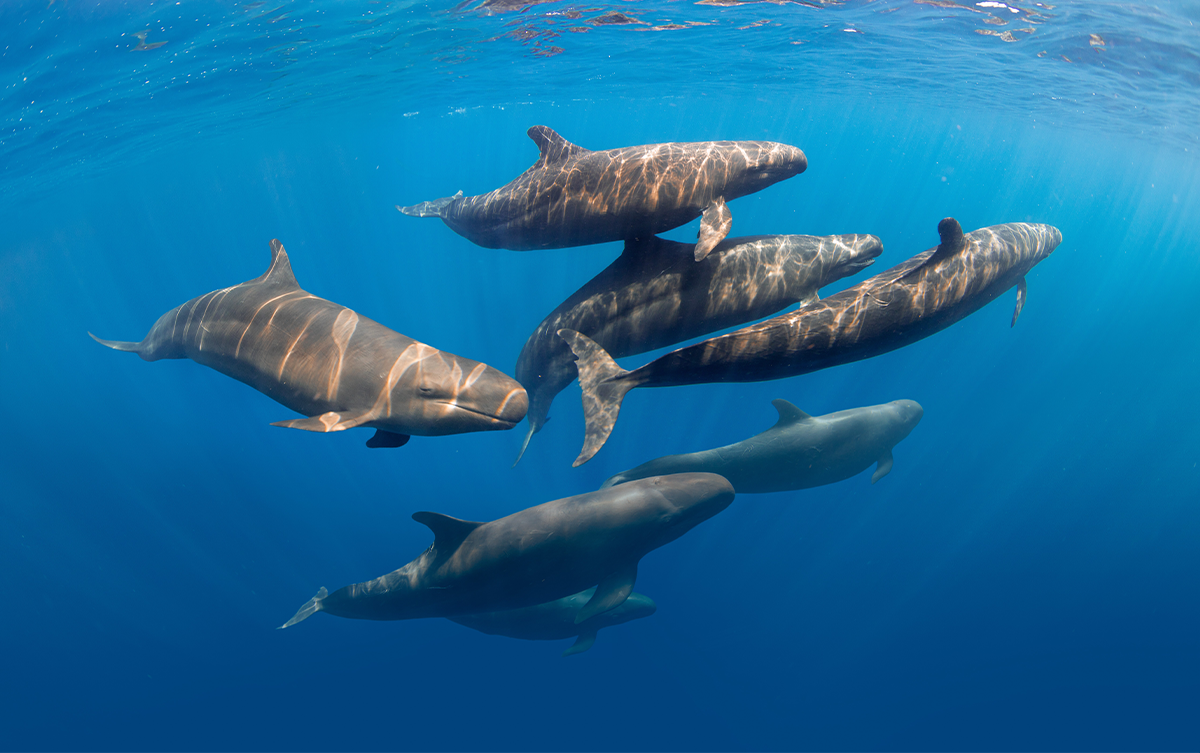
False killer whales, so named for their broad, rounded heads, have a one-of-a-kind feeding collaboration. In their “carousel” hunting mode, a dozen or more of them herd schools of fish into a ball and take turns striking them with their tail flukes.
But a recent paper in Endangered Species Research reports that something is amiss with food intake in the false killer whale population of Hawaii, which has been declining for more than a decade and now totals fewer than 140 individuals.
Marine mammal researchers used photos taken by drones from 2019 to 2025 to model the body size and weight of 64 false killer whales, deriving a “Body Condition Index” for each individual. Using photogrammetry, images of whales from above were converted to 3-D renditions that, when checked against scans of captive whales, were accurate to within 3 percent.
Read more: “An A to Z of Hungry Killer Whales”
The data showed a discouraging trend: a decline in whale body condition. In the more extreme cases, false killer whales (Pseudorca crassidens) had lost almost a quarter of their body weight, or about 400 pounds, in just a few months. “Our findings suggest that many individuals are living on a thin metabolic margin,” explained study author Jens Currie, doctoral student at the University of Hawaii, in a press release.
Currie and his colleagues hypothesize that a combination of factors is causing the calorie deficits. The population’s average Body Condition Index hit an all-time low in 2020, following a marine heat wave that raised sea surface temperatures by a record amount. The resultant coral bleaching may have knocked down the availability of fish that false killer whales depend on.
Even in a normal year, false killer whales increasingly compete with commercial fisheries for large fish that offer more nutrition per capture. “We are now examining how competition with fisheries for high-energy prey like ‘ahi (yellowfin tuna) and mahimahi may be forcing these whales into a state of chronic nutritional stress,” added Currie.
Better understanding whether prey limitations are contributing to the degradation of adult body condition may help set this population on a path to recovery—and preserve an important part of Hawaii’s ecology. “Losing our native population of false killer whales removes even more knowledge from our islands and our history,” lamented Kaʻapuni Aiwohi, cultural advisor at the Pacific Whale Foundation. “We cannot afford to lose any more pieces of Hawaii.” 
Enjoying Nautilus? Subscribe to our free newsletter.
Lead image: Vincent Kneefel / Ocean Image Bank