Typically, large organisms eat lots of food—whether it’s an elephant devouring 300 pounds of vegetation; a blue whale chowing down on 800 pounds of krill; or a growing teenage boy housing everything in the refrigerator. On the flip side, a new paper in Cell shows how supergiant deep-sea animals can survive for as long as five years without eating a thing.
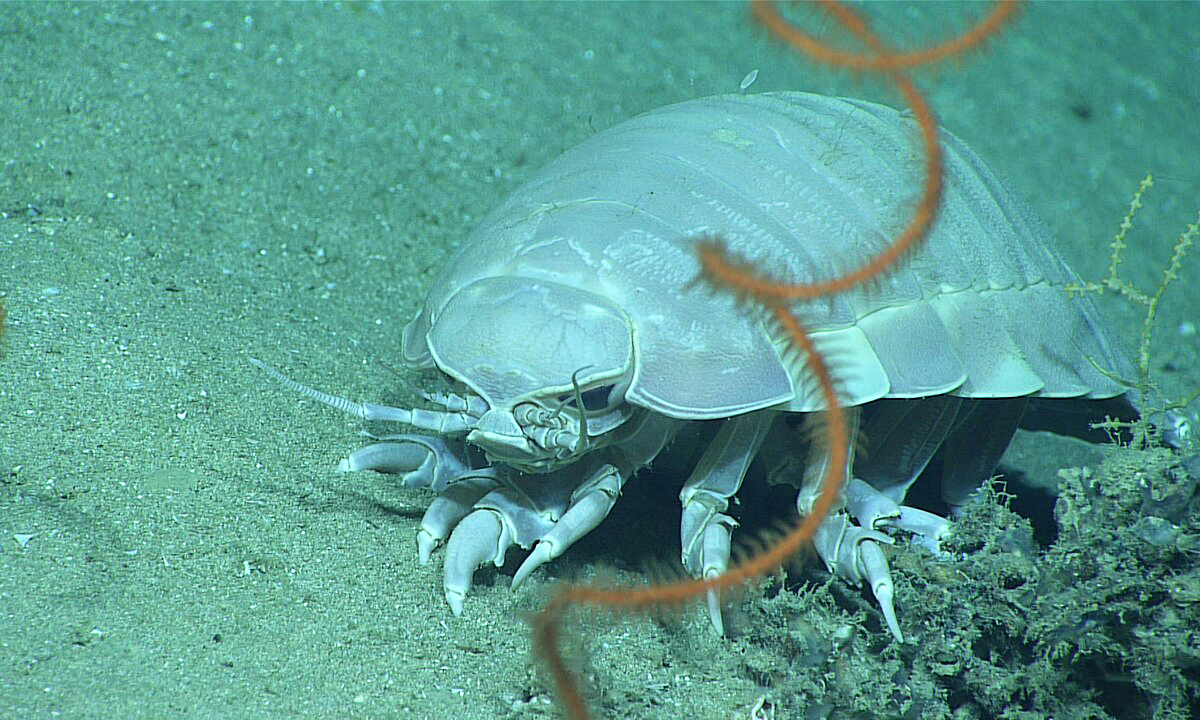
Deep-sea supergiant isopods (Bathynomus spp.) grow up to almost 20 inches long, which may seem small compared to ocean mammals, but it’s gigantic for an isopod. With a typical length of about 1.5 inches, isopods include the pill bugs you see on land under logs. But for these marine species, the rigors of deep-sea life inspire larger body sizes. And so, the deeper you go, the larger they get—even if it means, ironically, that they eat less.
“Our work not only deciphers the mystery of ultra-long starvation tolerance in deep-sea isopods,” said first author Jianbo Yuan, a marine invertebrate biologist at the Chinese Academy of Sciences, “but also provides an important paradigm for understanding how life balances growth and survival in extreme environments.”
Read more: “What Megalodons Tell Us About Gigantism”
Yuan and his collaborators examined two supergiant isopods: B. doederleini from about 990 feet deep and B. jamesi from about 3,000 feet deep. The average length of the deeper-dwelling B. jamesi was more than twice that of B. doederleini, and the ratio of stomach volume to body weight increased sharply with depth as well.
They sequenced both species’ genomes to look for evidence of metabolic adaptations to deep-sea life. The supergiant isopods demonstrated “profoundly depressed” metabolisms compared to their shallow-water relatives. In both cases, gene groups related to food digestion and metabolism were expanded relative to the norm, suggesting changes in food processing. The deeper-water B. jamesi especially stood out in its low-metabolism metrics coupled with higher molecular energy storage capacity.
The study authors concluded that the deeper the isopod, the more sporadic the food supply, and the more energy they must keep on reserve. Thus, they eat a lot when food is available and then hold onto food reserves under radically reduced metabolisms.
Sequencing the stomach and intestinal contents of both species revealed an intestinal microbiome that helps them maintain the metabolism necessary for deep-sea life. Chlamydiae bacteria, which promote fat storage, were particularly abundant in the deeper-water species. The gene ND1, implicated in suppressing energy metabolism in cold conditions, was found to have been transferred from bacteria into the isopod genome.
Essentially, these organisms use their extra-large stomachs to gobble up a bunch of food and extract calories from it over time in a slow metabolic burn, what the study authors deemed “increasing revenue and reducing expenditure.”
It’s a remarkable way to go five years between meals. 
Enjoying Nautilus? Subscribe to our free newsletter.
Lead image: NOAA