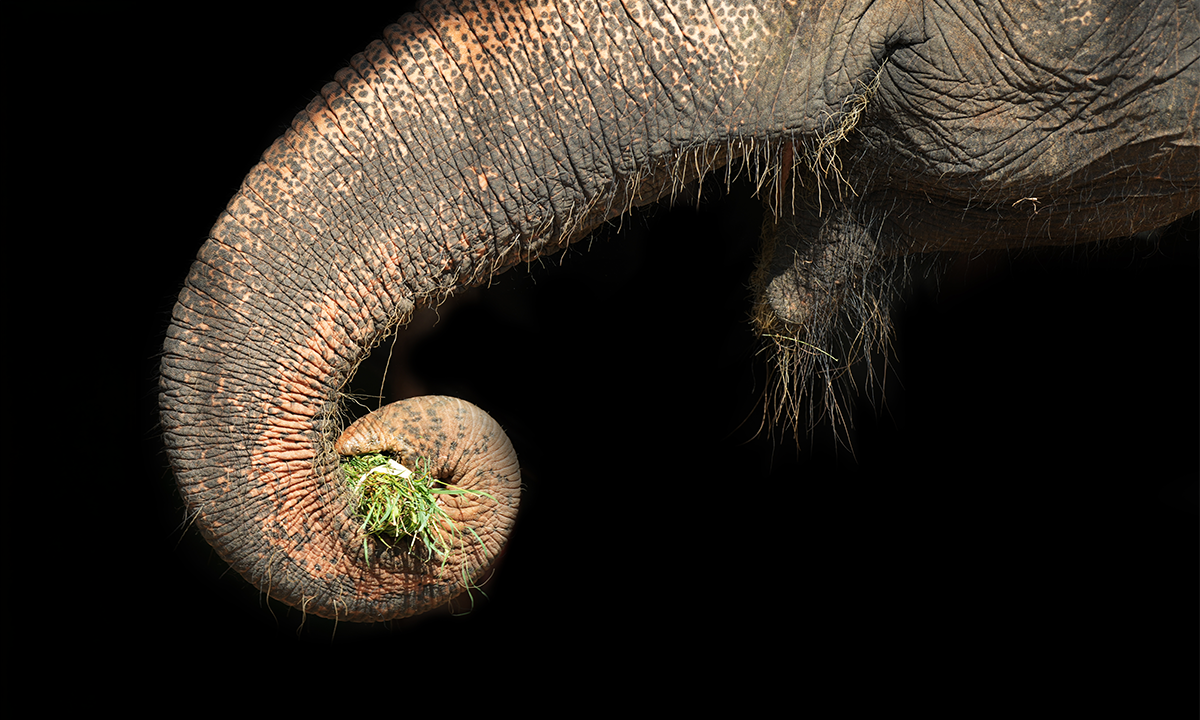
Have you ever wondered how an elephant can pick up something as delicate as a peanut with its massive, thick-skinned trunk? It seems a bit like trying to scoop up a single pebble with a snow shovel. Yet, elephants manage to “go from lugging logs to delicately grasping a tortilla chip” with their trunks. For proof, check out these videos from a 2017 Science study that characterized the grip forces of elephant trunk tips.
Now, a team of brain scientists, roboticists, and haptic intelligence researchers from Germany built on their findings through research on the function of elephant whiskers. A paper published late last week in Science reports that the whiskers of Asian elephants (Elephus maximus) are highly adapted for the task of tactile sensing. “They are geometrically and mechanically tailored to facilitate tactile perception by encoding contact location in the amplitude and frequency of the vibrotactile signal felt at the whisker base,” explained the study authors.
Unlike many mammals whose whiskers cluster around their cheeks or chins, elephants’ whiskers, totaling about 1,000, are distributed down the entire length of their trunks. By measuring the structure of trunk whiskers—from their shape to their stiffness, porosity, and internal makeup—the researchers learned about their function.
Read more: “Elephants Are Total Scaredy-Cats Around Bees”
Some mammals, like cats and rats, can move their whiskers using local muscles, but elephant trunk whiskers are fixed in place and can’t regrow if they fall out. However, like cat whiskers, elephant whiskers have stiff bases that transition to soft, rubbery tips. The whiskers also transition from porous roots to denser tip material. The researchers hypothesize that this configuration magnifies transmission of mechanical vibrations from the whisker tips to the sensory neurons at their bases.
Although elephant whiskers cannot move independently, as they brush against things, they amplify touch signals, helping the elephant sense its surroundings. Elephant eyesight is notoriously poor, so the whiskers offer a form of physical intelligence by providing intricate, real-time information about whatever the trunk encounters. Higher concentrations of whiskers, of 19 to 32 per square inch, confer extra sensitivity at the tip of the trunk, according to the study.
All of which is to say, whiskers literally extend the sensory capabilities of elephant trunks, giving them the ability to gingerly pluck that peanut off the ground. 
Enjoying Nautilus? Subscribe to our free newsletter.
Lead image: Sanit Fuangnakhon / Shutterstock