Sperm whales earned their name during the 18th century when whalers noticed milky white fluids inside the whales’ heads. Although it’s not sperm, the fluid—which occupies up to a third of a whale’s head space—plays a crucial role in sperm whale life by regulating buoyancy. As a whale dives down, the waxy oil cools and becomes denser, acting as a natural weight belt. As the whale surfaces, the waxy oil warms, expands, and gives it a lift. The volume of air in their lungs also expands as they surface, adding to the lift.
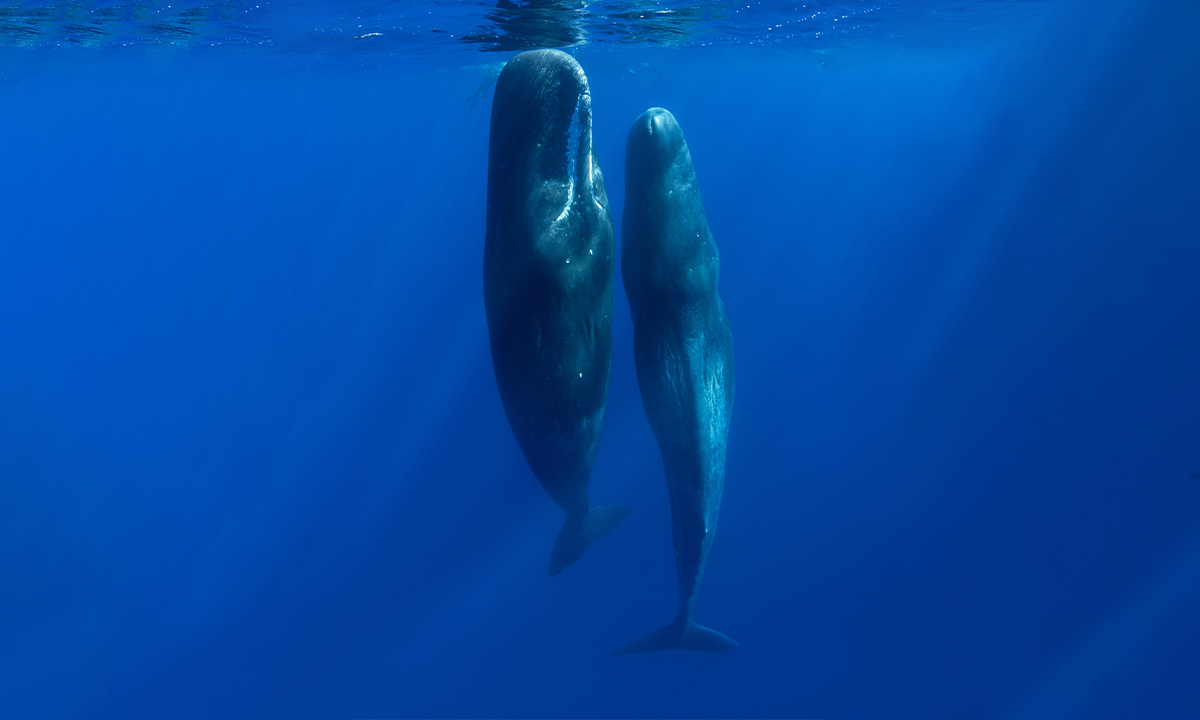
So, at the ocean surface, sperm whales (Physeter macrocephalus) are positively buoyant. Yet, somehow, they rest in a sleep-like state about 80 feet below the surface, just far enough down to avoid choppy waters.
A new study published yesterday in the Journal of Experimental Biology attempted to figure out exactly how they do this—overcoming their surface buoyancy to nap suspended below the waves.
Based on recordings of napping whales they garnered in earlier studies, researchers from the Université de Neuchâtel in Switzerland and the University of St Andrews in the United Kingdom hypothesized that sperm whales achieve neutral buoyancy by blowing bubbles in their sleep. “To test this hypothesis and examine how buoyancy influences resting sperm whales, we created a simulation based on tissue density, drag coefficient, and onboard gas volume,” explained the study authors.
Read more: “How Sperm Whale Sounds Are Like Team Uniforms”
To match the simulation results with real depth profiles, the researchers used novel recording devices, Dtags, that picked up sounds from whale blowholes as well as data on depth and body position. Dtags were stuck onto whales off the northern coast of Norway over eight summers and remained there until they naturally popped off and floated to the surface.
The 17 sperm whales that underwent the sleep test napped anywhere from seven minutes to more than three hours. They rested in a trio of ways: head-up (most common, in about 60 percent of naps); head-down then adjusting to head-up; and deep drifting. Regardless of the resting method, though, the whales released bubbles during more than 90 percent of their naps, confirming that by releasing gas, they can regulate their buoyancy enough to remain submerged.
Furthermore, whales resting near the surface blew more bubbles than those who started their naps deeper in the water, which is what you’d expect from buoyancy adjustments.
“Our study demonstrates active buoyancy regulation in resting sperm whales, achieved through bubble release and a reduction of surface-borne gas volumes throughout resting dives,” concluded the study authors.
Basically, their bubble-blowing is the exact thing that ensures that they don’t bubble up to the surface when they get some much needed shut-eye. 
Enjoying Nautilus? Subscribe to our free newsletter.
Lead image: ohrim / Adobe Stock