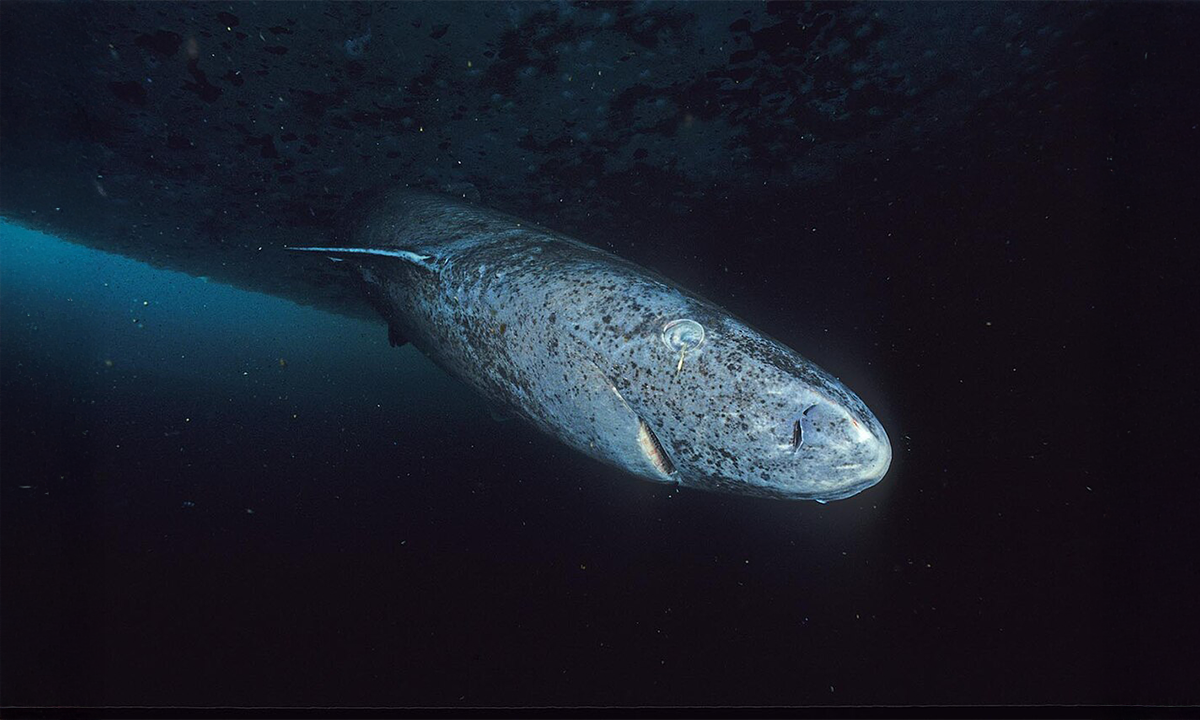
In the frigid, dark depths of the Arctic and North Atlantic Oceans, you may find huge, lethargic sharks born up to four centuries ago.
That makes the Greenland shark the world’s longest-living vertebrate. It has a round, stout snout and cloudy eyes. Researchers have long thought that the Greenland shark lost its eyesight over the course of evolution due to its lengthy lifespan and dim environment up to 10,000 feet deep in the ocean. For example, cave fishes have adapted to pitch-black cave environments and lost their eyes over time. Greenland sharks also often have parasites stuck to their corneas, which may block their sight.
But now, scientists say these sharks seem to maintain surprisingly sharp eyesight over their centuries-long lives, a finding that could pave the way for vision loss treatments in humans.
Dorota Skowronska-Krawczyk, a physiologist at the University of California, Irvine, wanted to take a closer look at the vision of Greenland sharks after watching lots of clips of these animals orienting their eyeballs toward light. “Evolutionarily speaking, you don’t keep the organ that you don’t need,” Skowronska-Krawczyk explained in a statement.
Skowronska-Krawczyk and her colleagues, who are based in Europe and the United States, studied baseball-sized eyeballs taken from Greenland sharks up to around 130 years old and compared them with eyes from bovines and human remains. They also examined the Greenland shark’s entire genome and compared it to related species to trace evolutionary shifts among relevant genes.
Read more: “Blindness Is a Strange Country”
This work revealed that “the Greenland shark retains an intact visual system well-adapted for life in dim light,” according to a paper published in Nature Communications.
The team noticed the types of cells required for vision were present in the sharks’ eyes, and couldn’t find clear evidence of degeneration of the retina. They also observed that parasites on the cornea didn’t hinder light from reaching the shark’s retina. Gene expression and features in the eyes, such as thin inner layers of the retina, pointed to adaptations for dim-light vision.
The most eye-opening discovery: They noticed “robust expression” of genes linked to DNA repair in the retina, “which may help support long-term maintenance of retinal integrity over the Greenland shark’s extreme lifespan.”
Understanding precisely how these sharks maintain such impressive visual integrity over centuries could help scientists find new ways to curb age-related vision loss in people, along with eye diseases including glaucoma and macular degeneration.
While this work remains in the early stages, the researchers will be keeping an eye on it for years to come. 
Enjoying Nautilus? Subscribe to our free newsletter.
Lead image: Hemming1952 / Wikimedia Commons