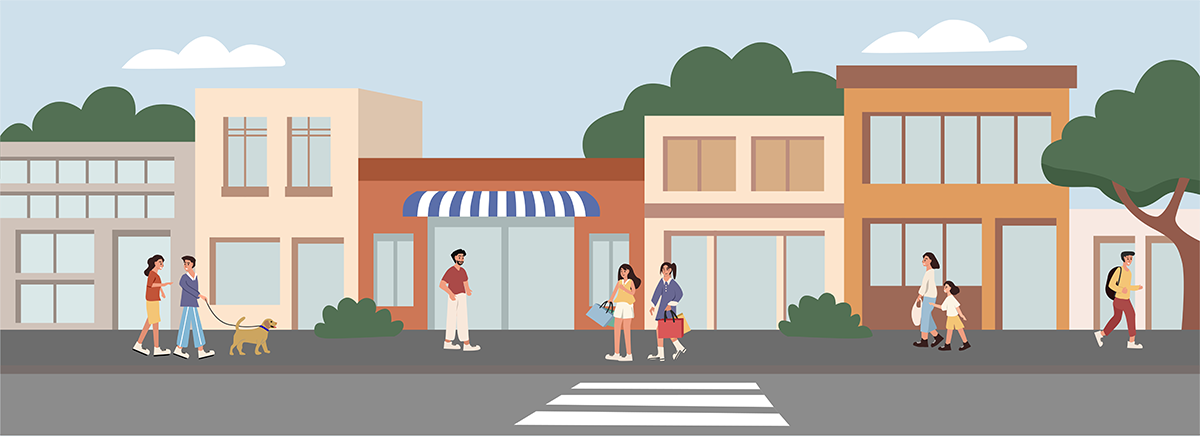
It’s easy to feel like aging is out of your control. While there are plenty of things you can do to maintain your health as long as possible, like eating a healthy diet, exercising, and maintaining social connections, there are factors that are far more difficult to control. According to research recently published in Social Science & Medicine, one of those factors might be your zip code.
To find out how our neighborhoods could affect how we age, researchers from New York University tapped two vast reservoirs of existing data: the Midlife in the United States (MIDUS) study, which focuses on health, and the Childhood Opportunity Index 3, which measures local opportunity. By cross-referencing health data from 1,215 American adults in the MIDUS study with measures of education, environment, social and economic resources, and more from the Childhood Opportunity Index 3, they were able to see how different neighborhoods correlate with the level of aging markers.
The team examined four age-related molecular markers but only one—the expression of CDKN2A, a gene involved in arresting cell division—turned out to be significant. They found that those living in disadvantaged neighborhoods had higher levels of CDKN2A RNA in their blood, even after controlling for other individual socioeconomic, health, and lifestyle factors. The inverse relationship between CDKN2A RNA levels and neighborhood opportunity score was strongest among measures of social and economic opportunity.
Read more: “Why Living in a Poor Neighborhood Can Change Your Biology”
“Stressors related to income, jobs, and housing are not occasional, but persistent conditions that shape daily life,” study co-author Adolfo Cuevas explained in a statement. “Our findings suggest that chronic stress caused by economic deprivation and limited mobility may be primary drivers of cellular aging.”
Essentially, those who live in more economically precarious neighborhoods may be suffering from the effects of cellular aging more than others in affluent zip codes. It’s a striking finding, and one the researchers hope will help reframe neighborhood revitalization as a public health concern.
“Improving neighborhood conditions, particularly social and economic resources, may be important for promoting healthy aging and reducing health disparities, but if we really want to address health disparities and improve health for everyone, it’s important to consider what needs to be changed at the structural level,” study co-author Mariana Rodrigues said.
It might take a village to raise a child, but adults need that village, too. 
Enjoying Nautilus? Subscribe to our free newsletter.
Lead image: Hayclaw Here / Adobe Stock