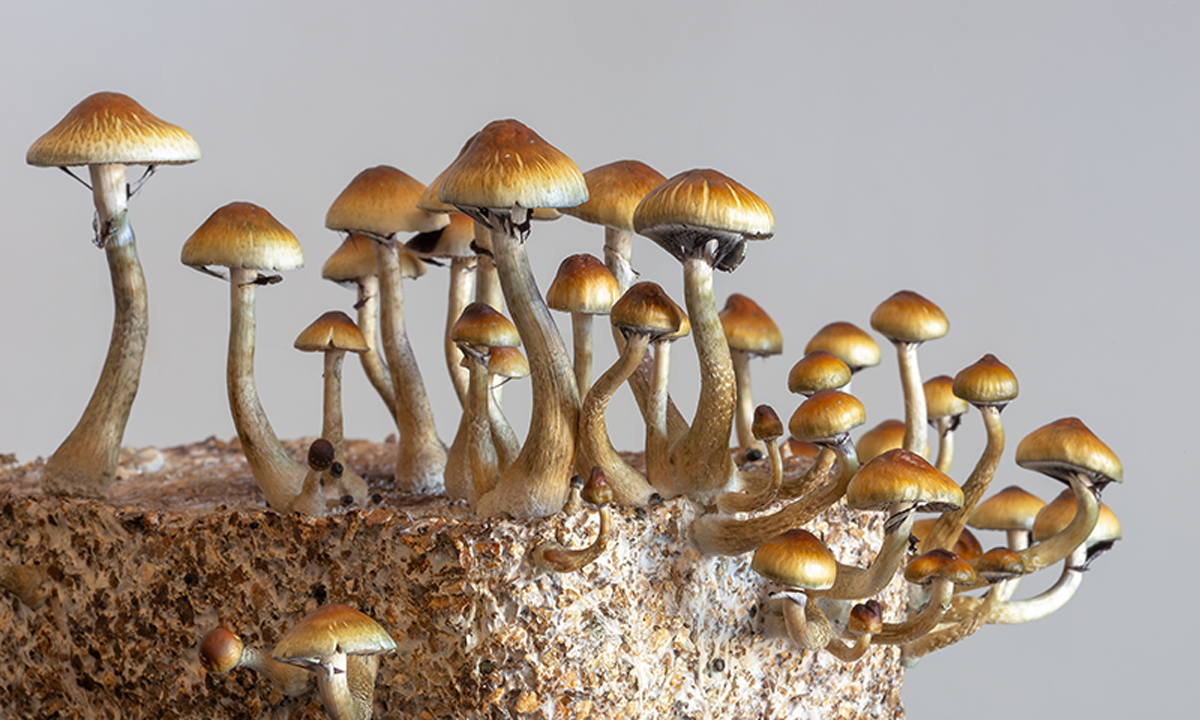
Psilocybin—the psychedelic ingredient found in some “magic” mushrooms—has shown a lot of promise for treating depression and anxiety in clinical trials. That’s particularly true over the longer-term. Even one to two doses has been reported to relieve symptoms in some people for several weeks up to as long as six to 12 months.
But the hallucinations that come along for the ride can sometimes spell trouble for people with other psychiatric illnesses—triggering psychosis in those who have schizophrenia, or in those with a family history of psychosis. The costs of providing caretakers to help safely guide people through these mind-bending trips can also make the drug too expensive for many.
Now, some researchers are asking whether they can create a drug with similar benefits but with a little bit less magic: providing the mood-boosting effects but doing away with the hallucinations. The researchers, from Dartmouth, recently identified a neural receptor that could be a potential target for such a drug, reporting their findings in Molecular Psychiatry.
“When people think about psilocybin, they think about acute effects like hallucinations, which are attributed to the activation of a specific neuroreceptor,” explained Sixtine Fleury, the study’s first author and a psychology and brain sciences researcher at Dartmouth, in a statement. “We thought that the beneficial effects reported for treating depression and anxiety may be found in other receptors.”
Read more: “The Psychedelic Scientist”
The long-lasting antidepressant effects of psilocybin are often credited to a single receptor in the brain: 5-HT2A, which also happens to be the one most closely tied to hallucination. But psilocybin’s “active” form psilocin—the part of the compound that actually binds to receptors in the brain after it’s ingested—attaches to many binding sites in the brain’s serotonin system, a neurotransmitter pathway that helps to regulate mood, sleep, appetite, and social behavior, among other things.
“Our study shows that there likely is another target,” explained study author Katherine Nautiyal, an associate professor of psychological and brain sciences at Dartmouth. “Researchers have narrowly focused on the 2A receptor because we know it causes hallucinations, but the screening profiles of psilocybin show that these drugs bind to nearly all of the serotonin receptors.”
The scientists wondered if a receptor known as 5-HT1B, which has already been implicated in reward processing, anxiety, and plasticity, all relevant to depression, might play a role in generating the positive and long-lasting mood effects of psilocybin. To check out this hypothesis, they ran a set of experiments in mice, which have a serotonin system similar to that of humans. They wanted to see if psilocybin worked differently when the 5-HT1B receptor was blocked so they tested it in three different ways before administering the drug.
First, they removed or blocked the 5HT1B receptor, using genetic engineering to create mice that lacked it. Next, they allowed mice to develop with normal 5HT1B receptors, but blocked these receptors when the mice were adults. Finally, they gave the mice drug blockers that muted the receptor right before they gave them the psilocybin. Then they injected psilocybin into the three different sets of mice and watched what happened in their brains using imaging and network analysis. They also measured behavior in the mice, both immediately after the injection and days later, such as how they navigated a maze or an open area, or how long it took them to start eating in a bright, stressful area.
What they found is that the 5-HT1B receptor really mattered for the longer-lasting, mood-relevant effects of psilocybin in mice. But activating 5HT1B alone didn’t recreate psilocybin’s full effects. In one of the stress tests, the benefits were mostly found in females, but another showed effects in both sexes—a reminder that there’s no one-size fits all response for psilocybin effects, even in mice. Still, the findings are a promising starting point.
“These substances have the potential to open new avenues for clinical therapy and therapeutic drugs,” Fleury said. “It’s important to find better treatments that are more efficient and more effective for people, but it’s also important that we have a safe way to do that.”
Their hope is that taking a psychedelic trip can heal the brain without the psyche leaving the comfortable grounding of Earth. 
Lead image: Fotema / Shutterstock