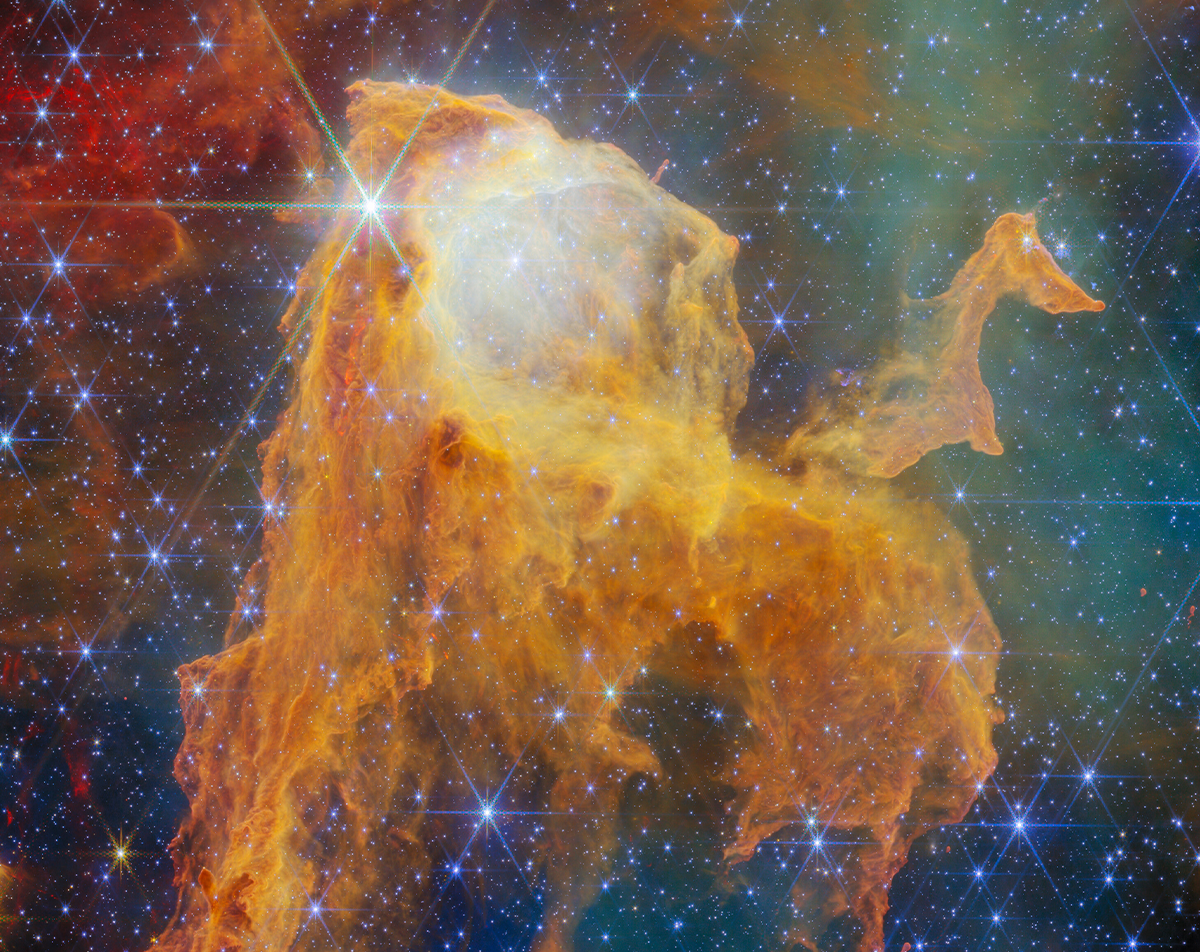
Attention space pirates: The latest jaw-dropping image from the James Webb Space Telescope—deservedly given Picture of the Month status from NASA, the Canadian Space Agency, and the European Space Agency—features a cosmic “treasure chest” right in its center.
That’s the nickname given to the picture by its publishers, and you can see why: The visual is dominated by a glowing, orange trunk, which is called a cometary globule. These gigantic clouds of gas and dust often take the shape of comets, with denser and darker heads leaving fainter trails behind them. However, they’ve got nothing to do with comets—they just have a similar appearance.
In this case, the head of the “comet” looks like the lid of an opened box. Scientists aren’t exactly sure how cometary globules are created in every scenario, but their origination typically requires the energy and radiation of young stars being formed inside of them. You can see it here as bright dots inside the treasure chest.
Around 70 stars are thought to be inside of the chest, with the largest being a rare O-type star about 19 times as massive as the sun. These stars are super-big, super-hot, and super-bright—and of great interest to researchers. Astronomers believe the star cluster is around 1.3 million years old, meaning the stars are still finding their way through the clouds of dust that surround them.
It’s all part of the Carina Nebula, which, in turn, is part of the constellation Carina, around 7,500 light-years away from Earth. It’s a particularly large and complex nebula, first discovered in 1752, and it’s one of five cosmic objects currently under observation by the James Webb Space Telescope.
Read more: “A Look Back at Hubble’s Most Breathtaking Images”
The treasure chest shape, though, is actually partly the result of something beyond the frame: the radiation and stellar winds being pumped out by the Eta Carinae star system, 39 light-years to the northwest, and another nearby system called Trumpler 16. They both contain incredibly big and bright stars—one in Eta Carinae is 100 times more massive and 5 million times more luminous than the sun—and they’re actively stripping away the lighter, less dense dust and gas from this region of space.
It’s likely that the chest began as a much bigger celestial area, driven by the star treasure inside, before being stripped down by external forces and chiseled into this particularly stunning shape. 
Enjoying Nautilus? Subscribe to our free newsletter.
Lead image: ESA/Webb, NASA & CSA, M. Reiter