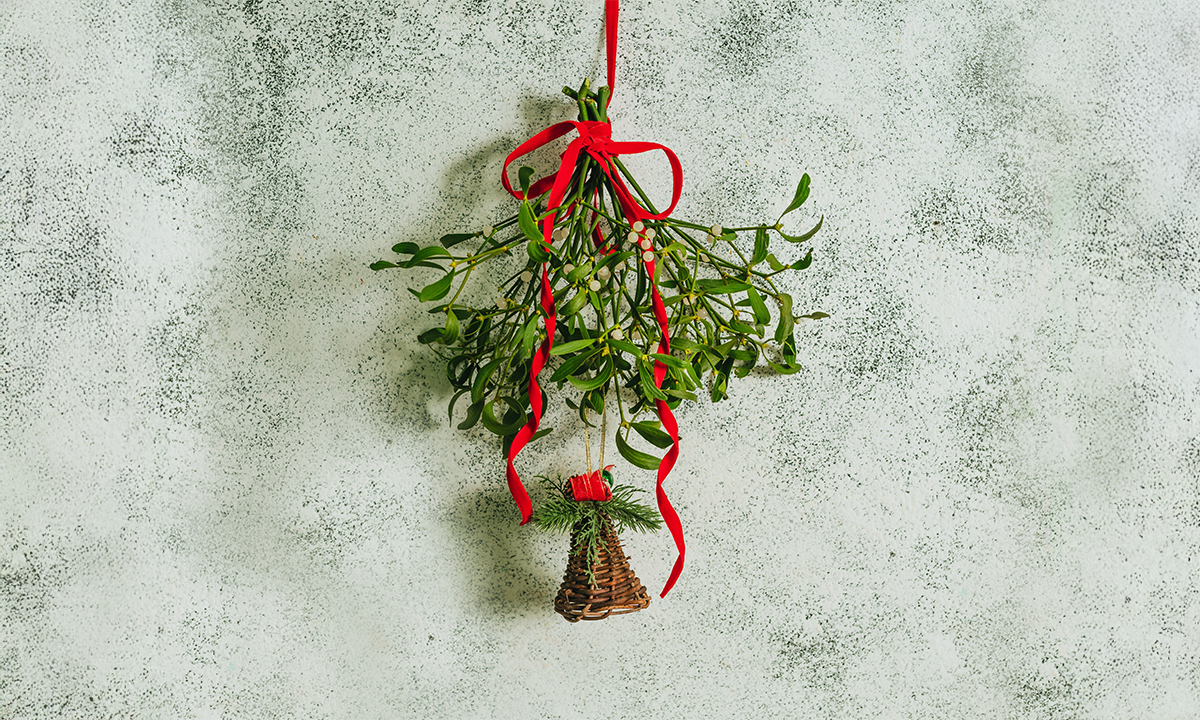
For reasons that aren’t entirely clear, people started kissing under mistletoe in 18th century England. Perhaps because mistletoe stays evergreen throughout the year, flourishing while trees are dormant, it was considered a symbol of fertility long before the smooching tradition began.
But paradoxically, mistletoe, comprising more than 100 species in the family Viscaceae, is a parasitic plant that’s thought to kill host trees and produce poisonous berries. The sticky coating on its seeds allows it to adhere to branches, from where it taps food and water from the bark. However, a study accepted for publication in Northwest Science reports that mistletoe in Oregon didn’t have negative health effects on oak trees.
Researchers from Oregon State University and the Oregon Department of Forestry used the urban forests in western Oregon cities as a natural laboratory to investigate the effects of western oak mistletoe (Phoradendron villosum) on non-native oaks. They collected data from 227 trees on mistletoe abundance and tree characteristics, including height, age, and condition.
Read more: “The Ancient Wisdom Stored in Trees”
The results yielded no observable connection between mistletoe infestation and tree health. “Of the 42 trees with greater than 20 mistletoe plants in their crowns, none was in poor condition, one was moderate and 41 were in apparently good condition,” explained study author Dave Shaw, an OSU Extension Service forest health specialist in a statement.
So, at least for nonnative trees in urban settings in Oregon, mistletoe doesn’t appear to be a menace. Furthermore, “Western oak mistletoe is probably a benefit to wildlife in urban forests,” added Shaw. Its berries are toxic to humans, but favored by western birds, including bluebirds, who disperse their seeds. In their paper, the study authors cite other studies showing that mistletoe can foster higher bird diversity and abundance.
The researchers also acknowledge instances of Oregon native white oak trees suffering negative health effects from heavy, long-term mistletoe infestations, so a nuanced approach to managing mistletoe is warranted.
In the meantime, smooch on! 
Enjoying Nautilus? Subscribe to our free newsletter.
Lead image: Lithiumphoto / Shutterstock