Yesterday, in the New York Review of Books, Freeman Dyson analyzed a trio of recent books on humanity’s future in the larger cosmos. They were How to Make a Spaceship: A Band of Renegades, an Epic Space Race, and the Birth of Private Spaceflight; Beyond Earth: Our Path to a New Home in the Planets; and All These Worlds Are Yours: The Scientific Search for Alien Life.
Dyson is “a brilliant physicist and contrarian,” as the theoretical astrophysicist Lawrence Krauss recently told Nautilus. So I was waiting, as I read his review, to come across his profound and provocative pronouncement about these books, and it came soon enough: “None of them looks at space as a transforming force in the destiny of our species,” he writes. The books are limited in scope by looking at the future of space as a problem of engineering. Dyson has a grander vision. Future humans can seed remote environments with genetic instructions for countless new species. “The purpose is no longer to explore space with unmanned or manned missions, but to expand the domain of life from one small planet to the universe.”
Dyson can be just as final in his opinions on the destiny of scientific investigation. According to Krauss, Dyson once told him, “There’s no way we’re ever going to measure gravitons”—the supposed quantum particles underlying gravitational forces—“because there’s no terrestrial experiment that could ever measure a single graviton.” Dyson told Krauss that, in order to measure one, “you’d have to make the experiment so massive that it would actually collapse to form a black hole before you could make the measurement.” So, Dyson concluded, “There’s no way that we’ll know whether gravity is a quantum theory.”
But Krauss, who always seems game for a debate, begged to differ in his Ingenious interview with Nautilus. Watch that clip below, and the rest of the conversation here.
Brian Gallagher edits the Nautilus blog, Facts So Romantic. Follow him on Twitter @bsgallagher.
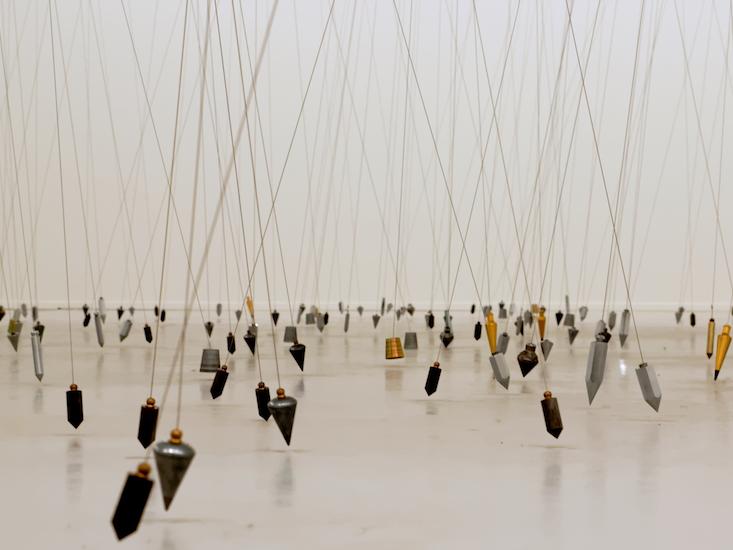
The lead photograph is courtesy of Guillaume DELEBARRE (Guigui-Lille) via Flickr.