If you’ve taken a spin around Instagram or TikTok recently, you’ve noticed early aughts fashion trends have made a resurgence. Skinny jeans are out, baggy jeans are in. So are the baby tees, chunky heels, and trucker hats that characterized Y2K style. It’s not a total surprise, fashion is cyclical, right?
Well, thanks to new research presented today at the Global Physics Summit 2026 we have the cold, hard data to back that assertion up.
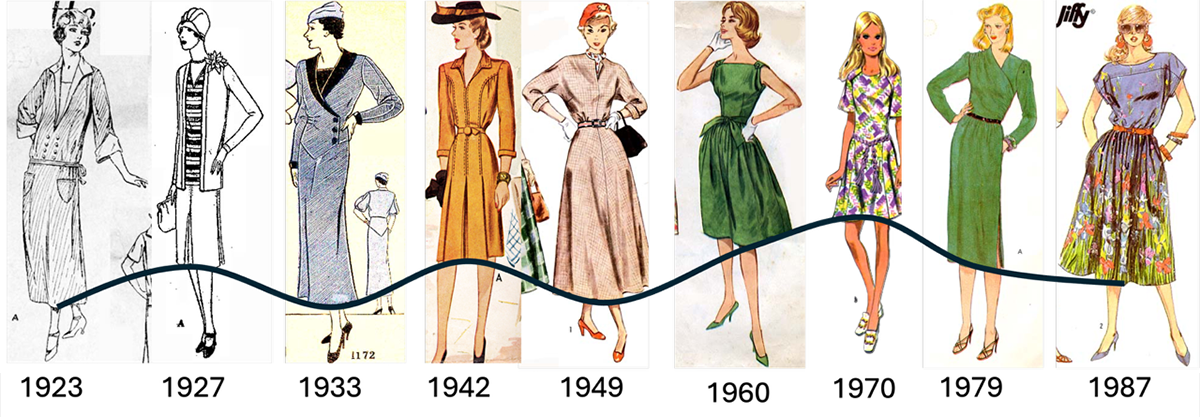
Two mathematicians at Northwestern University, Emma Zajdela and Daniel Abrams, were interested in taking a dispassionate, data-driven look at fashion trends, but first they had to do some alterations of their own. Using custom tools, the team measured the hemlines, necklines, and waistline positions of women’s dresses from the Commercial Pattern Archive at the University of Rhode Island and runway collections. They then transformed the designs—around 37,000 of them from 1869 to today—into numerical data to track how they changed over the decades.
“To our knowledge, this is the first time that someone developed such an extensive and precise database of fashion measures across more than a century,” Zajdela said in a statement.
Read more: “Dress for Evolutionary Success”
To dig into the data, the team built a mathematical model based on the tension between wanting to conform to styles and wanting to stand out. “Over time, this constant push to be different from the recent past causes styles to swing back and forth,” Abrams explained. “The system intrinsically wants to oscillate, and we see those cycles in the data.”
They found that the popularity of styles rose and fell over time, with peaks roughly every two decades. Hemlines showed one of the starkest cycles, with short flapper dresses in the 1920s giving way to more modest styles in the 1950s before the explosion of miniskirts in the 1960s.
Starting in the 1980s, however, things began to change. Instead of one dominant style, a wide range of hemline lengths cropped up in the data.
“In the past, there were two options—short dresses and long dresses,” Zajdela said. “In more recent years, there are more options: really short dresses, floor-length dresses, and midi dresses. There is an increase in variance over time and less conformity.”
In other words, fashion trends are becoming more fragmented, with several niches blossoming at once. If nothing else, it’s a great reason to put off cleaning out your closet for another 20 years. 
Enjoying Nautilus? Subscribe to our free newsletter.
Lead image: Emma Zajdela / Daniel Abrams