Scientists should respect the limits of their discipline. Photo illustration by Triff / Shutterstock
Have you heard that we may be living in a computer simulation? Or that our universe is only one of infinitely many parallel worlds in which you live every possible variation of your life? Or that the laws of nature derive from a beautiful, higher-dimensional theory that is super-symmetric and explains, supposedly, everything?
I’ve heard that too. It’s how my research area, fundamental physics, often ends up making headlines: With insights about the nature of reality so mind-boggling you can’t believe it’s still science. Unfortunately, in many cases it’s indeed not science.
Believing in an omnipotent Programmer is not science—it’s tech-bro monotheism.
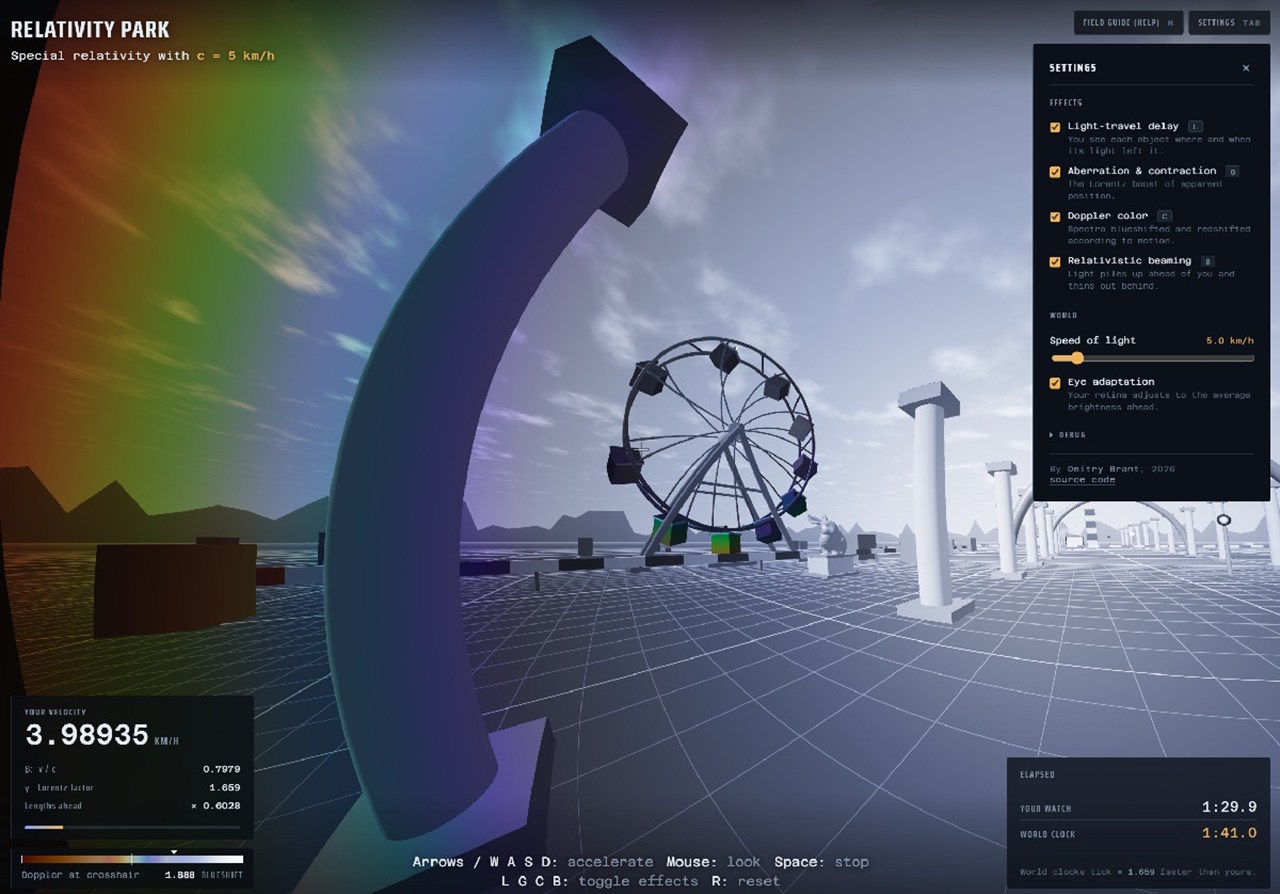
Take the idea that we live in a computer simulation. According to our best current knowledge, the universe follows rules that are encoded by a set of equations. We don’t know these equations completely (yet!), but you could rightfully say the universe computes in real time whatever are the correct equations. In that sense, we trivially “live in a computer,” but that’s just a funny way to talk about the laws of nature.
You may more specifically ask whether our universe’s computation is similar to the computation performed by computers we build ourselves, that is, pushing around units of information in discrete time-steps. This is a testable hypothesis, and to the extent that it has been tested, it has been falsified. It is not easy to obtain the already known laws of nature using discrete, local operations even approximately, and this mathematical difficulty has, so far, rendered scientifically well-posed versions of the simulation hypotheses incompatible with evidence.
And finally, if you are really asking whether our universe has been programmed by a superior intelligence, that’s just a badly concealed form of religion. Since this hypothesis is untestable inside the supposed simulation, it’s not scientific. This is not to say it is in conflict with science. You can believe it, if you want to. But believing in an omnipotent Programmer is not science—it’s tech-bro monotheism. And without that Programmer, the simulation hypothesis is just a modern-day version of the 18th century clockwork universe, a sign of our limited imagination more than anything else.
It’s a similar story with all those copies of yourself in parallel worlds. You can believe that they exist, all right. This belief is not in conflict with science and it is surely an entertaining speculation. But there is no way you can ever test whether your copies exist, therefore their existence is not a scientific hypothesis.
Most worryingly, this confusion of religion and science does not come from science journalists; it comes directly from the practitioners in my field. Many of my colleagues have become careless in separating belief from fact. They speak of existence without stopping to ask what it means for something to exist in the first place. They confuse postulates with conclusions and mathematics with reality. They don’t know what it means to explain something in scientific terms, and they no longer shy away from hypotheses that are untestable even in principle.
Particularly damaging to fundamental physics has been the belief that the equations which describe nature must be beautiful by human standards. There is no rational reason why this should be so, but faith in beautiful math has become pervasive in the community. And that’s despite the fact that relying on beauty as a guide to new natural laws has historically worked badly: The mechanical clockwork universe was once considered beautiful. So were circular planetary orbits, and an eternally unchanging universe. All of which, it turns out, is wrong.
And relying on beauty is still working badly for physicists. We see the tragedy playing out in the ongoing failure of ideas like a unification of the fundamental forces, a theory of everything, or new types of symmetries that experiments continue to not find. Such pretty hypotheses remain popular among physicists even though they haven’t led anywhere for decades. The recent Special Breakthrough Prize for Fundamental Physics drove home the point. The prize was awarded for Supergravity, a theory, invented in the 1970s, that is widely praised for its elegance and beauty. Supergravity has to date no observational support. It wins prizes nevertheless.
This blurring of the line between science and religion is not innocuous. Resources—both financial and human—that go into elucidating details of untestable ideas are not available for research that could lead to much-needed progress. I like the idea that the laws of nature are beautiful and the universe was made for a purpose as much as everybody else, and I appreciate public interest in our research anytime. But let’s not call it science when it is really not.
We have fought hard for secularism, and we don’t want religious leaders to meddle in scientific debate. Scientists, likewise, should respect the limits of their discipline.
Sabine Hossenfelder is a Research Fellow at the Frankfurt Institute for Advanced Studies where she works on physics beyond the standard model, phenomenological quantum gravity, and modifications of general relativity. If you want to know more about what is going wrong with the foundations of physics, read her book Lost in Math: How Beauty Leads Physics Astray.