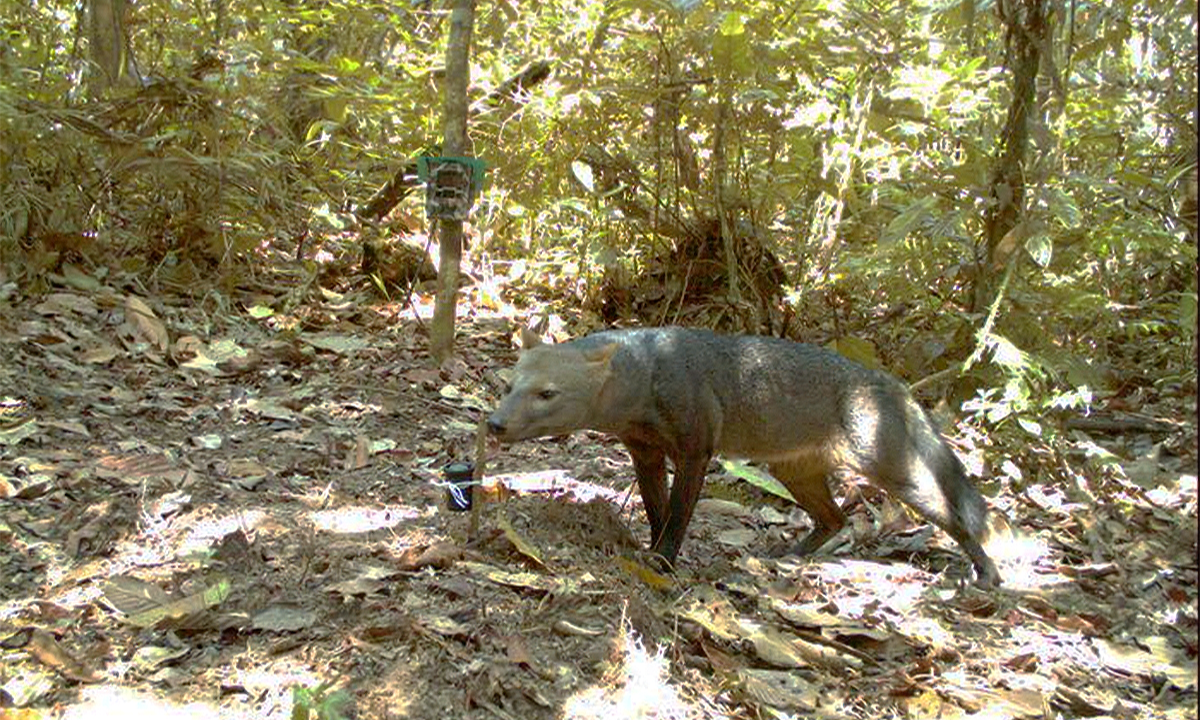
Deep in the Amazon rainforest lives a seldom-seen beast known as the short-eared “ghost dog.” There’s an air of mystery surrounding the wild dogs because it uses its keen sense of smell and hearing to avoid humans, which means information about them is scant—for example, there are only four museum specimens in existence. Now, new research published in the journal Neotropical Biology and Conservation is finally shedding some light on these cryptic canids.
True to their name, the short-eared ghost dogs (Atelocynus microtis) have small round ears, short legs, long bushy tails, and partially webbed paws (similar to other canids in the Amazon). According to previous research, they primarily feed on fish, insects, and small mammals, but have also shown a predilection for scavenging the cadavers of larger animals.
To find out more about these elusive animals, researchers from the Wildlife Conservation Society spent nearly 25 years monitoring 34 cameras and collected almost 600 observations in dense Bolivian rainforests. They discovered plenty of surprises. For starters, the ghost dogs aren’t nocturnal. Despite their cryptic nature, the short-eared canines are primarily active during the daytime and twilight hours (that is, dawn and dusk).
Read more: “Deforesting the Amazon Is Uprooting the Ancient Practices That Preserved I”
They’re also a lot more abundant than previously thought. While prior research found there was roughly one ghost dog per square mile, this latest study found more than 30 individuals per square mile. According to the researchers, they’re more abundant than large predators such as jaguars, but less prevalent than the smaller ocelots that also inhabit the region.
The newly appreciated abundance of the species is good news, but the ghost dogs aren’t out of the woods yet. In fact, the woods are what are protecting the endangered animals. Ghost dogs showed a strong preference for terra firme (upland forests away from rivers) and were commonly found in protected areas and Indigenous territories.
The researchers say the best way to ensure the ghost dogs’ continued survival is conserving their haunting grounds. 
Enjoying Nautilus? Subscribe to our free newsletter.
Lead image: G. Ayala & M.E Viscarra