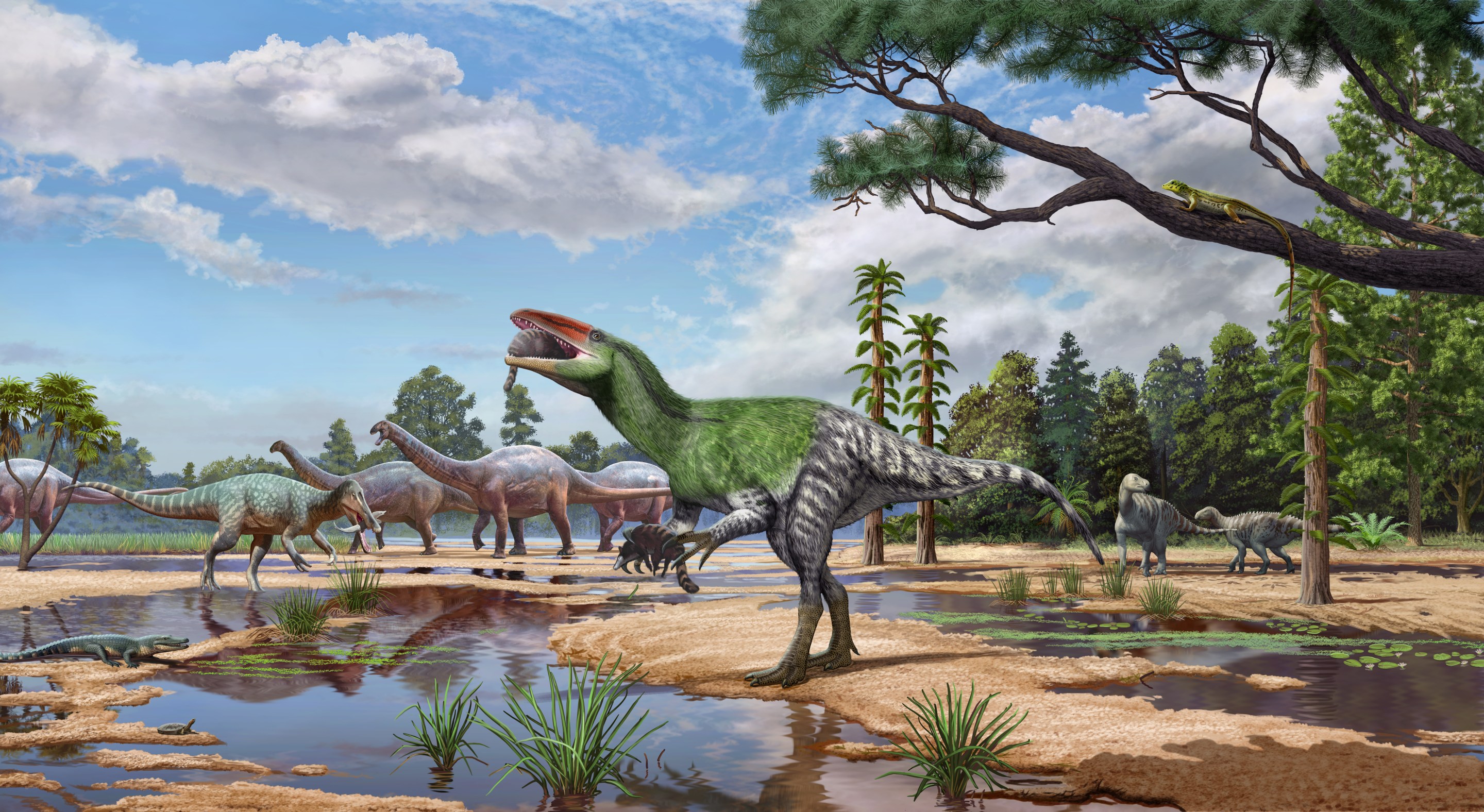
England may have a reputation for bleak weather, but the Isle of Wight is closer to dreamy than dreary. The small, diamond-shaped island off the southern coast has sun-drenched beaches and microclimates warm enough for tropical plants. Of course, 120 million years ago, it was even toastier, featuring a lush sub-tropical landscape populated by dinosaurs. Now paleontologists have discovered a new Cretaceous creature that lived there, and it’s proving to be an important piece in the puzzle of megaraptor migration.
A team of paleontologists identified the new species from a partial braincase unearthed from the Isle of Wight in 1924 by an amateur paleontologist. The specimen was discovered after a century spent languishing in a drawer of England’s Natural History Museum. Once brought to light, the team performed micro-CT scans to create 3D models of the interior and exterior of the skull.
Read more: “This Newly Discovered Dinosaur Looks Terrifying—But Probably Wouldn’t Eat You”
Comparisons to other dinosaur groups revealed it was a megaraptor—a family of bipedal predators with sharp claws that spread throughout the supercontinent of Gondwana during the Cretaceous. The opening of the skull where the spinal cord entered combined with a unique hour-glass-shaped crest indicated it was a previously unidentified species, and the team published their findings in the Royal Society Open Science.
The name they chose—Invictibellatrix amberina—carries a special meaning. The genus designation is Latin for “unconquered female warrior,” and it was given this sobriquet as a symbol of “hope and strength to all those who are bullied, discriminated, victimized and oppressed that tomorrow will be theirs and not to give up in the face of such odds.” (The species name, amberina, is a reference to fossilized amber found with the braincase.)
And it fits, too. Standing at around five feet tall and only 10-13 feet long, the dinosaur was far from an apex predator (unlike other megaraptors). Still, it definitely would have bullied us. “It was not the apex predator of its time, but for humans this dinosaur would have been more dangerous than a T. rex.” study author Cassius Morrison of the University College London said in a statement. “We would have been perfectly sized prey, about a third of their body weight. They definitely would have chased us. A T. rex wouldn’t have bothered, as we would have been too small.”
While the braincase is all the paleontologists have to go on, they say the dinosaur likely had feathers, four- to eight-inch claws, and would have occupied a similar ecological niche as hyenas, feeding on smaller prey items like lizards, mammals, and other tiny dinos.
As the first megaraptor found in Europe, the discovery is also helping to fill in some gaps in the fossil record. Megaraptors are thought to have originated in what’s now Asia before migrating to other parts of Gondwana. Or as study Charlie Scherer of University College London explained, “This new species is the first proof we have that megaraptorans were also present in Europe and that they reached Gondwana this way rather than island-hopping further south.” 
Enjoying Nautilus? Subscribe to our free newsletter.
Lead Image: Sergey Krasovskiy and Pedro Salas