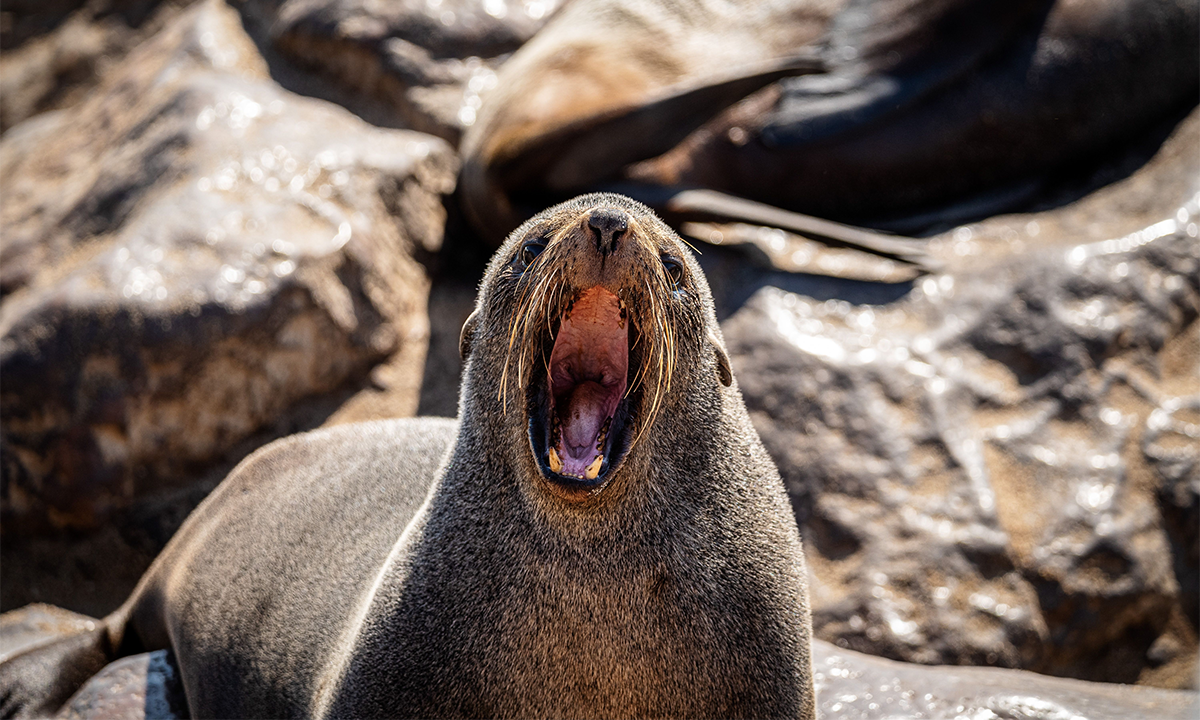
Until recently, vocal behavior in animals was assumed to be largely inflexible—a product of inheritance with little influence of learning. Increasingly, though, studies are finding examples of animals that, like humans, have the flexibility to change their calls according to context. Case in point: A new study in Science explores the unique adaptations of seals and sea lions that confer a level of vocal flexibility rivaling that of humans.
“All animals can learn,” first author and marine scientist at the New College of Florida Peter Cook explained in a press release. “And almost all birds and mammals communicate with their voices. The paradox of why so few animals can learn to control their calls is an irresistible scientific mystery.”
With neuroscientists from Emory University and the New College of Florida, Cook compared the brains of coyotes to those of pinnipeds (sea lions, elephant seals, and harbor seals). They mapped the animals’ neural architecture using MRI scans of post-mortem brains. Coyotes were included because they’re evolutionary cousins of the pinnipeds but lack their vocal flexibility.
Read more: “Why Are Marine Mammals Losing Their Hair?”
“Many people have an impression of seals and sea lions as just fat, furry slugs, laying on a beach and barking,” explained Cook. But “they have a tremendous drive to learn new things and are quick at picking up new behaviors,” including imitating human voices talking or singing.
The brain scans revealed a distinct difference between the coyote and the pinnipeds. In coyotes, the midbrain, which regulates breathing and swallowing, also controls the muscles used to vocalize. In contrast, the nerves for vocalization in seals and sea lions bypass the midbrain, interacting directly with the region of the brain that maps to vocal muscles and allowing pinnipeds to consciously control the muscles used in speech.
Why, though, would seals and sea lions have evolved such a brain bypass?
The researchers hypothesize that it was a side effect of their gaining voluntary control over their breath so they could make deep sea dives. Pinnipeds are known for their exceptional abilities to stay underwater—for as long as two hours in some species—to hunt and eat. The adaptations of holding their breaths and swallowing underwater could have been evolutionary drivers for the brain modifications that also facilitate vocal flexibility.
Whatever the impetus, as we map more animal brains, it will contribute to constructing an evolutionary tree for the neural architecture of language learning—and maybe help us better understand how we became so talkative. 
Enjoying Nautilus? Subscribe to our free newsletter.
Lead image: Wirestock Creators / Shutterstock