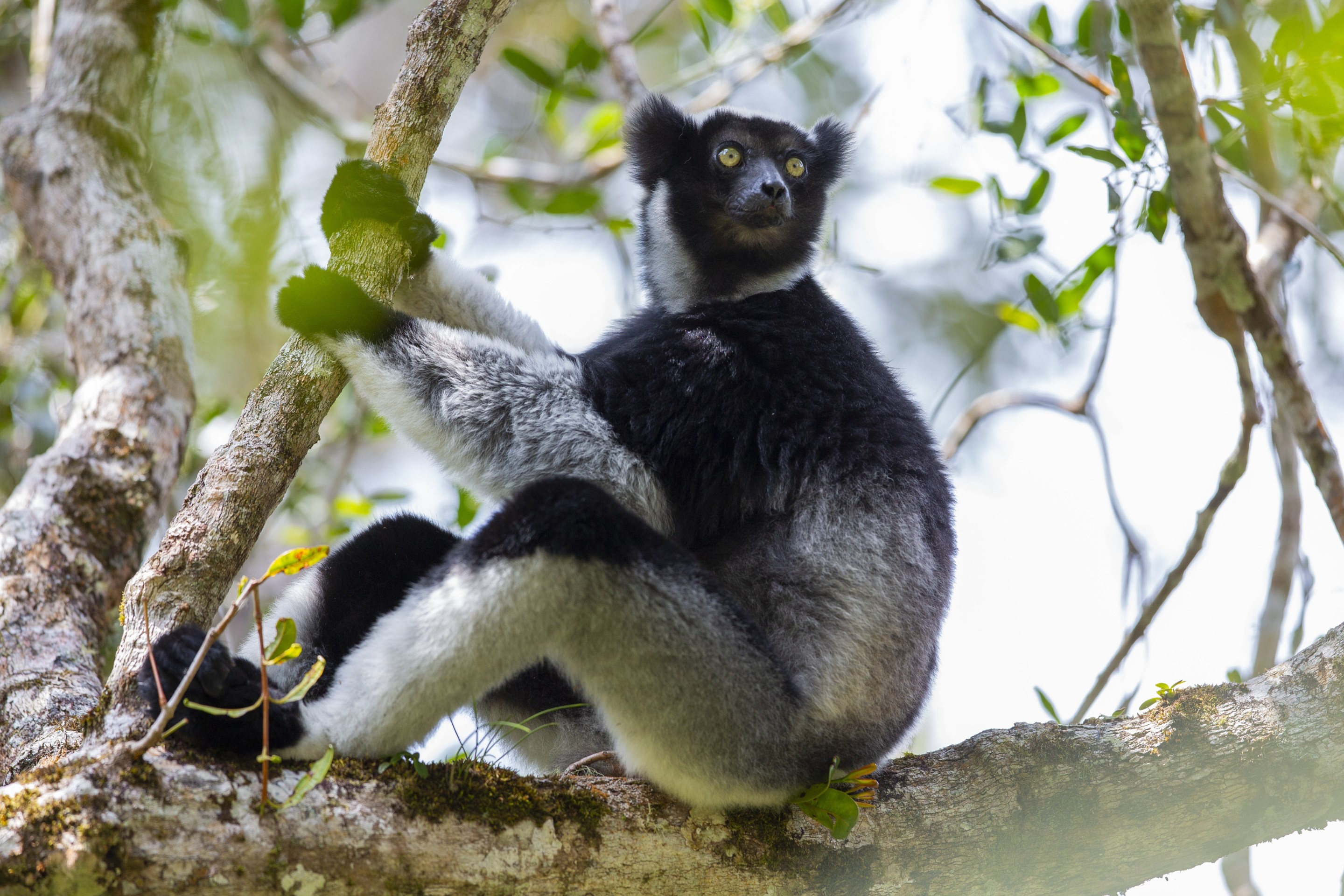
The indri lemur of Madagascar is one of the largest living lemurs on Earth, and not in the sense that they “live large” (they’re actually monogamous, preferring smaller, close-knit social circles). But they do have an impressive set of pipes. To defend their territory and reinforce social bonds, these primates scramble up to the forest canopy and belt out haunting tunes that can be heard for miles around. According to a new paper published in PLOS Computational Biology, they achieve this melodic feat in part by borrowing a tactic from opera singers.
As the pitch of the melody rises, human opera singers (especially sopranos) widen their mouths to allow the frequencies of their voices to resonate and amplify the sound. The result is a loud, clear tone that carries all the way to the nosebleeds. You can get a good idea watching this aria from The Magic Flute:
It turns out indri lemurs do the same thing. A team of researchers led by biologists from the University of Turin in Italy surveyed more than 80 videos of wild indris serenading all of creation. They used motion-tracking software to analyze how the lemurs’ mouths changed as they sang, and discovered a significant positive correlation between vertical mouth opening and the frequency of the song.
“Every time the pitch of an indri’s song rose, we could see its mouth opening wider, frame by frame,” study author Chiara De Gregorio of the University of Warwick explained in a statement. “It’s the kind of fine-tuned coordination between voice and body that we usually associate with trained human singers, not with a lemur singing from the forest canopy.”
Read more: “What Makes an Opera Star Stand Out?”
This process of adjusting the mouth opening to produce resonant frequencies that boost acoustic output is known as “formant tuning,” and it’s not restricted to humans and lemurs—or high pitches. Grey wolves, for example, lower their jaws to produce a deep sonorous howl.
So whether you’re baying at the moon, shrieking from the tree tops, or singing for the cheap seat, the strategy is the same. Open wide and let ‘er rip. 
Enjoying Nautilus? Subscribe to our free newsletter.
Lead Image: Filippo Carugati