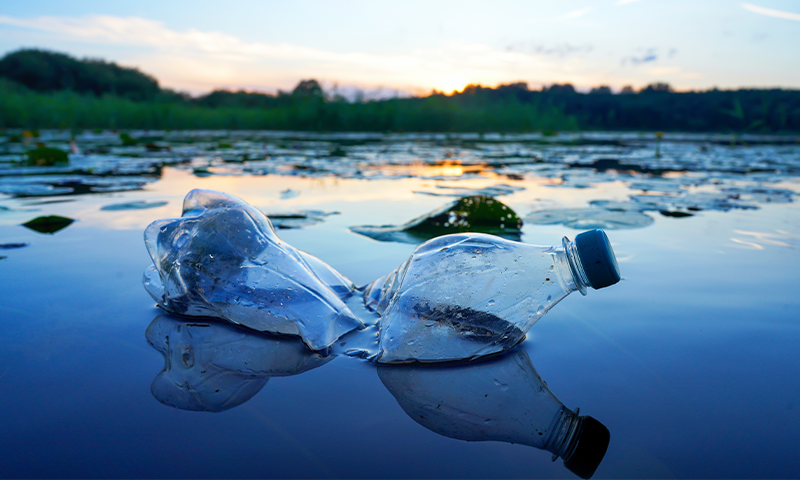
Plastics are easy to throw out but hard to get rid of. Unlike biodegradable materials, bacteria and fungi haven’t evolved the ability to break them down, leaving plastic garbage to languish for decades, eventually making its way into our oceans. And everywhere else. Now that may be changing.
According to a new study published in The ISME Journal, marine bacteria are starting to develop enzymes capable of breaking down polyethylene terephthalate (PET), one of the most common plastics. Researchers at Saudi Arabian and Spanish institutions used artificial intelligence and genetic information from a slew of ocean bacteria to identify a genetic sequence pattern they call the M5 motif that codes for functional PETases—the enzymes that break down PET plastics.
“The M5 motif acts like a fingerprint that tells us when a PETase is likely to be functional, able to break down PET plastic,” team co-leader Carlos Duarte said in a statement. “Its discovery helps us understand how these enzymes evolved from other hydrocarbon-degrading enzymes.”
Duarte and his co-authors confirmed that the M5 motif is what distinguishes true PETases from lookalikes with lab experiments. The M5 motif was present in almost 80 percent of the water samples tested, indicating that the potential for bacteria to develop the ability to feed on plastics is widespread. They reported that the bacteria making functional PETases were found between about 3,200 and 6,500 feet deep and at the surface of the ocean in spots with lots of plastic pollution.
Read more: "Can Humanity Stem the Plastic Tide?"
It’s welcome news. According to the study, more than 150 million tons of plastic waste have ended up in the oceans since 1950, so there’s plenty of potential food out there for enterprising bacteria that have the ability to break it down. In the meantime, the authors say this discovery could help with efforts to create synthetic PETases for use in recycling.
But the plastics crisis is multifaceted. It’s unlikely that the evolution of plastic-degrading microbes will happen at a pace that can keep up with the production and consumption of plastic by humanity.
A report released earlier this year, authored by an international team of health researchers, economists, and others, estimated that plastics-related health problems cost the world $1.5 trillion annually. “First and foremost, I’d like to see some kind of cap or limitation on global production of new plastic,” Philip Landrigan, lead author of that report and director of Boston College’s Program for Global Public Health and the Common Good and of its Global Observatory on Planetary Health, told Nautilus in August. “Even if we were to stop production totally today—which, of course, is not going to happen—there are 8 billion tons of plastic waste, large and small, circulating in the biosphere.”
These new findings offer some ray of hope that the planet’s microbes are starting to adapt to this massive input of waste and at least beginning the process of breaking some of it down. 
Enjoying Nautilus? Subscribe to our free newsletter.
Lead image: Maksim Safaniuk / Shutterstock