Earth’s atmosphere absorbs X-rays, which is a good thing because this high-energy electromagnetic radiation can damage DNA. It’s not good, however, for those interested in observing cosmic phenomena. Just like light (a lower energy electromagnetic radiation), X-rays are emitted by a number of different celestial bodies, from stars to black holes. To properly observe these emissions, we need to launch telescopes—like NASA’s Chandra X-ray Observatory—into space to get a better look. Now, an international team of astronomers studying data from Chandra may have found the remnants of an ancient supernova in the heart of our galaxy.
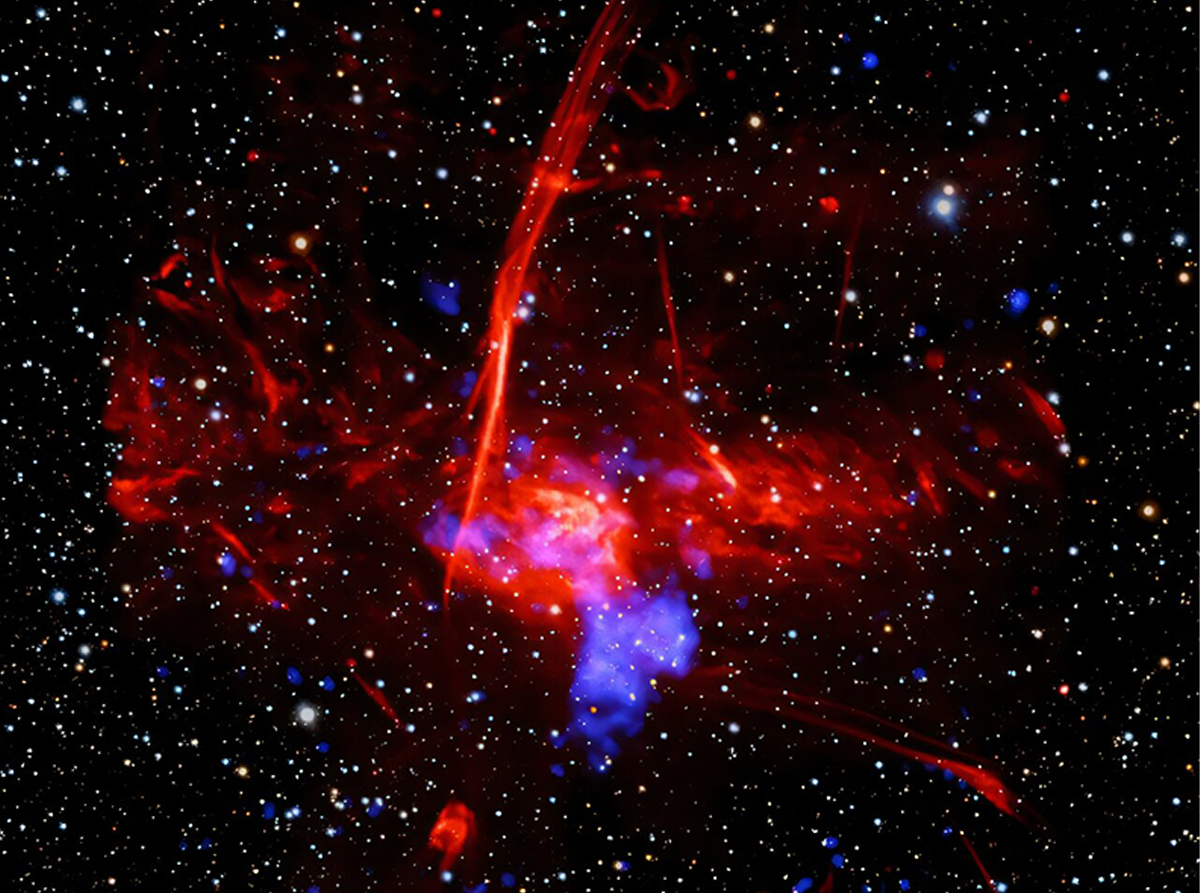
The ruins of the exploded star were located 26,000 light-years away in the Sagittarius C complex, close to Sagittarius A*, the supermassive black hole at the center of the Milky Way. If it’s indeed a supernova, it’s the closest one to the Milky Way’s galactic center ever discovered. According to the team’s analysis, the star responsible for the supernova blew up around 1,700 years ago, sending stellar debris flying at rates of around 1.8 million miles per hour.
The image above is a composite created from data collected by two space-based X-ray telescopes (NASA’s Chandra and the European Space Agency’s XMM-Newton) as well as telescopes that detect light waves (PanSTARRS in Hawai’i) and radio waves (MeerKAT in South Africa) here on Earth.
When put together, it certainly makes for an incredible singular image. 
Enjoying Nautilus? Subscribe to our free newsletter.
Lead image: NASA/CXC/UCLA/Z. Zhu et al. using data from ESA/XMM-Newton, PanSTARRS, and MeerKAT. Image Processing: NASA/CXC/SAO/L. Frattare and P. Edmond