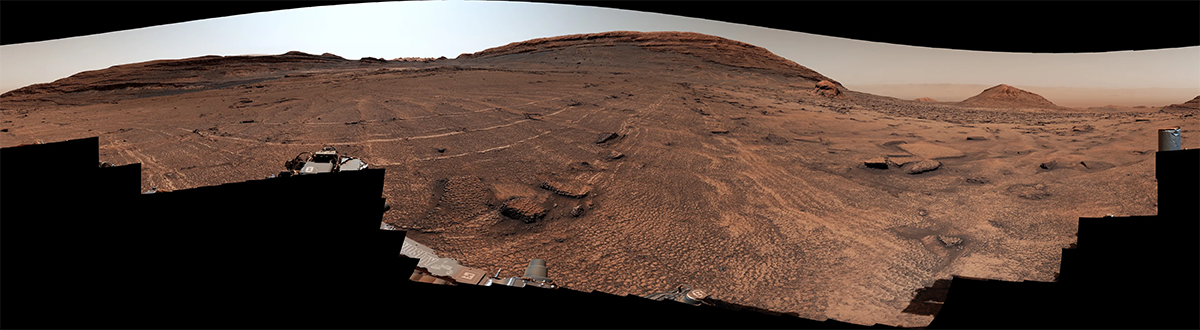
Someone’s going to be celebrating a birthday on Mars soon. On Aug. 6, 2012, NASA deployed the Curiosity rover to explore Gale Crater, and 14 years later, the birthday bot is still beaming back photos. The latest show striking honeycomb patterns in the Martian regolith that stretch as far as the electronic eye can see.
“We’ve seen a lot of fascinating landscapes through Curiosity’s eyes, but this sea of polygons took our breath away,” project scientist Ashwin Vasavada of NASA’s Jet Propulsion Laboratory said in a statement. “We measured their shapes and chemistry carefully and are hopeful there are clues in the data as to how these features formed.”
This isn’t the first time Curiosity has discovered unusual patterns on the surface of the red planet. A few years ago, research into hexagonal mud cracks Curiosity found revealed the presence of persistent wet-dry cycles in Gale Crater. That means the water that once existed in Gale Crater wasn’t just a one-time fluke, it hung around for a long time—possibly long enough for life to evolve.
Read more: “Uncovering the Spark of Life”
“This is the first tangible evidence we’ve seen that the ancient climate of Mars had such regular, Earth-like wet-dry cycles,” study William Rapin of France’s Institut de Recherche en Astrophysique et Planétologie said at the time. “But even more important is that wet-dry cycles are helpful—maybe even required—for the molecular evolution that could lead to life.”
That’s because these wet-dry cycles can promote what’s called “prebiotic polymerization.” When water evaporates, it brings solutes, like short amino acids, into closer contact facilitating the formation of larger molecules, like protein chains. So while it doesn’t directly lead to life, the process can form the building blocks of life.
And Curiosity has already found some of these building blocks. Earlier this year, tests carried out by the robot’s on-board chemistry lab showed the presence of large organic compounds, one of which had a structure similar to a DNA precursor.
Unfortunately, we’ll have to wait for more information about these new honeycomb patterns, as they were found just last month. In the meantime, we can all wish Curiosity a happy early birthday. 
Enjoying Nautilus? Subscribe to our free newsletter.
Lead image: NASA/JPL-Caltech/MSSS