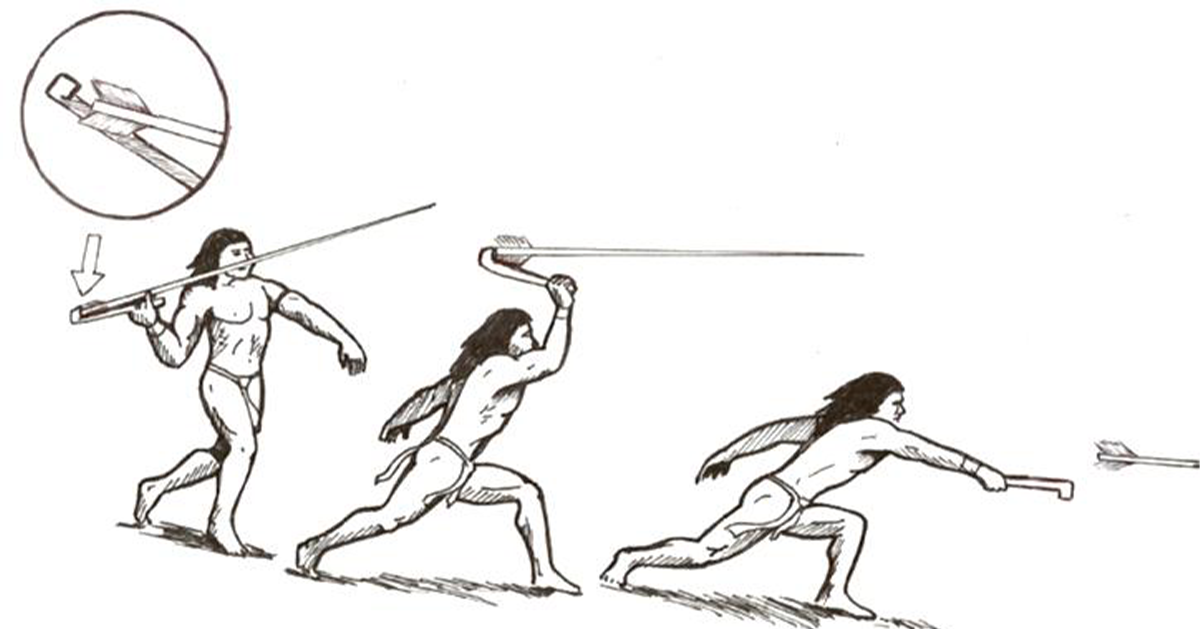
The first culture to take root in the Americas after ancient humans traveled over the land bridge from Asia was the Clovis culture. Named for the New Mexican town where their trademark stone spear tips were discovered in 1927, the Clovis people were nomadic foragers who hunted the occasional megafauna, like camels, mammoths, and bison. It was assumed they killed big game using an innovation called the atlatl, brought over from the Old World. But according to a new study published in the Proceedings of the National Academy of Sciences, that’s not likely.
Read more: “The Stick Is an Unsung Hero of Human Evolution”
If you’re unfamiliar with the Stone Age technology, an atlatl is a spear thrower consisting of a forearm-length stick with a notch or receptacle of sorts at the end. The spear or dart was placed into the receptacle, and the atlatl was used to fling it. It might seem a little redundant, but these spear throwers offered tremendous advantages. The atlatl effectively lengthens the arm creating a longer lever that translates into a more powerful throw, a faster, farther moving projectile, and a more forceful impact. In fact, it’s been hypothesized that it allowed women with less upper body strength to hunt as well as men.
A team of anthropologists recently applied statistical models to radiocarbon-dated Stone Age atlatls typically associated with the Clovis culture and discovered they were roughly 9,300 to 6,100 years old. That means they belonged to hunters that lived after the Clovis culture died out, which happened around 12,000 years ago. In other words, Clovis hunters may have hunted big game, but they most likely did the deed with thrusting spears and javelins, and not atlatls.
But if atlatls weren’t brought over from Europe, where did these Stone Age hunters get them?
According to the researchers, they re-discovered the technology independently in the Americas. It might not seem like the most parsimonious explanation at first glance, but spear-throwing technology has been developed by ancient cultures from the Aborigines to the Greeks. After all, the laws of physics are just as universal as the need to eat. 
Enjoying Nautilus? Subscribe to our free newsletter.
Lead image: Sebastião da Silva Vieira