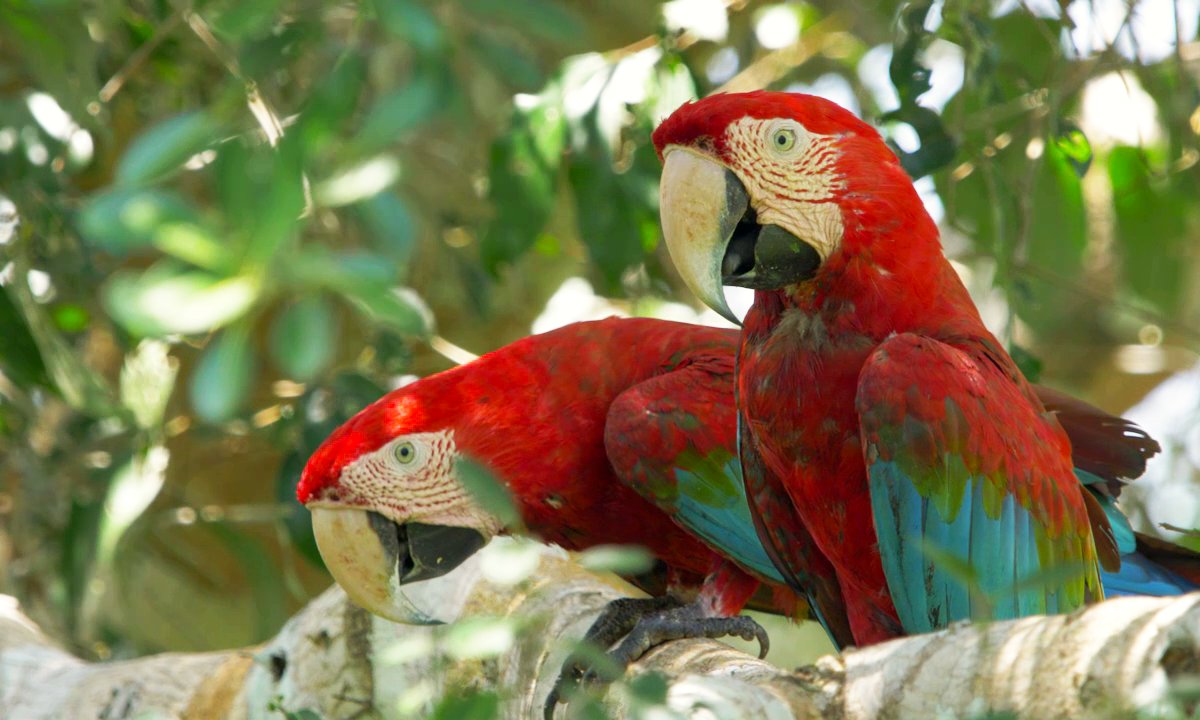
People like to keep macaw parrots as pets because they’re big, colorful, and talkative. Despite the high-care needs of these charismatic birds, we’re enamored of their ability to imitate human speech, such as in “Polly, want a cracker?” A new study published today in Nature Communications shows that our fascination with macaws dates back thousands of years.
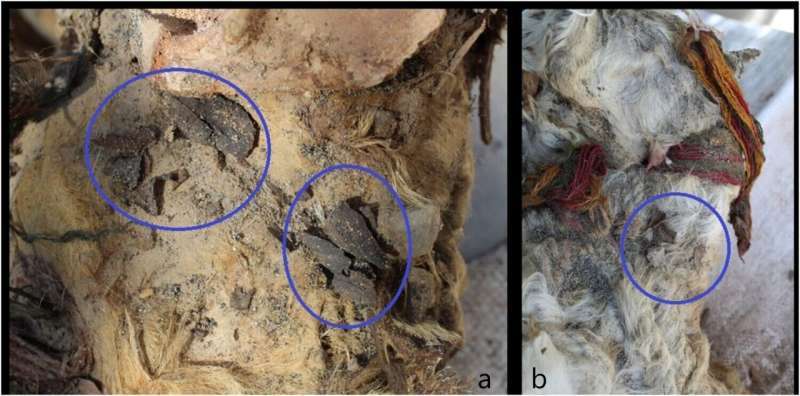
Researchers from Australia, Spain, Peru, and the United States studied feathers that were attached to funerary bundles in a tomb in Pachacamac, Peru, which was once a religious center for the Ychsma culture. Far from the macaws’ native rainforests east of the Andes Mountains, the coastal Pachacamac site flourished from about 1000 to 1470 A.D., before the Inca Empire arose. Parrot feathers have long been prized throughout South America, but these feathers told a story of a pre-Inca trade network.
The researchers combined several lines of evidence—ancient DNA sequencing, isotope analysis, and spatial modeling—to reconstruct the source of the feathers. They proved to be from four species of parrot: the scarlet macaw, blue-and-yellow macaw, red-and-green macaw, and mealy Amazon parrot. Their individual genetic diversity pointed to parrots from wild, rather than captive-reared populations. But the isotope analysis showed a diet rich in coastal human foods such as corn rather than a natural rainforest diet.
Read more: “I Know How the Caged Bird Jams”
Displaced at least several hundred miles from their native habitat, the birds couldn’t have traveled to Pachacamac independently. Their natural home ranges are only about 58 square miles (the size of a small city park), and they would have had to fly over the mountains.
“The fact that they ended up more than 500 kilometers away, on the other side of South America’s highest mountain range, proves human intervention. They do not naturally fly over the Andes,” explained lead study author and conservation ecologist George Olah from The Australian National University in a press release.
And so, the study authors concluded that the parrots were carried over the Andes, which would have been a long, taxing journey, then kept alive on the coast. The results imply a sophisticated knowledge of ecology and landscape long before the Inca Empire arose.
“We see evidence of organized exchange, ecological knowledge, and logistical planning that connected vastly different environments long before imperial roads formalized these connections,” added Olah.
How long the macaws were kept before their feathers became part of the Ychsma burial rituals is unclear, but, regardless, it highlights the cultural significance of these birds long before they became “Pollys” eating crackers in our homes. 
Enjoying Nautilus? Subscribe to our free newsletter.
Lead photo by Balazs Tisza