You’d think that our human fascination with geometric shapes would have developed recently, after humans became master builders of structures with parallel lines and right-angle corners. But a recent study in PLOS One, led by researchers from the University of Bologna, shows that Homo sapiens were already thinking geometrically way back in the Stone Age.
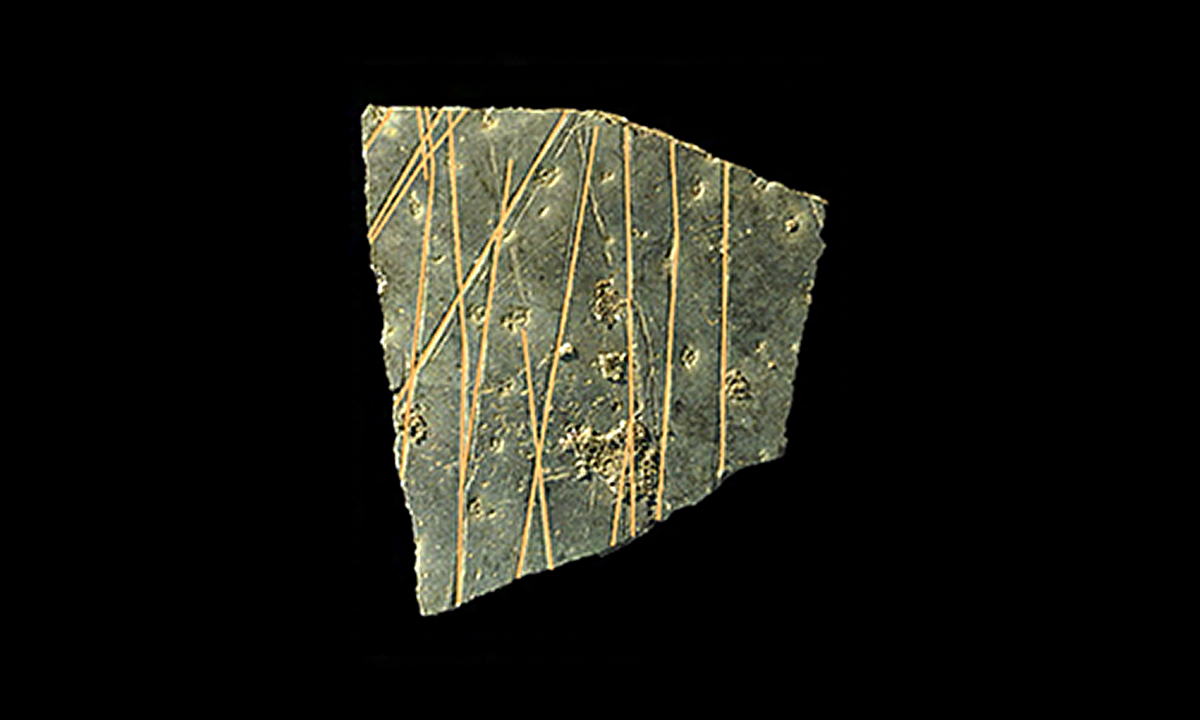
Ostrich eggshell fragments dating to 60,000 years ago, unearthed in South Africa and Namibia, were etched with drawings that proved to be nonrandom. “We are talking about people who did not simply draw lines, but organized them according to recurring principles—parallelisms, grids, rotations, and systematic repetitions,” said study author and Aegean Philology researcher Silvia Ferrara in a press release.
The shells were presumably the remains of water flasks used beginning in the African Middle Stone Age.
Ferrara and colleagues from the University of Bologna and Sapienza University of Rome analyzed the etchings on 109 eggshell fragments, collectively totaling 1,275 lines and 1,405 line intersections. Each eggshell drawing was assessed for level of complexity and structural composition, with statistical analyses determining whether significant differences from random line-making existed.
Read more: “Early Humans Made Animated Art”
Nearly 90 percent of the drawings showed geometric regularities, such as repeated use of 90-degree angles and parallel lines. Even the more complex parts, such as hatched bands, grids, and diamond-shaped motifs, could be interpreted in geometric terms. They were produced by cognitive operations including rotation, translation, iteration, and embedding. For example, hatched-band motifs were created by drawing a set of parallel lines, then crossing them with another set of parallel lines inclined as much as 90 degrees.
The study authors deduced that a “geometric grammar” guided the logical construction of patterns in these ancient humans, suggesting a remarkable capability for organized, abstract thought. They cognitively organized shapes in their drawings through repetition of lines, parallelism, and orientation changes.
“Transforming simple forms into complex systems by following defined rules is a deeply human trait that has characterized our history over millennia, from the creation of decorations to the development of symbolic systems and, ultimately, writing,” said first author Ph.D. student Valentina Decembrini.
At the very least, the sophisticated eggshell engravings are startling evidence of early graphic artists at work. 
Enjoying Nautilus? Subscribe to our free newsletter.
Lead image: From Decembrini, V., et al. PLOS One (2026)