We hear plenty about the great apes, but what about the lesser apes?
It turns out there’s just one group, gibbons, and they don’t get nearly as much attention as our closest primate relatives. But a new study published in the journal Animal Behavior and Cognition is trying to change that.
“Understanding the evolutionary origins of the human mind requires comparative studies across the ape lineage,” study author Makiko Uchikoshi, a primatologist at Kyoto University, explained in a statement. “Despite their evolutionary importance, gibbons remain one of the least studied ape groups in cognitive research.”
Read more: “New Ape Fossil Could Shift Our Evolutionary Origins Northward”
Compared to the great apes, gibbons split off earlier in the hominid lineage, diverging from our common ancestor 17 million years ago. They’re also the only apes that live in a pair-bonded social system, typically habitating in small groups. Taken together, this makes them valuable model organisms for studying social cognition, or how our brains process information about other individuals.
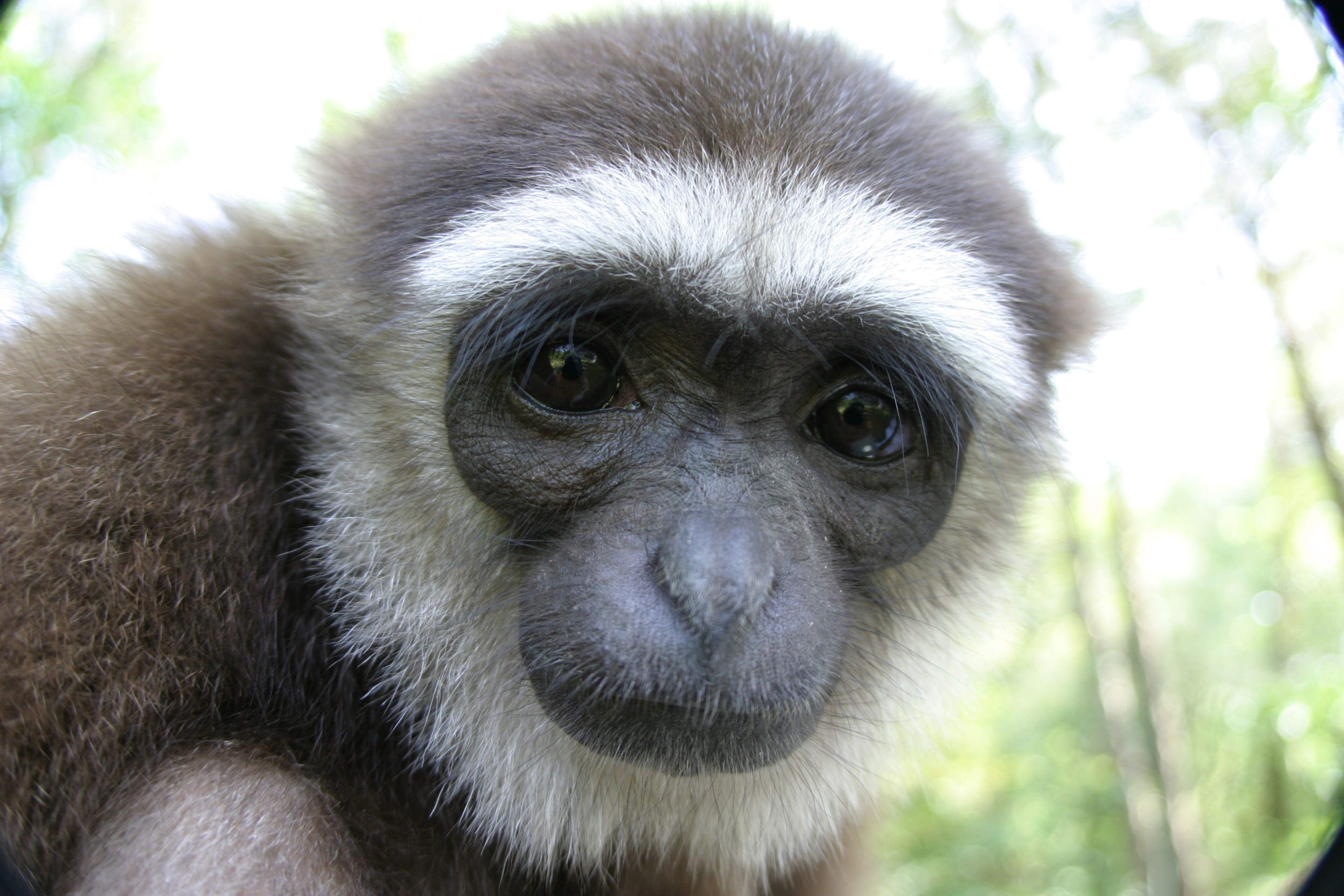
To get that ball rolling, Uchikoshi and other researchers from Kyoto University set up a monitor with a camera at the Japan Monkey Centre in a location where three adult gibbons were free to view it at their leisure. The screen displayed photos of either humans or other gibbons with neutral expressions while the camera tracked their eyes to determine which features drew their attention.
The team found that, just like humans, gibbons are drawn to the eyes. Pooling data from all three gibbons revealed they lingered there more than the mouth, nose, and other areas, regardless of the species in the photo. They also spent more time examining photos of other gibbons (compared to photos of humans), indicating they share key patterns of visual attention with humans and great apes.
But why the eyes and not the mouth or nose?
According to the team, it’s because primates “convey information about some mental states such as interest, desire, rejection, or acceptance through eye signals.” In other words, our peepers are a data-rich region of the face—or to put it more poetically, the “windows to the soul.”
While the researchers hope to build on these findings to gain deeper insights into the evolutionary underpinnings of social cognition, this first step is a revelatory one. “I have known the gibbons that participated in this study for nearly 28 years and have often experienced moments of eye contact, but I had never been able to measure objectively what they were actually looking at,” Uchikoshi said. “Being able to quantify where they look and for how long felt almost like magic.”
A glimpse into the eyes of our (lesser) relatives is also a glimpse into our own past. 
Enjoying Nautilus? Subscribe to our free newsletter.
Lead Image: Gaku Ohashi / Institute for the Evolutionary Origins of Human Behavior, Kyoto University