Every once in a while, the deep, cold cosmos seems like a pretty inviting place. Last week, NASA researchers shared findings that made me feel like giving our amazing, spiral Milky Way a big, old galactic hug.
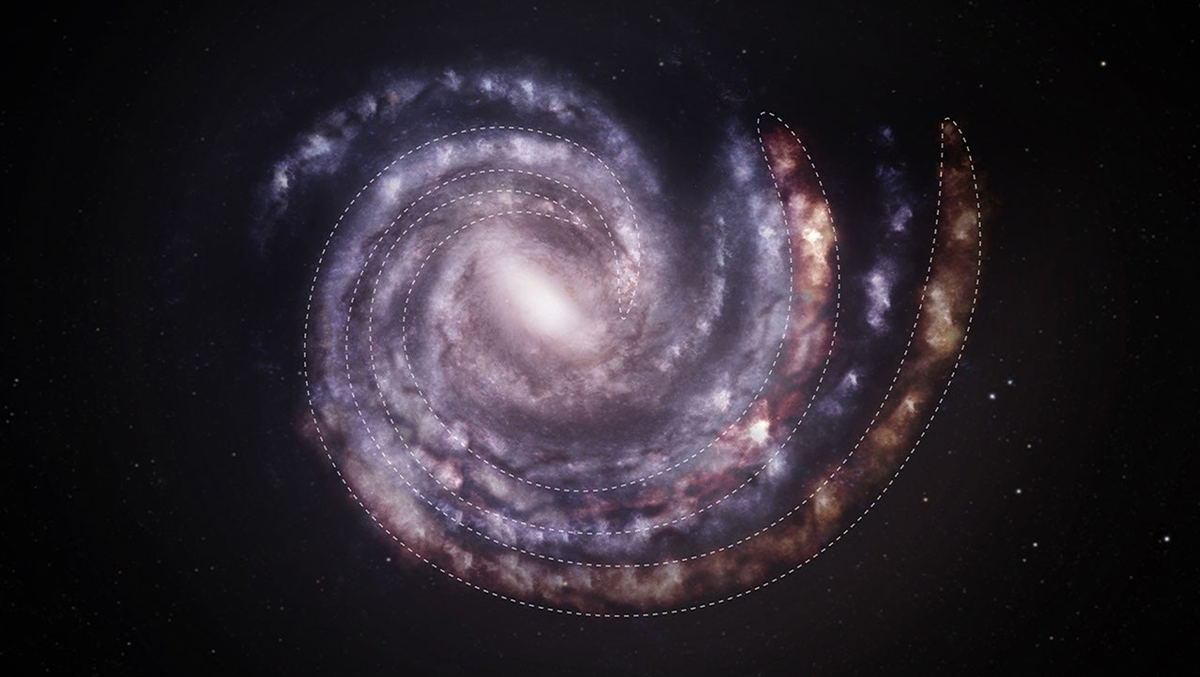
Astronomers crunching data from the space agency’s Chandra X-ray Observatory and the European Space Agency’s XMM- Newton, surmised that the outermost arms of the Milky Way are spread farther and wider than previous models of the galaxy had calculated. Publishing their results in the journal Astronomy & Astrophysics, researchers based their conclusions on measuring massive distances between dust clouds in the outer reaches of the Milky Way and studying rings around gamma-ray bursts that emanate from collapsing or merging stars.
Read more: “The Myths and Lore of the Milky Way”
“This is a very direct way—relying only on geometry—to precisely measure distances to the Milky Way’s spiral arms,” said Beatrice Vaia, who coauthored and led the study while a Ph.D. student in a joint program between Scuola Universitaria Superiore IUSS Pavia and University of Trento in Italy, in a statement. “Most other methods rely on assumptions about how the Milky Way rotates, which become increasingly uncertain in the outer regions of our galaxy."
In addition to sparking a bit of affection for our home galaxy, the results can help astronomers continue to more-accurately map the Milky Way and also the dust clouds that litter interstellar space. 
Enjoying Nautilus? Subscribe to our free newsletter.
Lead image: An artist’s concept showing the Milky Way galaxy as seen from above, with the estimated positions of spiral arms based on previous data, in blue. Overlaid on this is an updated view of the Milky Way showing different positions for the two outermost spiral arms, shown in red and bordered by dashed lines. Both arms may be more distant than previously thought, based on newly processed X-ray data from Chandra and XMM. Credit: NASA / CXC / SAO / M.Weiss.