Teeth are among the most abundant fossils on Earth, but even in a crowded pool, this find in San Mateo County, California, stands out.
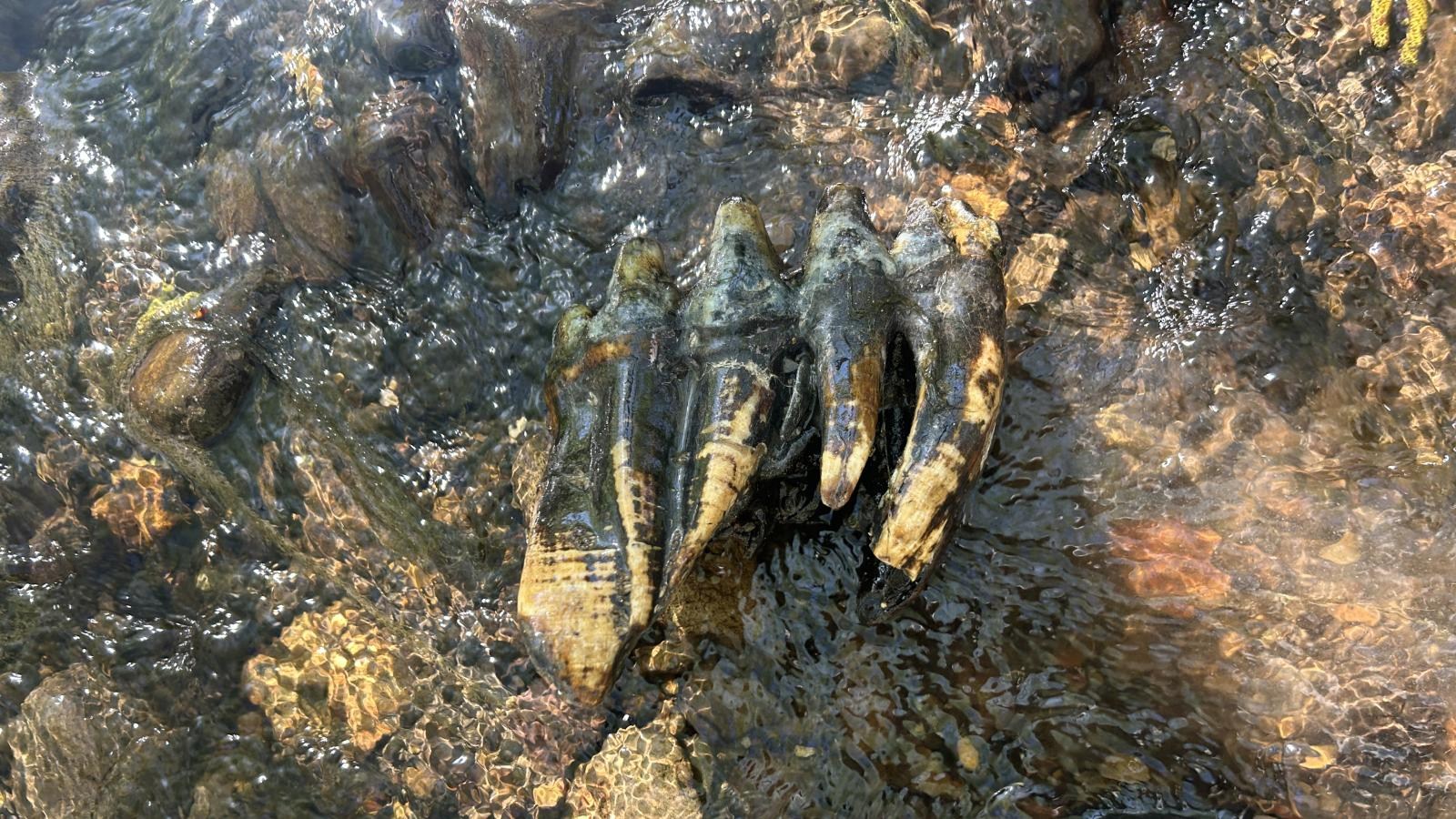
The prehistoric tooth, pulled out of a creek bed in the region and belonging to an ancient Pacific mastodon (Mammut pacificus), is “the most complete mastodon molar from our area,” according to paleontologist Wayne Thompson, who helped identify it.
Read more: “How Ancient Beasts Spread Sweet Fruits”
Thompson added that it’s also “the most spectacular mastodon molar that I’ve ever seen” in a statement, explaining that the finding gave him “chills and shivers up and down my spine.”
The tooth is at least 10,000 years old and measures 8.5 inches in length, 7 inches in depth, and 3 inches in width. The fossil is now on its way to Stanford University, where it’ll be more accurately dated and 3D scanned.
As KION Central Coast reports, the intriguing find was originally discovered by Balance Hydrologics geomorphologist Brigid Lynch, who had been working on a conservation project. It was only after a reverse Google Image search that Lynch determined that this wasn’t a strangely shaped rock, but rather a tooth from an Ice Age mastodon.
You wouldn’t necessarily identify it as a tooth either: The roots look like individual fangs, while the actual chewing side is made up of several ridges of enamel, ready to bite down on leaves, plant shoots, or fruit.
How it got dislodged from whatever sediment it was in and found its way down to a creek is still a mystery, but Thompson believes the molar’s excellent condition suggests the skull isn’t too far away.
Fossil samples of this species are relatively rare, so discovering more parts of the animal will help to fill in some knowledge gaps around M. pacificus—and what exactly led to its demise when the last Ice Age ended.
The elephant-like species was thought to be active across what is now California, Oregon, the northern Rocky Mountains, and parts of Mexico. Much of the wildlife and foliage would’ve been the same as it is today, with the mastodon sharing ground with elk, coyotes, and badgers—right before most of the world’s megafauna disappeared (due to climate change, human activity, or a combination of the two).
“As a geologist, I’ve gone out and seen stuff in the field, but definitely nothing as exciting as this,” said Lynch in a statement.
So the next time you’re splashing around by the river and spot something odd, it’s definitely worth taking a closer look. 
Enjoying Nautilus? Subscribe to our free newsletter.
Lead Image: Midpeninsula Regional Open Space District