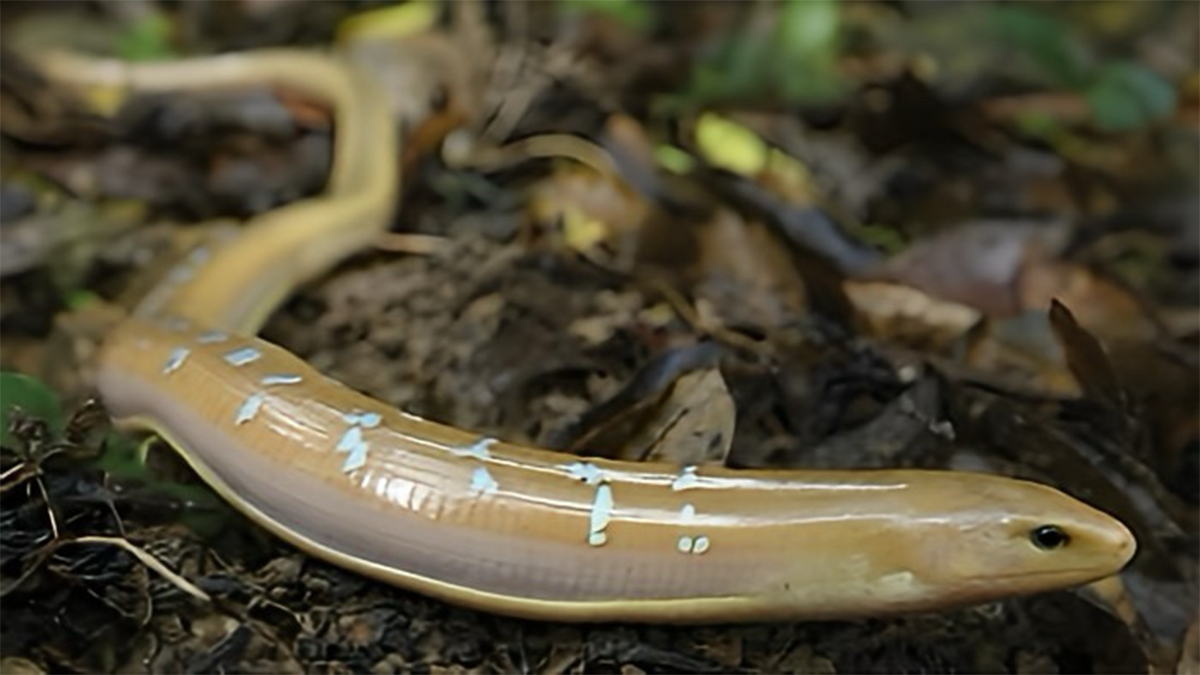
Slithering through the damp leaf litter, deep in the forests of Taiwan is an elusive creature that’s been causing confusion for decades—the Formosan legless lizard. Now, researchers are trying to set the record straight with a bit of taxonomic housekeeping in the journal ZooKeys.
But first, what makes this limbless reptile a lizard and not a snake?
For starters, it has ears, or at least tiny external earholes, which snakes lack. It also has eyelids and can blink with them, while snakes have transparent, fused membranes protecting their eyes. Finally, it has a lateral groove on each side of its body which allows the skin to expand.
While its appearance may confound those unfamiliar with the finer points of reptile classification, the distinction between snake and lizard wasn’t the source of the confusion. Instead, early naturalists originally believed there were two legless lizards lurking in the forests of Taiwan: Dopasia formosensis and Dopasia harti.
D. harti displayed striking blue spots, while D. formosensis, with a uniform beige coloring, lacked them. Complicating things further, the original holotype for D. formosensis—the representative specimen museums usually hold for scientists to refer back to—vanished shortly after World War II.
To solve the confusion, researchers from National Taiwan Normal University have selected a new holotype (or “neotype”) for the single species D. formosensis, which molecular analysis revealed in a previous study includes the incorrectly labeled “species” D. harti.
Read more: “The Inner Worlds of Reptiles”
As for the spots themselves, after analyzing other specimens of the legless lizards, researchers determined the markings were an example of sexual dichromatism—only sexually mature males of the species have them, females and immature males are a little more drab.
The new study also documented the species’ behavior. Because these limbless wonders are notoriously difficult to locate in their natural habitat, the researchers turned to citizen scientists of the delightfully named Taiwan Roadkill Observation Network.
With the help of the roadkill network’s observations, researchers determined males are more mobile during the breeding season. They also tend to fight one another, something that can lead to the loss of their abnormally long tails. Like other lizards, they can also shed their tails under duress, but unfortunately they don’t grow back. Females, on the other hand, display egg-guarding behavior, staying close to their clutch until they hatch.
Because the Formosan legless lizards are so secretive, it’s unclear how many of them exist in the wild, which leaves their conservation status as something of a question mark. Still, the researchers didn’t want to disturb them further, and opted instead to perform their analysis entirely on existing collections.
It just goes to show what you can accomplish with a little legwork (pun unavoidable). 
Enjoying Nautilus? Subscribe to our free newsletter.
Lead photo by Yu-Jhen Liang