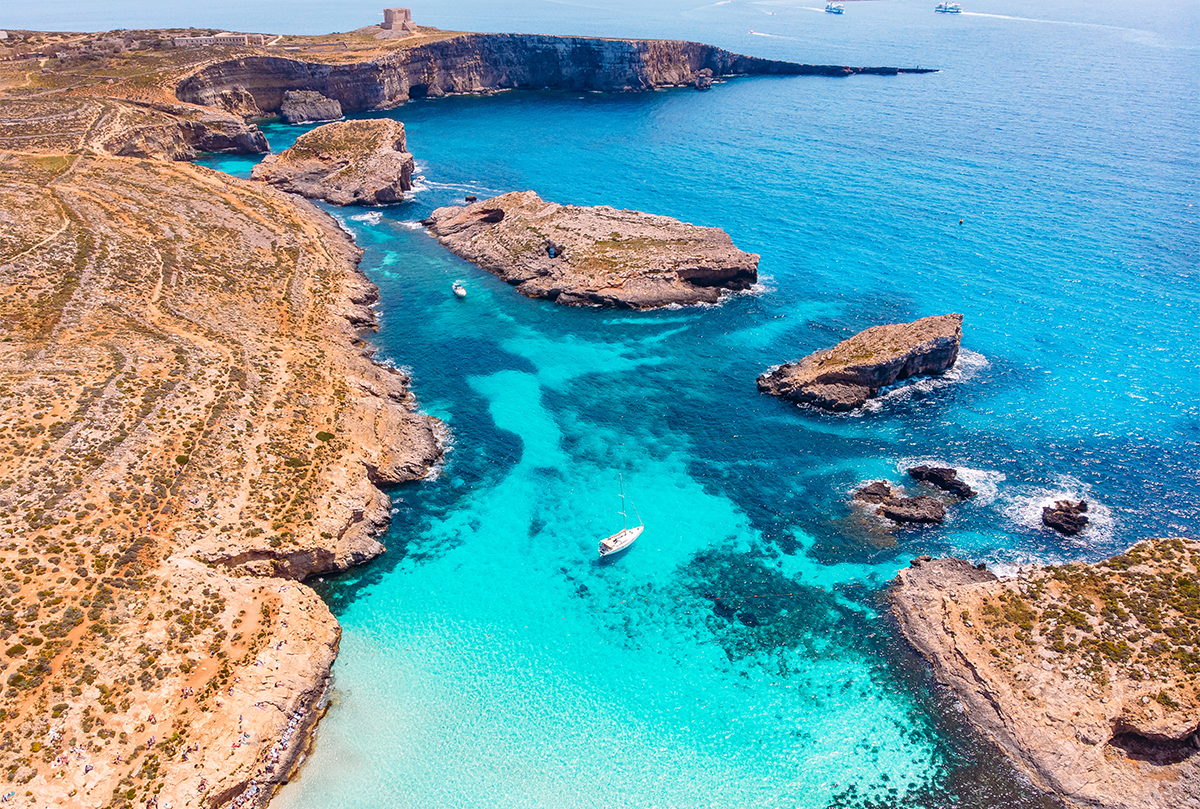
Malta is incredibly tiny. At around 120 square miles, the island nation off the coast of Sicily is one of the smallest countries by land area (in fact, you could cram about 10 Maltas into the state of Rhode Island). Today, it has a population of over half a million, yet it can only grow about 20 percent of the food those people eat, relying on trade instead.
Which presents something of a puzzle. Stone tools and other evidence indicates that the island was populated by hunter-gatherers between 8,500 and 7,500 years ago. These foragers weren’t farming on what little land Malta has, so how did they survive? A new study published in PNAS Nexus, might have some answers.
An international team of archaeologists combined palaeoclimate data, sea-level models, and insights from modern ethnographic sources to reconstruct Malta’s past. They determined that Malta was once connected to the much larger Sicily by a land bridge, but the two became separated around 14,200 years ago, when rising sea levels shrank the landmasses of both islands. Before the split, the team estimated Malta could sustain a maximum population of 419 individuals. After the split, that number dropped to around 150 to 170—much too small to be genetically sustainable, the team says.
Read more: “Sailing Weather Gets Weird”
And yet, they were there, so what gives?
According to the researchers, Malta wasn’t really a “home” to a genetically doomed population at all. Rather than a final destination, it was merely a stopover for Stone Age seafarers to hunt, fish, and gather resources for at least a millenium—and it may have been just one of many.
“Our study proves that Malta was part of a hitherto unknown, sustained, long-distance sea voyaging network,” study author Elearnor Scerri explained in a statement. “The last European hunter-gatherers weren’t only reconfiguring the use of land and sea in a way that preempts the modern world, they were also maintaining social networks in ways we don’t see before, connecting islands and coastlines, perhaps even across continents.”
Essentially, the Stone Age hunter-gatherers of Malta went on quite the odyssey. 
Enjoying Nautilus? Subscribe to our free newsletter.
Lead image: Parilov / Adobe Stock