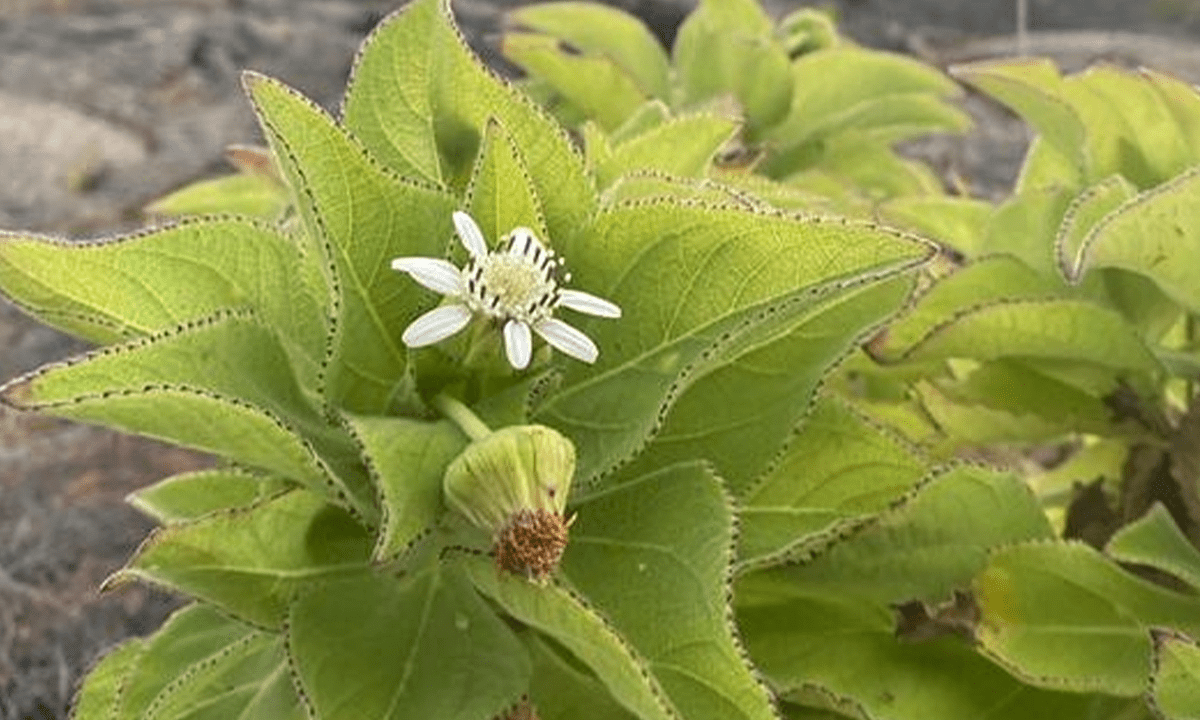
When Charles Darwin’s famous finches colonized the Galápagos Islands, they adapted to their new homes by developing beaks singularly suited to feed on the unique nuts, fruits, and insects each island offered. But they weren’t the only organisms that took advantage of the opportunity for adaptive radiation. The giant daisy genus Scalesia took root there as well, and a new study published in Nature Communications reveals how the species evolved to fit their new digs.
Just like Darwin’s finches, Scalesia plants adapted to fill a variety of ecological niches once they arrived from mainland South America, from muggy forests to dry lowlands. It didn’t take them long either, all living species of Scalesia popped up on the islands as recently as 1 million years ago. “The appearance of different species varies dramatically, from low shrubs to tall trees,” study co-author Michael D. Martin of the Norwegian University of Science and Technology said in a statement. “Most striking are the leaves, which range from large and entire to small and deeply lobed.”
Read more: “Why Is Everything an Orchid?”
These lobed leaves are believed to help cool the plants by allowing for more air circulation while also reducing water loss. They definitely seem to be a boon to Scalesia. Multiple species have developed the adaptation independently, according to the researchers’ genomic analysis, but what surprised them most was how they evolved these structures—each species used different genes belonging to the leaf development pathway to evolve lobes.
“This provides a clear example of parallel evolution: nature arriving at the same solution multiple times, but through different genetic pathways,” study co-author Vanessa Bieker explained. “Instead of being controlled by a single ‘master gene,’ evolution appears to draw on an entire network of interacting genes, tweaking different components to produce similar outcomes.”
And they’re still evolving, too. “Populations within the same species show large genetic differences and have been isolated from one another for long periods,” Martin said. “This means new species may be in the process of forming.”
Sometimes a change of scenery is all you need to thrive. 
Enjoying Nautilus? Subscribe to our free newsletter.
Lead image: Michael Martin, NTNU University Museum