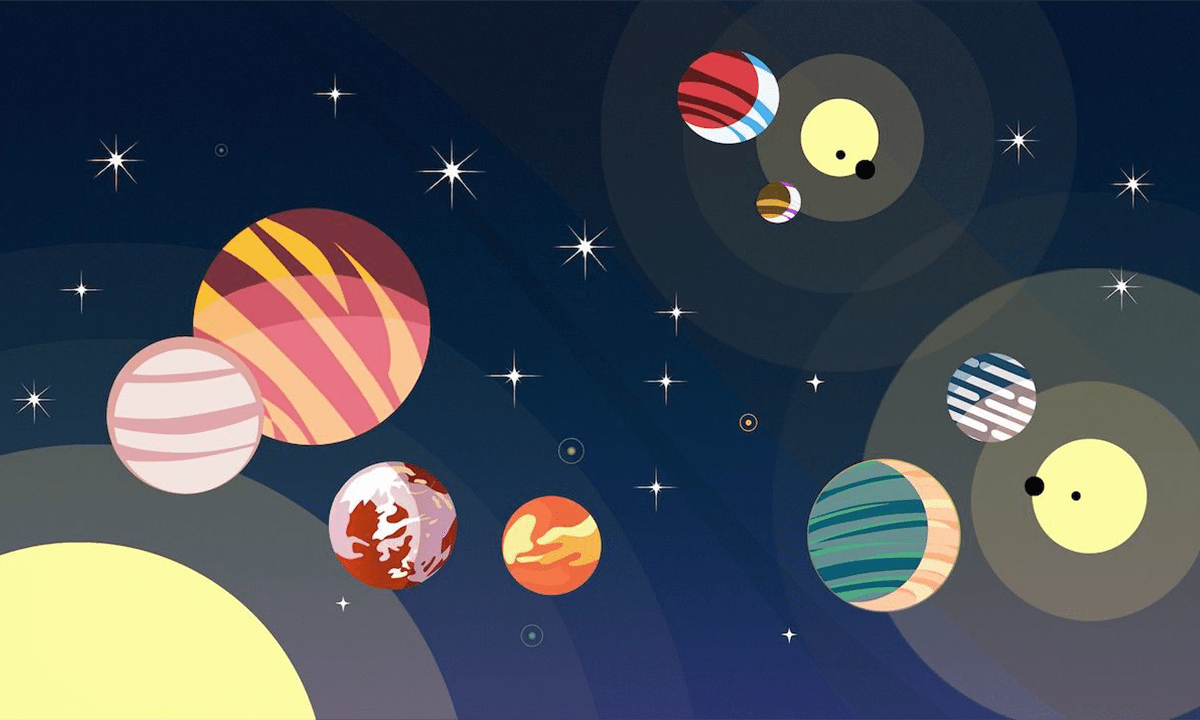
Given the exponential rise in discoveries of exoplanets—with 6,000 and counting now identified—detecting signs of alien life has never been more of a needle-in-a-haystack exercise. But astronomer Lisa Kaltenegger and undergraduate students at Cornell University are trying to change that by using data from the European Space Agency’s Gaia mission and the NASA Exoplanet Archive to catalog rocky exoplanets likely to have Earth-like characteristics, such as water on their surface. They published their research last week in the journal Monthly Notices of the Royal Astronomical Society.
“While it’s hard to say what makes something more likely to have life, identifying where to look is the first key step—so the goal of our project was to say, ‘Here are the best targets for observation,’” explained Gillis Lowry, study author and astronomy student (now at San Francisco State), in a press release.
To qualify, an exoplanet needs to be neither too close nor too far from a host star, such that it’d be bathed in similar energy to what we receive on Earth.
Read more: “The Exoplanet That Wasn’t”
Forty-five exoplanets made the cut, of which 24 stood out as most likely to have habitable surfaces. Some of those winners were already well-known, such as Proxima Centauri b. Others were more recent discoveries, such as TOI-715b. The most intriguing ones include LHS 1140 b, at 48 light-years from Earth, and the set of seven planets with masses comparable to Earth’s around the red dwarf star TRAPPIST-1.
“Observing these planets can help us understand when habitability is lost, how much energy is too much, and which planets remain habitable—or maybe never were,” said Cornell student Abigail Bohl.
Many questions remain—for example, whether a planet could remain habitable even if an elliptical orbit periodically takes it outside the most livable temperature zone, as some edgy planets like TRAPPIST-1g go through intervals of extreme cold. Or how eccentric—that is, deviating from a circle—a planet’s orbit can get and still allow it to hold onto surface water and atmosphere.
Regardless, the list of best places defined in this study to search for alien life helps narrow the field, as well as better defines the criteria for habitability, which has become increasingly more important given how many new exoplanet detections keep rolling in lately. 
Enjoying Nautilus? Subscribe to our free newsletter.