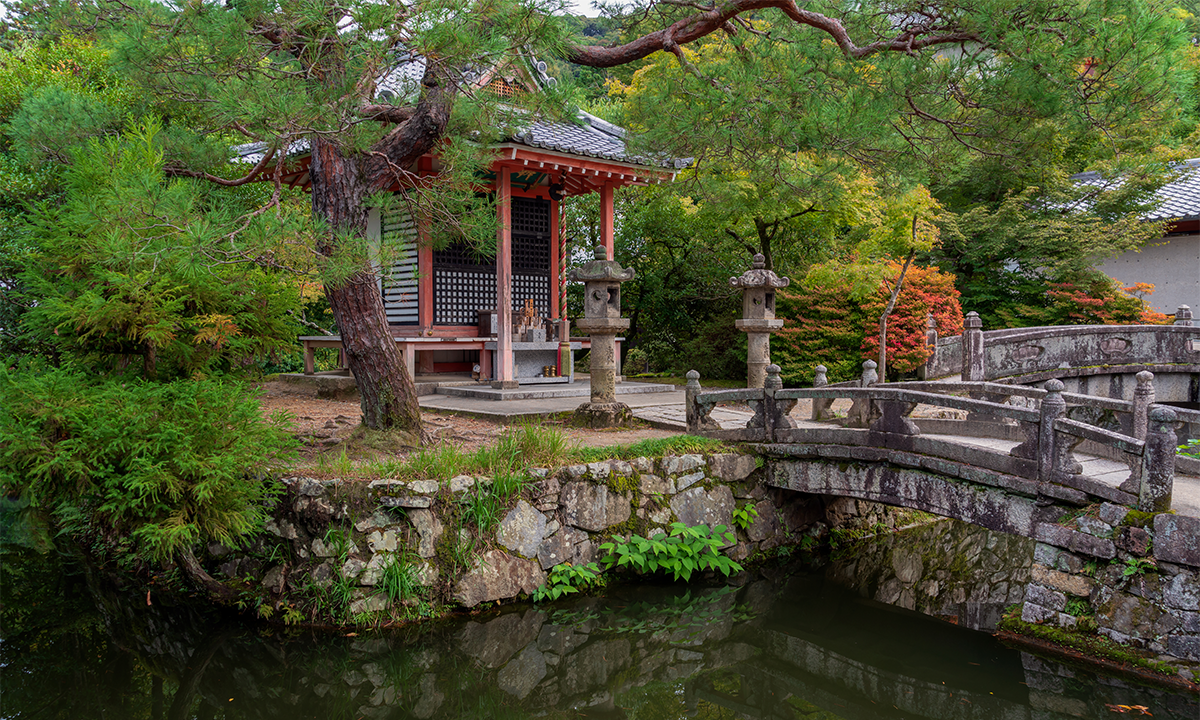
Japan is home to tons of Buddhist temples and Shinto shrines (which you should be sure to visit if you ever find yourself there). These picturesque locales—numbering in the hundreds in cities like Kyoto—offer serene oases in busy urban environments for both people and wildlife alike. According to a new study published in Urban Ecosystems, frogs in particular are drawn to their many water features, making the landmarks both culturally and ecologically important.
Curious about amphibian life among these watery respites, environmental scientists from Kyoto University set out to catalog their frog populations. The team focused on 31 temples, shrines, and adjacent areas in Kyoto's Higashiyama region, surveying their various ponds and streams for signs of frogs.
The team took a comprehensive approach, visually identifying frogs, tadpoles, and eggs, collecting samples to analyze environmental DNA, and even recording the various croaks and chirps they heard there. They also collected data on the characteristics of the water features (ponds versus streams, the presence or absence of koi, types of vegetation, and so on).
Read more: “The Wild, Secret Life of New York City”
“We observed amphibians at considerably more waterbodies than we had expected, and this made us realize just how rich in wildlife the local watersides—including those around temples and shrines—truly are,” study author Kae Okoshi said in a statement.
Altogether, they found that Kyoto’s shrines and temples were home to at least seven species of frogs (six native, one invasive). Some of the species they found are, at the bare minimum, regionally threatened, including Bufo japonicus, the Japanese common toad. Additionally, a tree frog species (Zhangixalus arboreus) and the lone fire-bellied newt species they discovered (Cynops pyrrhogaster) are listed as “requiring attention” in the area.
According to the team, the differing ornamental land- and waterscaping of the shrines and temples could influence the species of frogs each location attracts. “For example, overhanging trees planted for aesthetic reasons may facilitate foam nesting by Zhangixalus arboreus, whereas canals and spring-fed channels maintained for water management may provide lotic microhabitats suitable for Rana tagoi [Tago’s brown frog],” they wrote.
Taken together, these characteristics could present a kind of “cultural filter,” the researchers say, screening out some frogs and welcoming others.
It’s an important reminder that while we may engineer wild spaces in urban centers primarily for people, our choices can have unintended consequences that reverberate down the food chain—for better or worse. 
Enjoying Nautilus? Subscribe to our free newsletter.
Lead image: Ula Ulachka / Adobe Stock