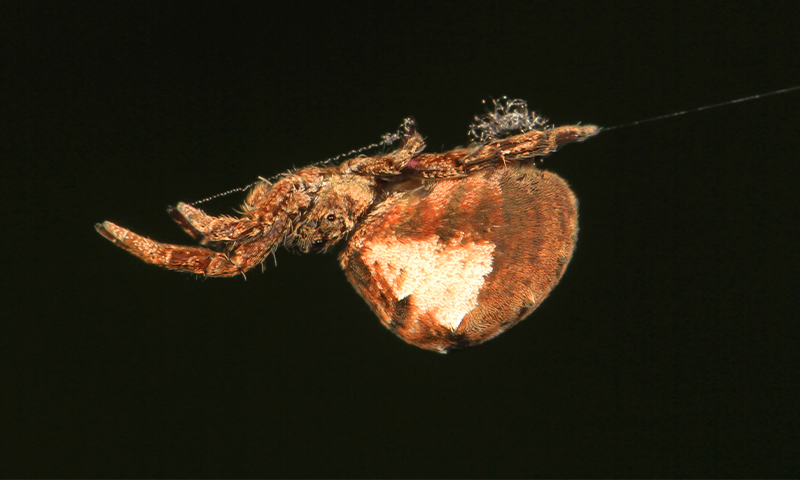
The triangle weaver spider (Hyptiotes cavatus) gets its name from the three-sided web it weaves—and deploys—to capture prey. The spider anchors two corners of the triangle while holding the third corner itself, stretching it back to create a taut, elastic platform. When unlucky prey wander in, the spider releases its corner, causing the entire web to rapidly recoil around its future meal—faster than even the spider’s twitchy muscles can move.
It might feel a bit like a trap Wile E. Coyote would spring, but the real artistry of the triangle weaver’s ambush lies in the craftsmanship of its silk.
Spiders can produce several different types of silk, each uniquely suited to its job—sticky silk to ensnare prey, wispy silk to float on air currents, sturdy dragline silk to anchor a web, and so on. The secret of the triangle weaver’s dragline silk is its elasticity, and the key to its elasticity, according to a recent study, is the amino acid proline.
Read more: “We Crush, Poison, and Destroy Insects at Our Own Peril”
Spider silk is made from proteins called “spidroins” and the spidroins that make up the triangle weaver dragline silk are composed of up to 24.3 percent proline—the highest known proline levels of any known spider silk. Proline is rare among amino acids for its side chain that forms a ring with the protein backbone, and it’s this structure that imparts such extreme elasticity to the triangle weaver’s web.
Of course, arachnids aren’t the only organisms that create or use spider silk. Humans have learned to synthesize and employ spider silk in medicine, optical instruments, bulletproof vests, and more. Gaining a deeper understanding of what gives this incredible material its marvelous properties will allow us to construct even better biomaterials in the future. 
Enjoying Nautilus? Subscribe to our free newsletter.
Lead image: Judy Gallagher / Wikimedia Commons.