If you were a female frog, you’d listen intently to the calls of your male suitors. From the croaking of bullfrogs, to the twangs of green frogs, to the chirping of Gracixalus frogs, the sounds they make convey all kinds of information about their body sizes and health. And selecting a suitable mate makes a significant difference in your reproductive success. A recent study in Current Zoology, however, reveals that parasites may complicate this selection process.
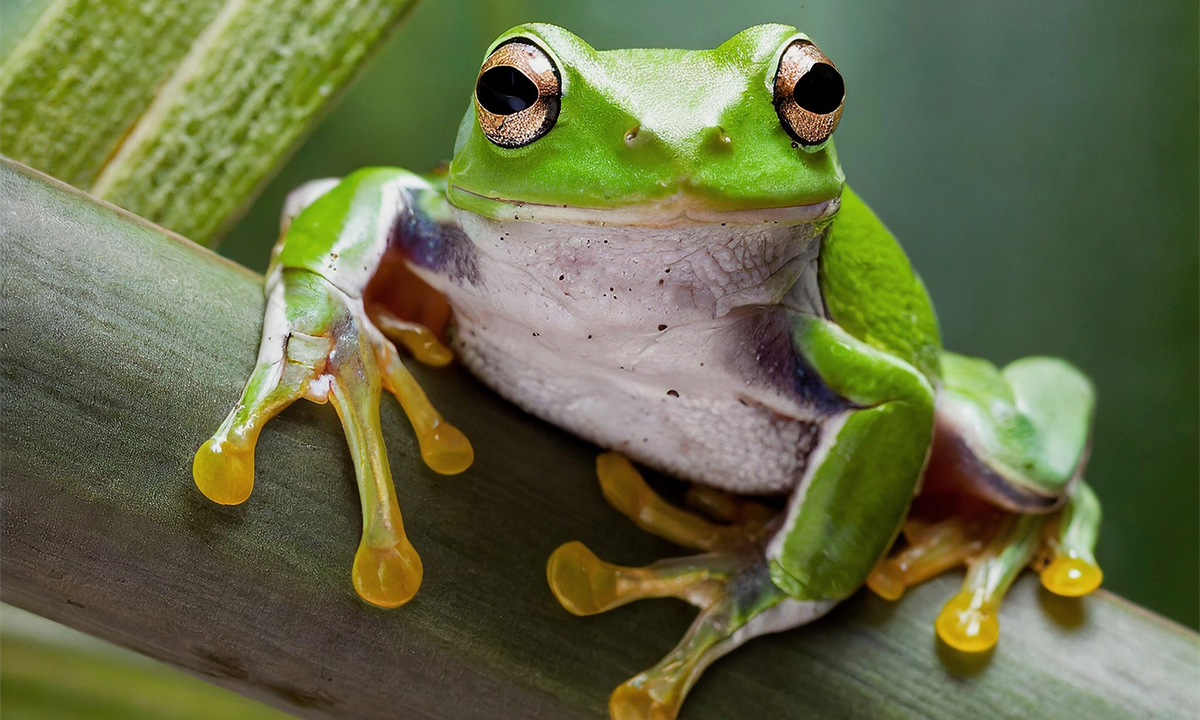
Biologists from East Carolina University, Florida Atlantic University, and the Nature Conservancy in Minneapolis studied the honking sounds of male American green tree frogs (Dryophytes cinereus) living in a North Carolina pond. Previous studies demonstrated that, based on mate choice, females prefer males with faster, lower-frequency honks that last longer, as they assess those males to be bigger and stronger.
The researchers recorded the calls of male tree frogs, and then captured these frogs to count the number of tongue worms in their mouths before releasing them back to the pond. Parasitic worms (Halipegus occidualis), which are accidentally ingested with infected damselfly or dragonfly prey, attach to the tongue undersides and cheeks of green tree frogs. They’re prevalent enough that a single green tree frog may host up to 40 such worms in its mouth.
Read more: “Maybe Playing Dead Will Get Him to Leave You Alone?”
The big issue here is that the parasite infections create a conundrum for female frogs since the infection causes a male’s call to be lower (a positive sign) but also shorter (a negative sign). Moreover, as first author Sara R. Goodnight explained in a press release, “In this system, the frogs most successful at finding food may also be the ones most likely to pick up parasites. That means females are evaluating signals that can simultaneously advertise both strength and risk.”
To evaluate female choice under these circumstances, the researchers captured female tree frogs as well and observed their responses to playbacks of the recorded male calls. In repeat trials, each female had to choose (by moving closer to the speaker) between a pair of calls from uninfected males, moderately infected males, and heavily infected males.
Females avoided the most infected males, despite their sexy lower calls. That said, they chose moderately infected males over males with no infection. The calls of moderately infected males, while not as low as those of the infected males, lasted longer, perhaps letting females know that they were more energetic because they were better at foraging.
“Females may be responding to several signals at once, some linked to desirable traits like size and others hinting at infection,” said co-author Michael W. McCoy of Florida Atlantic University. “Our results show that parasites can reshape the information animals use when choosing partners by subtly changing multiple aspects of a male’s call.”
So maybe even better than a woman’s intuition? A female frog’s intuition. 
Enjoying Nautilus? Subscribe to our free newsletter.
Lead image: Raseduly / Shutterstock