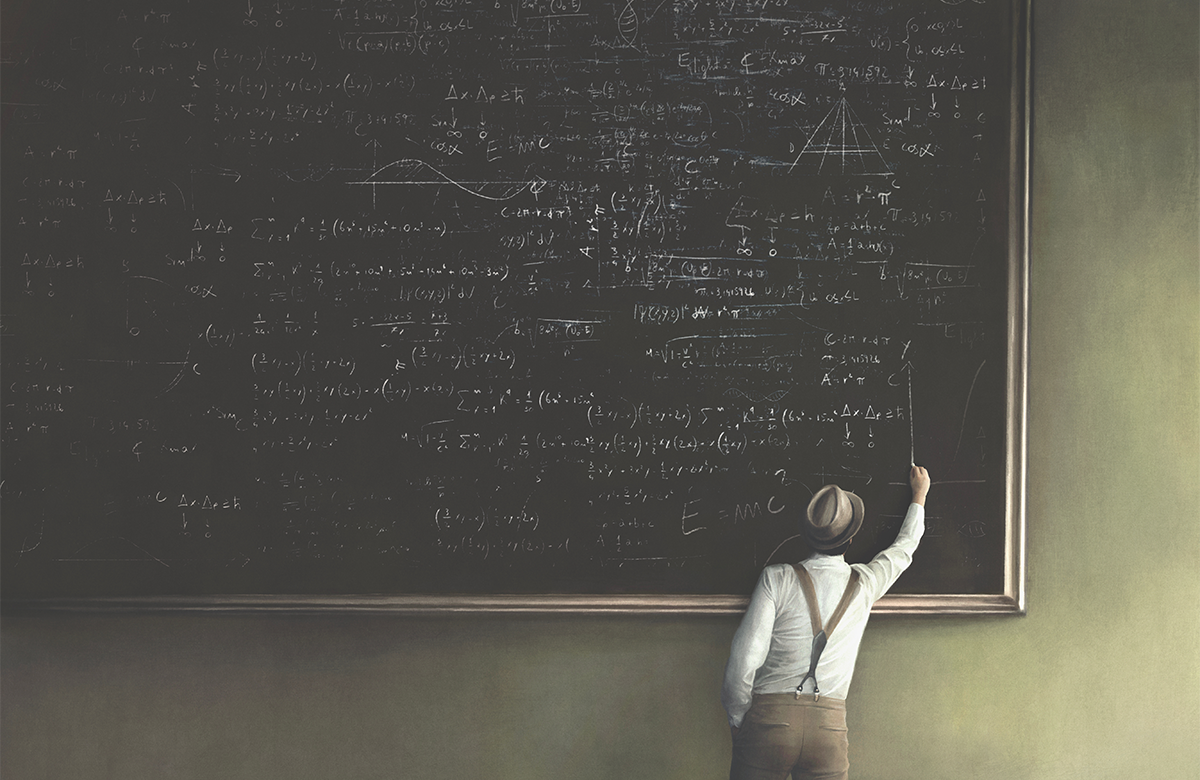
The Great Math War by Jason Socrates Bardi is a history of the intellectual crisis that shook mathematics in the early 20th century. Bardi’s barnstorming narrative focuses on the intellectual and personal battles between three major figures with competing philosophies—Bertrand Russell, David Hilbert, and L.E.J. Brouwer—as well as the world events that shaped the search for certainty in the field.
1 The Future Is Not What It Used to Be—Or Is It?
Despite my fondness for all things Yogi Berra, especially memorable quotes like the one borrowed above, I have come to conclude that the legendary coach is sometimes wrong— especially about the future.
When I began researching my new book on infinity, love, warfare, paradoxes, and the foundational crisis in mathematics from 1883 to 1938, I quickly discovered that futurism remains unchanged even as the things we consider futuristic evolve. People saw the future the same way we do today some 125 years ago: scary, off-putting, and somehow compellingly attractive at the same time. Think of the faint smell of wild onions in fresh-cut grass or what I describe as the old-man smell of Paris before the Great War: baked baguette and BO. The future is ammonia overwhelmed by a thin, patchouli whiff of hope.
The word “futurism” was coined by Italian poet Filippo Tommaso Marinetti in his famous 1909 manifesto. He later wrote another, pro-fascist manifesto—as well as a dietary screed calling for Italian citizens to stop eating pasta, to which I reply: Stuff the Mussolini. Keep the cannoli.
In my book The Great Math War, I trace the origins of futurism to few years before Marinetti’s eponymous manifesto—placing its birth in 1900 Paris, when 40 million people jammed the streets to catch a glimpse of the once-in-a-lifetime, gee-whiz, wonder-of-science and art extravaganza that was the 1900 Paris Expo. L’exposition universelle internationale de 1900 finally arrived that summer, and so had they. Delivery is the fondest form of deliverance.

The Expo featured the coolest and latest tech. The first plastic wrap. The first portable camera. X-ray scanners. Moving walkways. Escalators. Electric lights. One building was aglow with 5,000 incandescent bulbs, a new record. Planes were coming in 1900. Cars were coming, too. The first automobile race had just taken place. The first auto show would soon open in New York. Paris that summer was full of hand-built, cloud-belching, choke-belly cars—gas, electric, leather, and crank. They ruled the streets. They filled the air with exhaust and roar. Ignition. Piston. Smog and fumes. The crowds went crazy. Most of them had never even seen a car before. Only monsters make sounds like that!
And the artwork—Oh, the artwork! Galleries. Gardens. Paintings. Sculptures. The event of the year, one magazine boasted. Nothing like it had ever been seen. Dozens of artists. Hundreds of galleries. Thousands of paintings. A smorgasbord of marble. The world’s most celebrated painters: Manet, Monet, Matisse, and Munch!
Mathematicians were in Paris as well that summer, for their Second International Congress. And they were shown the future as well, thanks to 30-something German mathematician David Hilbert who took the stage and dazzled them. He was their Cézanne. Their Rodin. And in one single keynote, Hilbert changed the face of scientific lectures forever.
His famous “23 Problems” address was a little like the original TED Talk a century before such things existed. He preached a simple, compelling gospel, which I like to call “exuberant solutionism.” Any challenge can be conquered, Hilbert said. If you can logically state it, you will eventually solve it, with enough hard work and applied reason.
That, for me, was the true moment modern futurism was born—when we first stepped into the blinding light of futures past and drank the Kool-Aid of if-you-can-see-it-you’ll-surely do-it brighter tomorrows. Exuberant solutionism has been alive ever since. Lose weight. Get rich. Beat Mike Tyson. Plant a flag on Mars. Cure diseases in a decade. Find a problem, Hilbert said, solve it, and move on. It’s the perpetual call!
2 Infinity Has Been Around for a Long Time
Hilbert had a specific reason for instilling exuberant optimism, however. He pushed the future out of desperate hope. Mathematics by then had wormed its way into every corner of science, filling the creases and sealing the cracks of human knowledge. People had long glorified the subject, calling mathematics “Queen of the Sciences.” And Hilbert was a motley fool in love.
His Queen ruled, Hilbert knew, and he sometimes egotistically asserted as much. “Physics is much too hard for physicists,” he once famously quipped. And yet deep down inside, he was really worried.
All reigns end. Rulers fall—defeated, overthrown, retired, or dead. Things break. Buildings crumble. Cities disappear. Empires die. Memories fade. Numbers are retired. Paradigms lose relevance. Fickle Father Time destroys every absolute monarch. Even the mightiest Ozymandias crumbles to dust eventually. Look on my Works, ye mighty, and despair!
That’s what Hilbert feared in 1900. Mathematics was looking like a crumbling heel. His queen was dying, and single-handedly, he was going to save her. He wanted to future-proof mathematics by kicking his audience in the pants with a list of problems, and not just any problems. Huge ones. Hard ones. Impossible knots that had tied the field for years. Centuries. Fickle math pickles in desperate need of slice.
Read more: “Math’s Beautiful Monsters”
So he challenged. Those lucky enough to hear Hilbert’s talk will remember it the rest of their lives. Millions more will marvel after the fact. Some will sincerely claim it was the most important lecture by a mathematician in human history — a mold-breaking, mind-bending, future-shaping, say-hello-to-my-little-friend triumph.
The very first problem Hilbert wanted to solve was something called the Continuum Hypothesis, formulated some two decades before by German mathematician Georg Cantor Jr. after he invented set theory. There are two types of infinity, Cantor said, and all infinite sets fall into one of the two: Little infinity and big infinity. Denumerable and nondenumerable. Infinity the size of the whole number set and infinity equal to the real number set. One bucket or the other, and nary a set in between, Cantor claimed.
Infinity had been around for a long time by then, but it had always been out of reach for mathematicians and philosophers. Aristotle, Zeno, St. Thomas Aquinas, Galileo, Gauss—all saw it in purely “potential infinity” terms: a bogey in the bush, not a bird in the hand.
That all changed with Cantor, who was perhaps the first person in history to truly hold infinity in his palm. He was a true believer who, like Dan Aykroyd’s character Elwood Blues, was convinced was on a mission from God.
3 Mathematics May Be Older Than Language
As I was finishing this book, I discovered Cantor could have been on a mission from Charles Darwin instead. Several papers came out in neuroscience and other fields suggesting mathematical abilities may be evolutionarily derived, not divinely gifted.
A study of infants in Barcelona found evidence human babies develop logical reasoning skills as early as 19 months. Research in Okinawa discovered that sweetly striped Finding Nemo clownfish Amphiprion ocellaris recognize each other by counting their stripes. And scientists in Tübingen, Germany, showed that crows can be trained to peck out recursive sequences, mentally embedding one representation within another quite adeptly, “on par with children and even outperforming macaques.” This was something long thought to be a unique feature of human intelligence—though the birds had something to say about that caw-caw claim.
In writing my book, I came to embrace the idea that math is a “human primitive,” something that evolved before even language. Our fundamental quantitative math skills may have been a key to human survival through the ages, affording our ancestors essential data-driven outdoor abilities. “Counting winter dinners, one a hill,” as American poet Robert Frost once said.
David Hilbert was convinced this was true. He saw his Queen, including higher abstract forms of mathematics, as being fundamental to the Homo sapiens condition. “The axiomatic method is not new,” he wrote in 1913, “but is deeply rooted in human thinking.”I have come to agree with him. Sadly, that puts me at odds with my favorite Yogi Berra-like college professor who once began and ended his class with the same question: Why is the world mathematical? Maybe it’s not, as he meant to imply. Perhaps it’s just that we are. 
Adapted from The Great Math War: How Three Brilliant Minds Fought for the Foundations of Mathematics by Jason Socrates Bardi. Copyright © 2025 by Jason Socrates Bardi. Available from Basic Books, an imprint of Hachette Book Group, Inc.
Enjoying Nautilus? Subscribe to our free newsletter.
Lead image: fran_kie / Adobe Stock